

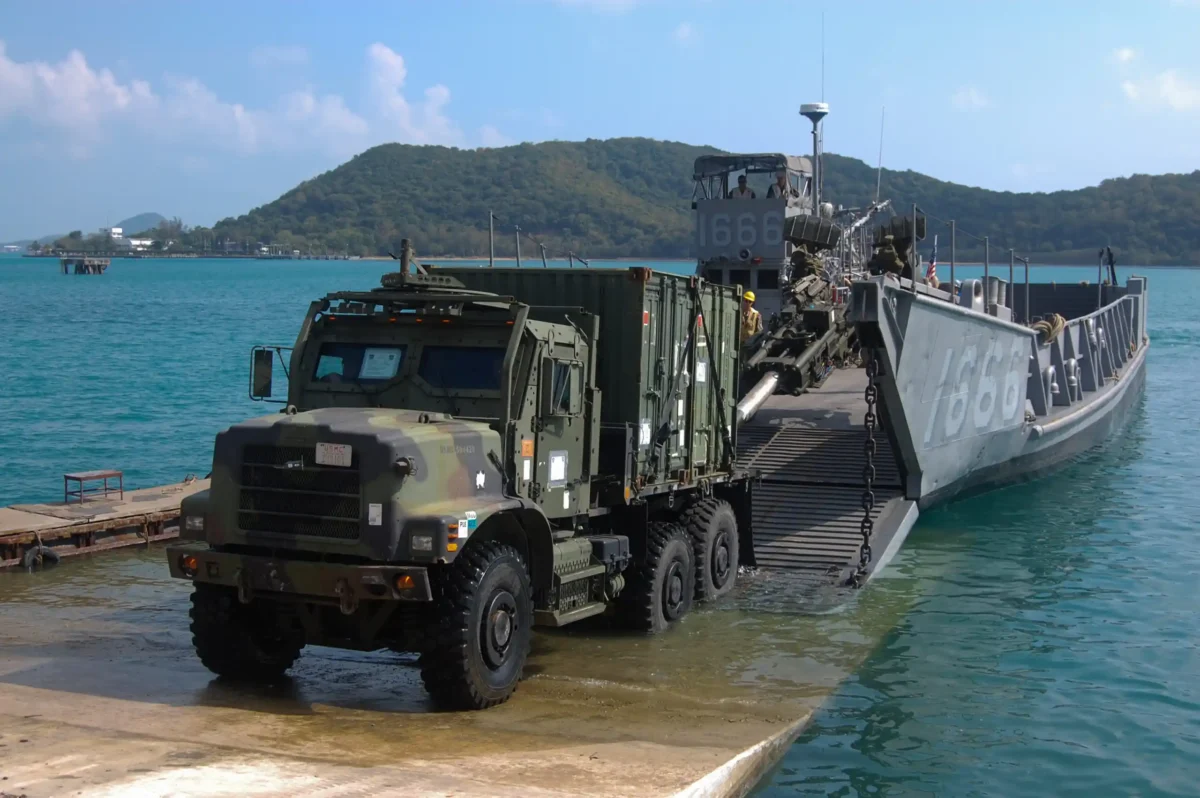
Defense Feeds, Okinawa, Japan – The U.S. Marines test MTVR trucks on Japan beaches, evaluating how the service’s Medium Tactical Vehicle Replacement (MTVR) fleet can support expeditionary logistics, vehicle recovery and sustainment operations across the First Island Chain.
The trials focused on operating heavy tactical vehicles in coastal environments where infrastructure may be limited or unavailable during future contingency operations.
The exercise reflects the U.S. Marine Corps’ continuing effort to improve logistical mobility in the Indo-Pacific, where dispersed operations across islands are expected to place greater demands on transport and sustainment capabilities.
U.S. Marines Test MTVR Trucks on Japan Beaches
The exercise in which the U.S. Marines test MTVR trucks on Japan beaches examined the vehicle’s ability to move personnel, equipment and supplies across soft sand while also conducting recovery operations for vehicles that become immobilized in challenging terrain.
These capabilities are increasingly important as expeditionary forces prepare to operate from temporary coastal positions rather than established military installations.
The MTVR has long served as one of the Marine Corps’ primary tactical transport vehicles, supporting cargo movement, troop transport and logistical sustainment across difficult terrain. Evaluating its performance on beaches provides valuable operational data for missions where ports or permanent infrastructure may not be immediately accessible.
The trials also assessed coordination between mobility, engineering and logistics personnel responsible for maintaining supply routes under expeditionary conditions.

Beach Logistics Support Expeditionary Operations
Modern Marine Corps operational concepts emphasize mobility across widely dispersed island environments. Rather than concentrating forces at large bases, expeditionary units are expected to establish temporary operating locations that can be rapidly supplied and repositioned as operational conditions change.
In these scenarios, beaches may serve as critical entry points for vehicles, supplies and engineering equipment. Successfully moving heavy trucks across soft coastal terrain requires not only capable vehicles but also careful route selection, recovery planning and coordination between multiple support elements.
Testing these procedures during peacetime allows units to refine techniques before they are required during real-world operations.
First Island Chain Requires Flexible Sustainment
The First Island Chain presents unique logistical challenges because of its geography, with military forces potentially operating across numerous islands separated by significant maritime distances. Maintaining operational tempo in such an environment depends on reliable transportation assets capable of supporting distributed forces with fuel, ammunition, food and engineering equipment.
Exercises involving MTVR trucks contribute directly to the Marine Corps’ Expeditionary Advanced Base Operations (EABO) concept, which relies on small, mobile units capable of relocating frequently while remaining sustainably supplied. Improving beach mobility and recovery procedures helps ensure these units can continue operating even when traditional transportation infrastructure is unavailable or degraded.
The lessons learned may also inform future doctrine, training and equipment development for expeditionary logistics throughout the Indo-Pacific.
Mobility Remains the Foundation of Expeditionary Readiness
The U.S. Marines test MTVR trucks on Japan beaches as part of a broader effort to strengthen the logistical backbone supporting distributed military operations. While advanced missiles, sensors and unmanned systems often receive the greatest attention, expeditionary forces ultimately depend on reliable transportation and sustainment to remain operational over extended periods.
By validating the performance of proven tactical vehicles in realistic coastal conditions, the Marine Corps is improving its ability to move supplies where they are needed while reducing the risk of logistical disruptions. Vehicle recovery capability is equally important, ensuring mobility assets remain available even when operating in difficult terrain.
The fact that the U.S. Marines test MTVR trucks on Japan beaches demonstrates that future expeditionary operations will rely not only on advanced combat systems but also on resilient logistics capable of supporting dispersed forces across challenging maritime environments.
As the Marine Corps continues refining its Indo-Pacific posture, mobility and sustainment will remain essential elements of long-term operational readiness.
