

The United States may be on the verge of an unprecedented step: procuring major naval vessels from allied shipbuilders in Japan and South Korea to help address growing capacity constraints in the U.S. naval industrial base.
A proposed $1.85 billion funding request included in the Pentagon’s fiscal year 2027 budget is increasingly being viewed not merely as a study effort, but as a potential precursor to future warship procurement from allied shipyards. As USNI News first reported, the Pentagon has directed the U.S. Navy to consider Japanese and Korean shipyards and designs for use in the U.S. fleet, with budget documents stating that the funds would be “split into two separate study and procurement efforts targeting the fleet’s future [cruiser/destroyer] and frigate inventories.”
Among the major shipbuilders that could potentially benefit from such an initiative are South Korea’s Hanwha Ocean, HD Hyundai Heavy Industries and Samsung Heavy Industries, as well as Japan’s Mitsubishi Heavy Industries (MHI), Kawasaki Heavy Industries (KHI) and Japan Marine United (JMU).
USNI News reported that the Pentagon is considering both foreign ship designs and the possibility of constructing ship components in allied shipyards as part of its effort to expand naval shipbuilding capacity.
Advanced surface combatants can be built in both countries at substantially lower cost and faster production rates than in the United States, with both nations making extensive use of robotics and modern shipbuilding techniques. USNI News reported that then-Secretary of the Navy John Phelan acknowledged the Navy had been directed to examine the possibility of foreign-built combat ships, noting that producibility considerations would point toward South Korea and Japan.
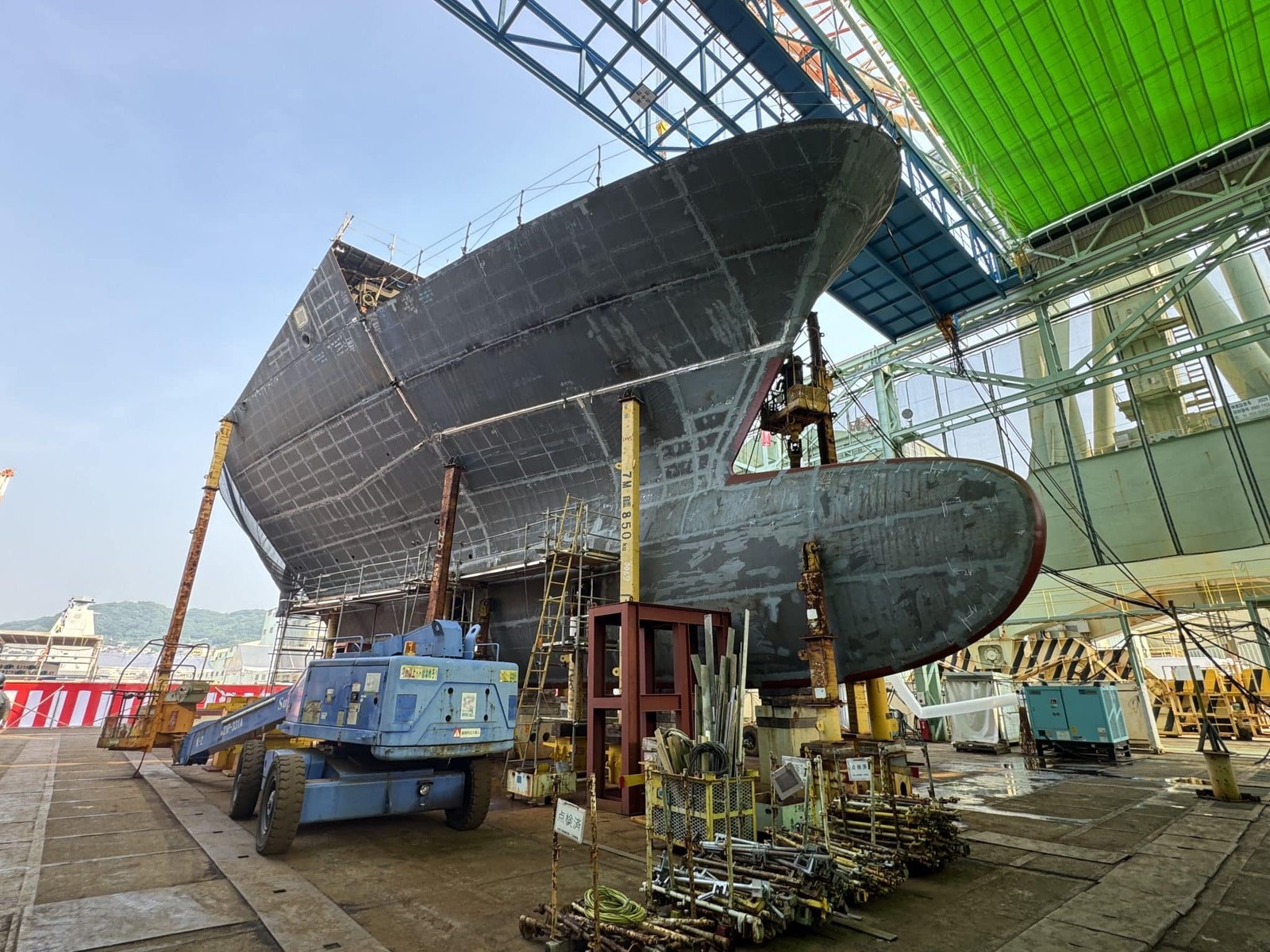
Japan’s MHI and JMU provide a notable example of the speed at which allied shipbuilders can deliver major naval programs. The two companies have laid the keels for two Aegis System Equipped Vessel (ASEV) ships within the past year and are expected to deliver them in 2028 and 2029. By comparison, Arleigh Burke-class destroyers in the United States are running well behind schedule across multiple programs.
A Bridge, Not a Permanent Shift
Administration officials have repeatedly stressed that overseas construction would be a temporary measure rather than a permanent transfer of naval production abroad.
The approach mirrors the “Bridge Strategy” outlined in the White House’s maritime industrial policy. Under this model, foreign shipbuilders would construct initial vessels overseas while simultaneously investing in U.S. shipyards through acquisitions, modernization projects, or new facilities, with production gradually transitioning to American soil.
The administration points to its icebreaker agreements with Finland as a template, under which initial vessels are built abroad before follow-on production shifts to U.S. shipyards. Hanwha’s 2024 acquisition of Philly Shipyard has been cited by U.S. officials as a model for leveraging foreign investment to strengthen America’s shipbuilding industrial base.
Legal and Political Obstacles Remain
Significant legal and political hurdles remain. Current U.S. law generally prohibits the construction of naval warships in foreign shipyards unless the president issues a national security waiver, and Congressional support would likely be required for any broader procurement effort.
Several lawmakers have already voiced concerns about the impact on domestic shipbuilders, supply chains and sensitive technologies, with some considering legislation that would restrict the use of federal funds for warship construction outside the United States.
OMB Director Russ Vought has nonetheless signaled the administration’s resolve.
“If we cannot get the ships we need from traditional sources at cost and on time, we will get them from other shipyards,” he said at the Navy League’s Sea-Air-Space symposium in April, according to USNI News.
If implemented, the initiative could mark the first acquisition of a major foreign-built surface combatant by the U.S. Navy in more than a century, placing Japanese and South Korean shipbuilders at the center of Washington’s effort to rebuild maritime power amid intensifying competition with China.
