

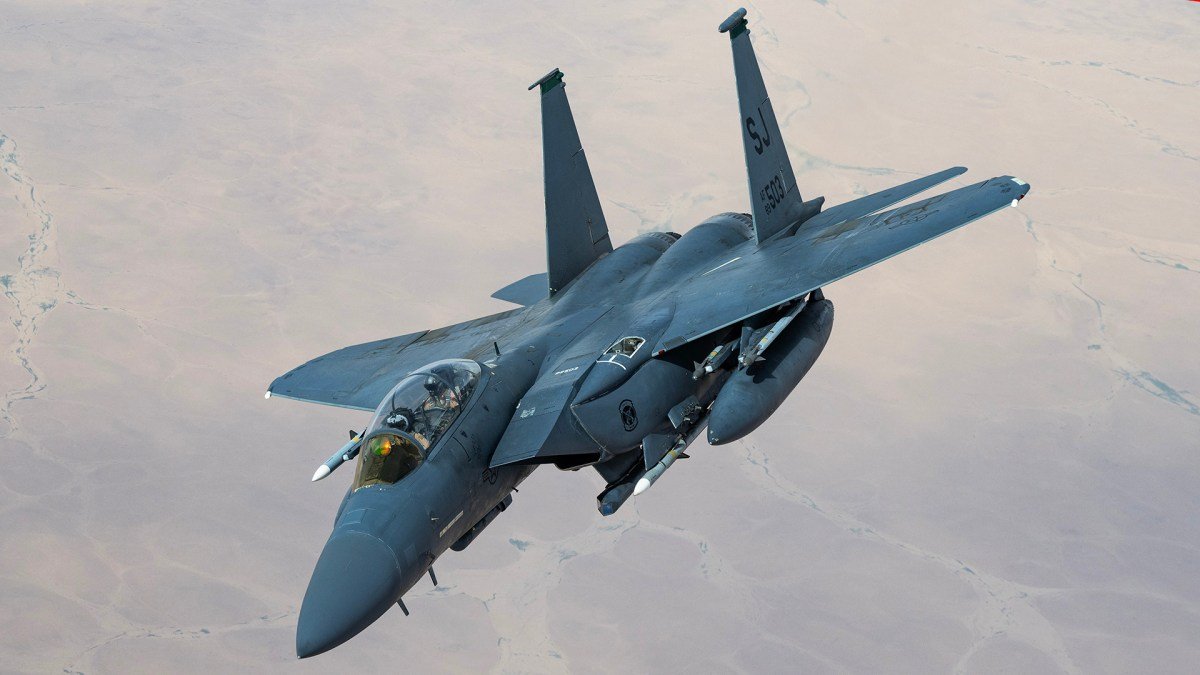
U.S. Central Command (CENTCOM) has denied claims circulating online of the loss of another F-15E Strike Eagle, this time over enemy territory, as part of ongoing operations against Iran. Earlier this week, three Strike Eagles were downed in an apparent friendly fire incident, reportedly by a Kuwaiti F/A-18 Hornet. All of this comes as the U.S.-Israeli air campaign continued to expand, and as the overall conflict has otherwise spilled further through the region.
You can catch up with our latest coverage of ongoing operations against Iran here.
“Rumors circulating on social media of a U.S. F-15E crash in Iran early Wednesday are baseless and NOT TRUE,” CENTCOM stated on X Thursday morning.
A CENTCOM spokesperson also told TWZ directly that there have been no aircraft downed other than those in Kuwait.
The denial came after a now-deleted post from the popular @sentdefender account on X claiming a F-15E had gone down went viral, with at least nearly 800,000 views. The post said the aircraft had gone down during a strike mission over southwestern Iran, but said the proximate cause was unknown. The Strike Eagles were said to have been able to eject safely and were then recovered in a joint U.S.-Israeli combat search and rescue mission. Claims about the loss had already been swirling amongst the open-source community.
“We have made the decision to delete reports made last night regarding the crash of a USAF F-15E Strike Eagle in Iran and the successful evacuation of the crewmembers by U.S. and Israeli Combat Search and Rescue (CSAR),” the account wrote in a new post today. “Defender Media maintains confidence in its sources, however, the story is as of now being officially and publicly denied by U.S. Central Command (CENTCOM).”
TWZ has reached out to @sentdefender for further comment.
This is not the first time CENTCOM has taken part in the online information war that has become standard for conflicts in the social media era. Yesterday, the command took to X to refute several claims made by Iran about killing 100 Marines, sinking a destroyer, taking down other aircraft, and forcing U.S. troops to withdraw from the conflict.
“ALL LIES,” CENTCOM stated in its post.
What is true is that the U.S.-Israeli air war over Iran is expanding and includes an increasing number of aircraft employing stand-in munitions closer to their targets. Potential risks can only be magnified, at least to a degree, as operations push deeper into Iran. There is always the potential for aircraft to go down for reasons other than enemy fire, as well.
The rest of our ongoing rolling coverage of the conflict continues below, with the latest updates at the top.
UPDATE: 12:36 PM EST –
As the joint U.S.-Israeli Operation Epic Fury attack on Iran continues into a sixth day, the war is spreading beyond the Middle East. On Thursday, Azeri officials said Iranian drones struck territory and vowed to retaliate. The country shares a border with northwestern Iran.
“At around midday on 5 March, drone attacks were carried out against the Nakhchivan Autonomous Republic of the Republic of Azerbaijan from the territory of the Islamic Republic of Iran,” the Azerbaijan Foreign Ministry said in a statement. “One drone struck the terminal building of the airport in the Nakhchivan Autonomous Republic, while another drone fell near a school building in the village of Shakarabad. We strongly condemn these drone attacks launched from the territory of the Islamic Republic of Iran, which resulted in damage to the airport building and injuries of two civilians.”
Four people were injured in the attack, according to Azeri officials, and Azerbaijani President Ilham Aliyev told a meeting of his Security Council that his country would respond militarily.
“We will not tolerate this unprovoked act of terror and aggression against Azerbaijan,” he proclaimed, according to Reuters. “Our Armed Forces have been instructed to prepare and implement appropriate retaliatory measures. We are ready to demonstrate our strength against any hostile force – and they should not forget this in Iran.”
Aliyev did not offer specifics about what kind of retaliation.
Iranian Deputy Foreign Minister Kazem Gharibabadi denied Tehran had targeted Nakhchivan, saying, “We do not attack our neighboring countries.”
Video seen below is said to show the aftermath of these attacks.
Meanwhile, several nations continue to send more military assets to Cyprus. Sky News reported on X that the U.K., Italy, Spain, and the Netherlands are all deploying warships to help bolster the island nation’s defenses. Notably, French President Emmanuel Macron has ordered the aircraft carrier Charles de Gaulle to head to the eastern Mediterranean. In addition, Greece has already deployed four F-16s to the island.
This comes as RAF Akrotiri, a British air base on Cyprus, continues to come under attack. On Thursday, an image emerged showing what appears to be a hole punctured in a hangar regularly used by U.S. Air Force U-2 Dragon Lady spy planes operating from the base. A one-way attack drone hit the RAF Akrotiri base late on Sunday, 1st March. It is unclear if any aircraft were there at the time.
The U.K. Defense Ministry told us that there were no casualties and that damage to the base was “minimal.” There was “no damage to equipment inside the hangar,” the official added.
We’ve reached out to the U.S. Air Force and U.S. European Command for comment and will update this story with any pertinent details provided.
The Pentagon and at least one Gulf Arab nation have reportedly reached out to Ukraine for cheap interceptors to help fend off waves of low-cost Iranian drones that have killed American troops and caused widespread damage across the Middle East. The talks, reported by the Financial Times, come amid continuing questions about the sufficiency of stocks of anti-air interceptors as Iran’s retaliatory attacks continue. As we have frequently noted, Ukraine has made significant investments in the development of new, lower-cost interceptors in response to years now of Russian drone attacks.
On Thursday, Ukrainian President Volodymyr Zelensky also acknowledged the interest in his country’s counter-drone systems.
“We received signals from partners in the Middle East,” he explained on X. “There have been strikes by Iranian ‘Shaheds’ on civilians in those countries. They are seeking our expertise. We are open. If their representatives come, we will provide the expertise. Especially since there is also a request from Europeans and from the United States. Requests have come to us to share our experience with partners in the Middle East.”
However, Zelensky also stated his oft-repeated concern about his own country’s stock of interceptors and suggested a swap of those for Patriot missiles.
“Regarding weapons: we ourselves are at war. And I said, completely frankly, that we have a shortage of what they have,” the Ukrainian leader noted. “They have missiles for the Patriots, but hundreds or thousands of ‘Shaheds’ cannot be intercepted with Patriot missiles – it is too costly. Nothing is too much for the people, of course, but they simply do not have that many missiles. That is why they need interceptor drones, which we have. Meanwhile, we have a shortage of PAC-2 and PAC-3 missiles. So, when it comes to technology or weapons exchange, I believe our country will be open to it.”
While the Pentagon eyes Ukrainian interceptors, U.S. Central Command is reportedly seeking additional personnel to help handle the flow of intelligence pouring in from the Middle East. CENTCOM “is asking the Pentagon to send more military intelligence officers to its headquarters in Tampa, Florida, to support operations against Iran for at least 100 days but likely through September,” Politico reported, citing a notification it obtained.
“It’s the first known call for additional intelligence personnel for the Iran war by the administration, and a sign the Pentagon is already allocating funding for operations that may stretch long beyond President Donald Trump’s initial four-week timeline for the conflict,” the outlet posited. “The rush to add people and resources to support efforts that are often organized well in advance of U.S. military action highlights how the Trump team had not fully anticipated the wide fallout of the war it launched alongside Israel on Saturday.”
It has been pointed out that the “through September” timeline for these temporary deployments may simply be dictated by standard personnel management procedures.
CENTCOM has released a new video showing attacks on Iranian hardened shelters and aircraft out in the open.
CENTCOM has also highlighted new attacks on Iranian mobile missile launchers. As we noted yesterday, these strikes have been a big focus of Epic Fury and have helped drastically reduce the number of missiles Iran has launched.
A new uncrewed surface vessel attack on a commercial ship has been reported. The Bahamas-flagged crude oil tanker Sonagol Namibe, which was anchored in Iraqi waters, is said to havebeen struck. As we previously reported, the first Iranian kamikaze boat attack during Epic Fury took place on March 2 on a ship in the Gulf of Oman.
A video emerged on social media purporting to show the moment that USV hit the Sonagol Namibe.
In the wake of the sinking of an Iranian frigate by a U.S. Navy fast attack submarine, Iran’s Foreign Minister Sayed Abbas Araghchi called the incident an “atrocity” and vowed revenge. The unnamed American submarine sank the Moudge class frigate IRIS Dena in the Indian Ocean near the island of Sri Lanka. Our sister site Task & Purpose has reported that a Los Angeles class submarine was responsible. Regardless, it is was the first sinking by a U.S. Navy submarine since World War II.
“Mark my words,” he stated on X. “The U.S. will come to bitterly regret [the] precedent it has set.”
The Indian government has also now released a statement with details about the rescue effort after the IRIS Dena was torpedoed.
Satellite imagery collected today shows what appears to be oil on the surface of the water near Galle, Sri Lanka, which could be tied to the sinking of the IRIS Dena.
Meanwhile, another Iranian ship is seeking shelter in Sri Lanka.
“The Sri Lankan minister Nalinda Jayatissa told parliament that another Iranian vessel was sailing close to Sri Lanka’s territorial waters on Thursday morning,” The Guardian reported. “We are making necessary interventions to resolve this issue, restrict the threat to lives and to ensure regional security.”
Unnamed Sources told the Guardian that “the ship was a logistical pipe-laying vessel, which is not categorised as a warship. It may be as close as 10 nautical miles from the western coast of Sri Lanka, putting it within the country’s sovereign waters.”
The sources told the news outlet that the ship, which is reported to have a crew of more than 100 onboard, “had made an urgent request to dock at Colombo port for engine repairs.”
Contact the author: howard@thewarzone.com
