

Key Points
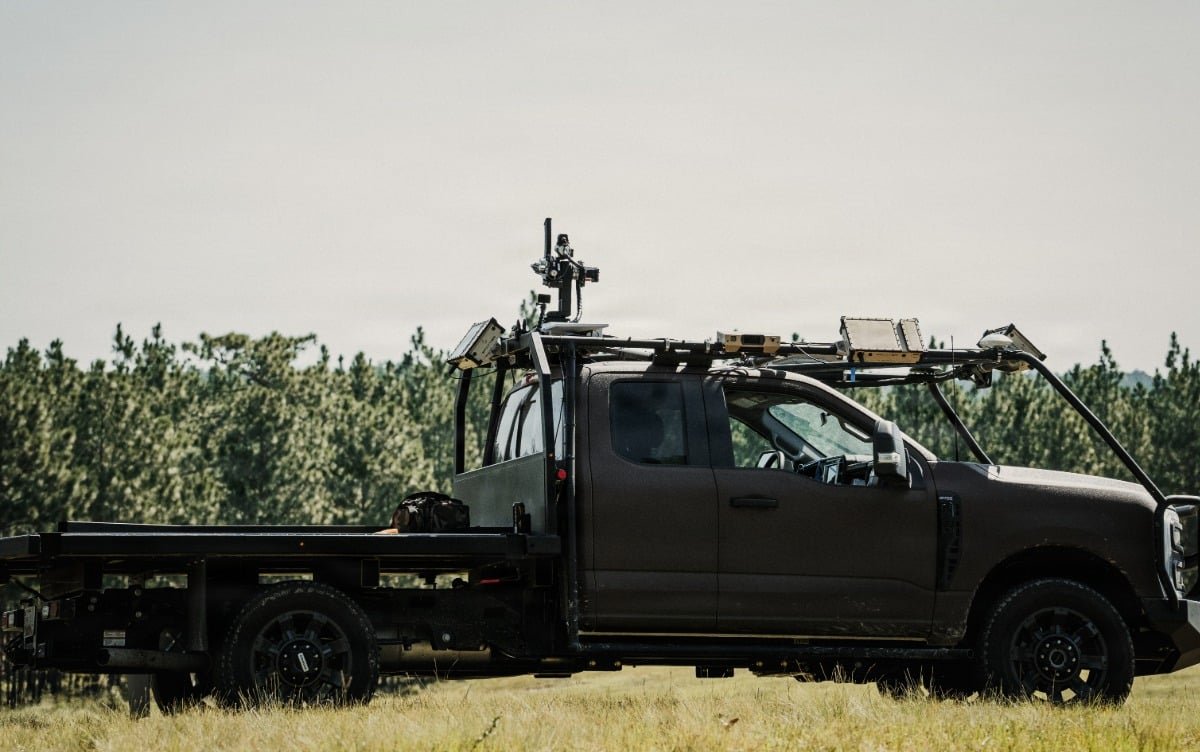
- The U.S. Army tested a self-driving Ford F-250 fitted with an Edda counter-drone turret during a Project Sandhills 2.0 live-fire exercise at Fort Bragg on August 18, 2026.
- The vehicle combines Forterra’s AutoDrive autonomy system with a 9 Mothers-built turret designed to shoot down fast-moving drones at 10 to 100 meters.
A Ford F-250 that can drive itself carried a shotgun-armed drone-killing turret onto a live-fire range at Fort Bragg on August 18, 2026, the latest test in a U.S. Army program built to get engineers out of the blast radius during breaching operations.
The vehicle, tested at Range 63 as part of Project Sandhills 2.0, runs on the Forterra AutoDrive autonomy stack and carries an Edda counter-unmanned aircraft system turret built by Austin-based 9 Mothers. The Army described the vehicle as carrying modular systems to support automated obstacle reduction while limiting soldiers’ exposure to direct enemy fire.
Obstacle reduction is engineer-speak for clearing lanes through minefields, wire, and other barriers so troops and vehicles can move forward. It is dangerous, deliberate work, and it is exactly the kind of task the Army wants a machine doing instead of a soldier.
– ADVERTISEMENT – CONTINUE READING BELOW –
The Edda turret weighs about 23 kg (50 pounds) and detects drones acoustically, listening for the sound signature of small rotors rather than relying on radar or radio-frequency sensors that a drone can detect in return. Once it picks up a target, an onboard visual tracking system takes over and the turret engages with a shotgun effector, built to hit fast-moving drones roughly 7 inches across at ranges of 10 to 100 m (33 to 328 feet). Because the system stays passive until it fires, it does not broadcast a signal an adversary could use to locate the vehicle first.
Sandhills 2.0 grew out of an earlier Army effort known simply as the Sandhills Project, run by the 20th Engineer Brigade under the XVIII Airborne Corps. That first phase produced the Lancer, an unmanned ground vehicle built on a Polaris Ranger chassis, which the United States later sent to Ukraine. Sandhills 2.0 is meant to move that work from prototype demonstrations to systems the Army can actually field.
Forterra secured the prime contract for Sandhills 2.0’s autonomous breaching and terrain-shaping work on July 31, 2026, after taking part in earlier Army integration exercises. Under that contract, the company is delivering autonomous mission systems built on Ford F-250 trucks, intended to handle zone-clearing and line-charge deployment without a soldier in the vehicle.
The Army’s interest in pairing autonomous breaching vehicles with counter-drone defenses traces directly to Ukraine. First-person-view drones have proliferated on that battlefield, and the United States donated its own breaching vehicles there in 2025. Army officials have said publicly that FPV drones could jeopardize a breaching operation in a future conflict if the vehicles doing that work have no way to defend themselves while they work.
The August 18 test folded the Edda turret onto the autonomous F-250 platform to see whether a single vehicle can clear obstacles and defend itself against drones at the same time, rather than requiring a separate escort or a second vehicle carrying only counter-drone equipment.
