

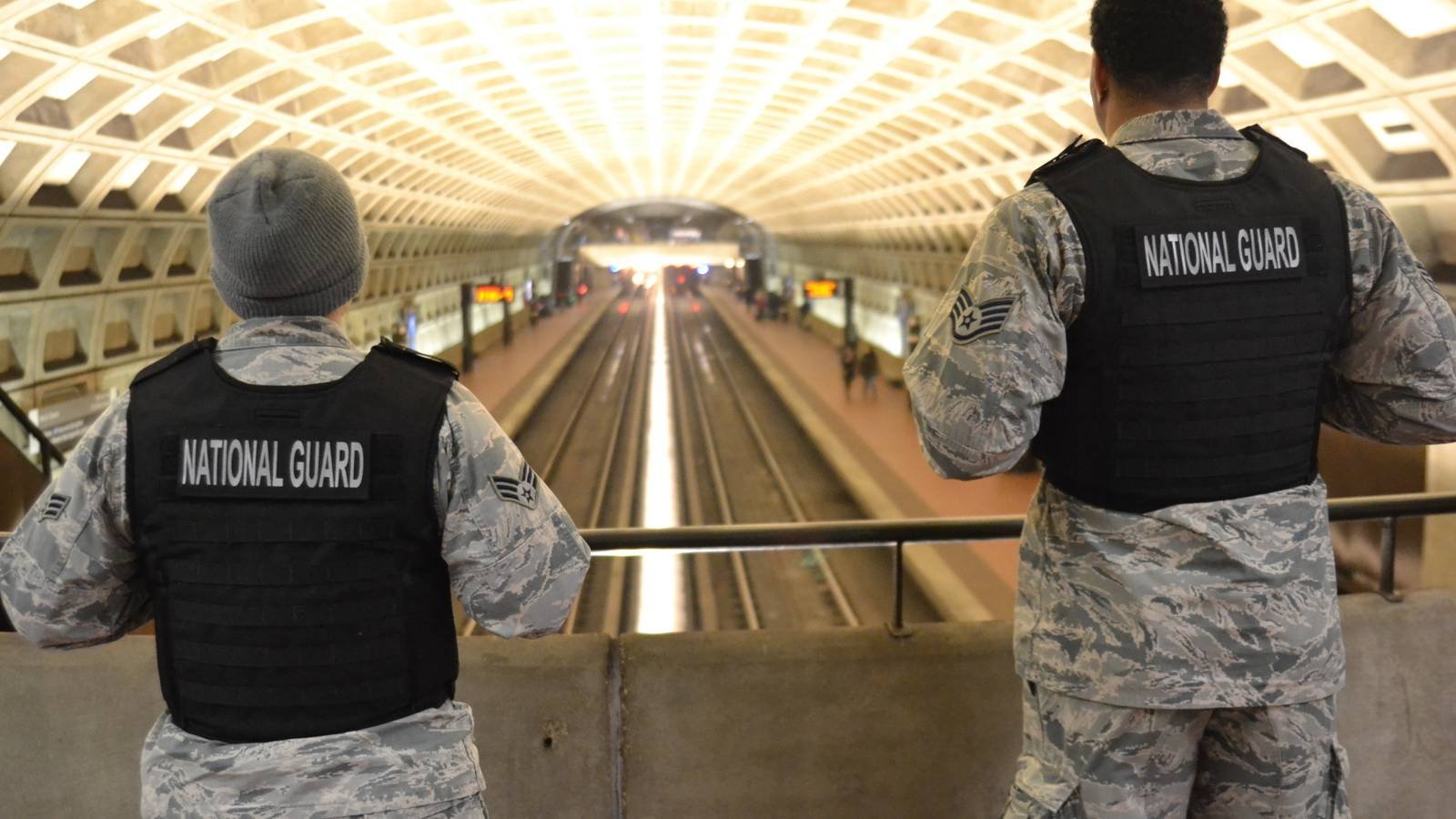
A federal appeals court heard arguments Wednesday over whether President Donald Trump’s National Guard deployment in Washington, D.C., is legal, more than 14 months after troops first arrived in the capital.
At the heart of the case is whether the president, as part of his so-called crime-fighting mission, can send the Guard into the city—which as a federal district has limited control over its own affairs.
A three-judge panel of the U.S. Court of Appeals for the District of Columbia Circuit questioned Justice Department attorney Eric McArthur during the hearing.
Judge Cornelia Pillard asked how the administration’s legal theory was “not federalization and therefore running up against” the Posse Comitatus Act, the 1878 law barring the military from domestic law enforcement, according to the Associated Press.
One Judge Called It Illegal; A Panel Let It Continue
Washington D.C. Attorney General Brian Schwalb, whose office brought the lawsuit, shared a statement with Military.com following the hearing that the deployment “violates the law and the principles on which this country was founded.”
U.S. District Judge Jia Cobb ruled Nov. 20, 2025, that the deployment illegally intrudes on local officials’ authority to direct law enforcement in the district.
Cobb found that while the president has authority to protect federal functions and property, he cannot unilaterally deploy the D.C. National Guard for crime control or call in troops from other states. She paused her own order for 21 days to allow an appeal.
A separate three-judge panel of the same appeals court then froze Cobb’s ruling on Dec. 17.
In a unanimous 32-page order, those judges said Trump might prevail in arguing that the president “possesses a unique power” to mobilize the Guard in Washington, and that other factors favored the administration, including the “disruption to the lives of thousands of service members.”

The district, the panel wrote, “has not identified any ongoing injury to its statutory interests.” Judge Bradley Garcia and Judge Judith Rogers heard the case alongside Pillard, according to the AP.
Schwalb Says Troops Should ‘Return to Their Homes’
The district’s lawsuit argues the deployment illegally uses the D.C. Guard for local law enforcement, brings in out-of-state troops without the city’s consent, and places troops under federal command while they remain in state militia status.
Schwalb said that “thousands of armed soldiers who are not from here and have limited law enforcement training have occupied our streets,” describing troops “patrolling near our schools, deploying next to ballot boxes.”
Guard members, he added, should “return to their homes, their families, and their regular jobs.”
2,000-Troop Decrease in Over a Year
Trump ordered the deployment in August 2025. At its summer peak during the semi-quincentennial celebration, the force numbered about 5,000 troops.
That figure stood at about 2,900 as of last week, according to the AP, which reported the troops have supported arrest operations, patrolled neighborhoods and participated in cleanup efforts.

The Defense Department has extended the mobilization until January 2029. The federal government awarded a $292 million contract to provide apartments for Joint Task Force-D.C. members, per AP.
Legal scholars are split on the district’s legal odds.
Since Washington is not a state and the president is commander in chief, there is a “tremendous amount of leeway and discretion for the president” over the local Guard and out-of-state units, Syracuse University law professor William Banks told the AP.
He added that beyond a narrow home-rule argument, “There is no overarching federal principle that would bail out the district in this case.”
William & Mary law professor Margaret Hu told the AP the deployment’s open-ended nature was the key issue.
“Some argue that the indefinite nature of the deployment means that there’s no emergency justification here,” she said.
The panel gave no timeline for a ruling. Whichever side loses is widely expected to ask the U.S. Supreme Court to step in, and the December stay keeps the Guard on Washington’s streets indefinitely—at least for now.
