

Imagine two fighter jets entering a tight turn at high speed. One has a higher top speed. The other can change direction faster, keep its nose pointed where the pilot wants it, and recover energy before the next maneuver. Which one would you call more agile?
That distinction is at the heart of the most agile fighter jets in the world.
Agility is not simply about flying fast or pulling a dramatic high-G maneuver. It is the aircraft’s ability to rapidly change its speed, direction, attitude, and flight path while remaining controllable. Think of it less like a drag race and more like a gymnast moving through a routine, power matters, but so do balance, control, timing, and body mechanics.
Several factors determine fighter-jet agility. Thrust-to-weight ratio affects how quickly an aircraft can accelerate and climb, while thrust-vectoring engines can give the pilot additional control authority at extreme angles of attack. Aerodynamics, wing loading, roll rate, flight-control software, and G-limit also shape how quickly a fighter can respond.
And there’s an important catch: the most maneuverable fighter jet isn’t automatically the best fighter overall. Modern air combat also depends heavily on stealth, radar, electronic warfare, sensors, missiles, and networking.
In this ranking of the most agile fighter jets in 2026, the focus is narrower: pure aircraft agility and maneuverability. Publicly available performance data, aerodynamic design, thrust-vectoring technology, and high-angle-of-attack capability will all be considered.
So, which fighters can really make physics work overtime? Let’s break them down.
How We Rank the Most Agile Fighter Jets
Before naming the most agile fighter jets, it helps to settle one thing: agility cannot be reduced to a single impressive number.
A fighter with a huge engine may accelerate brutally well but still struggle to change direction efficiently. Another aircraft might have a lower top speed yet turn tightly, roll rapidly, and remain controllable at extreme angles of attack. It’s a little like comparing a sprinter with a gymnast, both are fast and powerful, but they use that power very differently.
For this ranking, several performance indicators matter. Thrust-to-weight ratio is one of the biggest. More thrust relative to aircraft weight generally gives a fighter better acceleration, climb performance, and energy recovery after a hard maneuver. The F-22, for example, is commonly cited with a thrust-to-weight ratio around 1.26, alongside a +9G limit.
Then there is thrust vectoring. Instead of relying entirely on aerodynamic control surfaces, the aircraft can redirect engine exhaust to help control its attitude. The F-22 uses two-dimensional vectoring primarily for pitch, while the Su-57 employs multi-axis thrust-vectoring technology.
But here’s where things get interesting: thrust vectoring isn’t the whole story. Wing loading, control-surface authority, relaxed stability, fly-by-wire controls, high-angle-of-attack behavior, turn rate, roll response, and energy retention all contribute to real agility.
Key factors used in this ranking
| Factor | Why it matters |
| Thrust-to-weight ratio | Acceleration, climb, energy recovery |
| Thrust vectoring | Control at extreme angles of attack |
| Turn performance | Ability to change direction rapidly |
| High-AoA control | Maneuverability when airflow is disrupted |
| Aerodynamics | Determines how efficiently the aircraft moves |
| Fly-by-wire | Helps exploit the airframe’s performance envelope |
| G-limit | Defines structural maneuvering limits |
Most importantly, spectacular airshow maneuvers shouldn’t be confused with combat superiority. A fighter can perform a dramatic post-stall maneuver yet lose enormous amounts of energy doing it.
In an actual engagement, energy management and the ability to regain speed can matter just as much as the ability to point the nose somewhere spectacular.
That’s why this list focuses on the broader picture, not just which jet can make the wildest-looking turn.
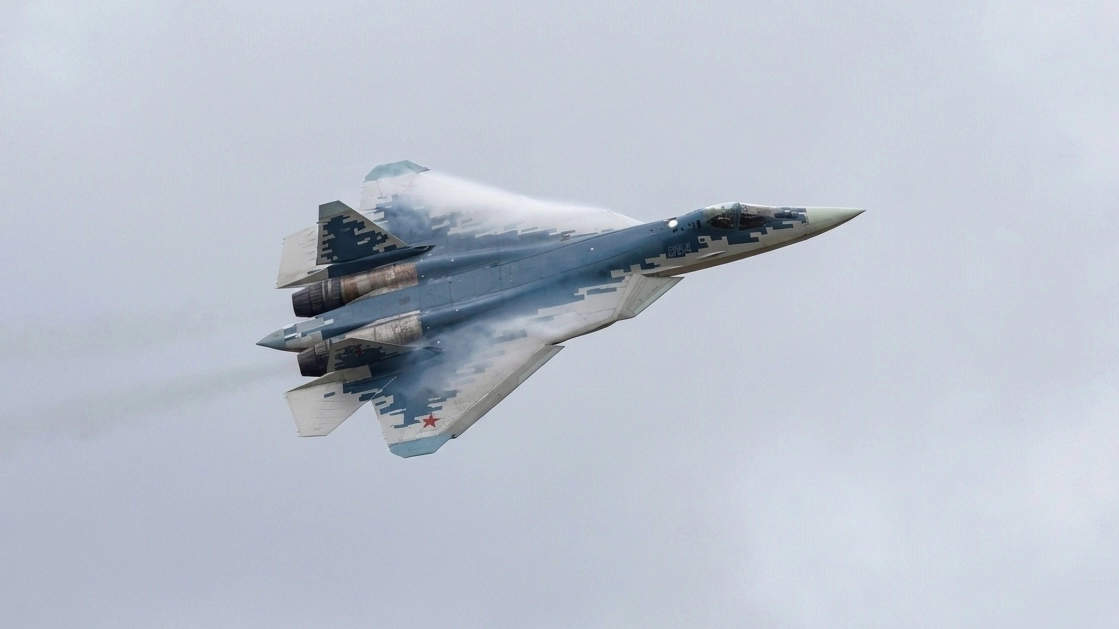
1. Sukhoi Su-57 Felon — Russia
If agility were a dance, the Sukhoi Su-57 would be the fighter that ignores the choreography.
The Russian fifth-generation fighter is designed around an unusually broad idea of maneuverability. Rather than simply making tight turns at conventional flight attitudes, the Su-57 is built to remain controllable when the airflow becomes messy and the aircraft approaches extreme angles of attack.
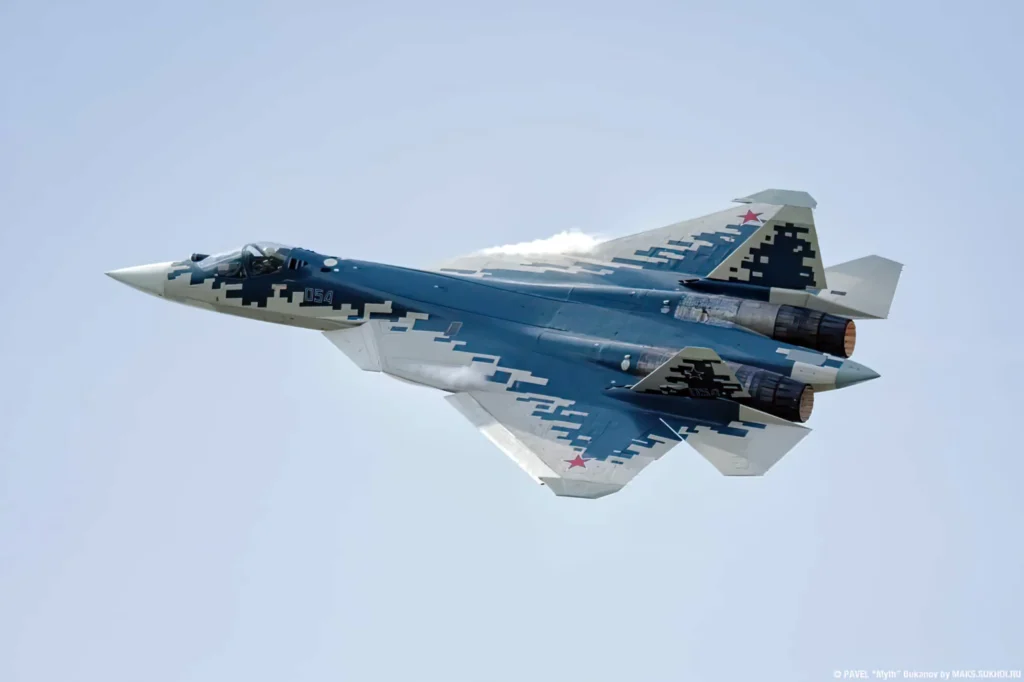
Its combination of relaxed stability, advanced flight controls, leading-edge vortex control surfaces, and thrust-vectoring engines gives it considerable authority in pitch, yaw, and roll.
That last part is particularly important. The Su-57’s engine nozzles are canted, allowing differential thrust-vectoring inputs to create control moments beyond ordinary aerodynamic surfaces.
In plain English, the engines themselves become part of the aircraft’s steering system. This helps explain why the jet can perform dramatic high-angle-of-attack maneuvers that would be difficult to sustain using conventional controls alone.
Su-57 Agility at a Glance
| Feature | Su-57 |
| Generation | 5th |
| Engines | 2 × AL-41F1 on current production aircraft |
| Thrust vectoring | Yes |
| Flight-control approach | Relaxed stability + digital controls |
| High-AoA capability | Exceptional |
| Maximum speed | Around Mach 2 |
| Published climb-rate estimates | Up to roughly 330–361 m/s |
Open-source assessments put its maximum sustained turn performance in the high-20-degrees-per-second range, although figures vary by source and flight condition.
A recent 2026 open-source aerodynamic study estimated approximately 23.7 degrees per second sustained turn rate under its modeled conditions, an important reminder that published numbers aren’t universal test-card results.
What makes the Su-57 especially interesting, then, isn’t one magic statistic. It’s the combination. The aircraft can exploit thrust vectoring and aerodynamic control together, giving the pilot an unusually large maneuvering envelope.
That earns the Su-57 the No. 1 position for pure agility in this ranking, though whether that translates into victory in a real air-combat encounter is a much more complicated question.
2. F-22 Raptor — United States
If the Su-57 represents extreme maneuverability through aggressive thrust-vectoring, the F-22 Raptor takes a slightly different route: enormous engine power, careful aerodynamic design, advanced flight controls, and just enough thrust vectoring to make the combination unusually potent.
The result is one of the most agile fighter jets ever built.

The F-22 is powered by two Pratt & Whitney F119-PW-100 engines, each producing about 35,000 pounds of thrust, giving the aircraft roughly 70,000 pounds of combined thrust.
Its engines use two-dimensional thrust-vectoring nozzles, allowing the Raptor to control pitch beyond what conventional aerodynamic surfaces could achieve alone.
But the interesting part isn’t simply the number on the engine specification sheet. It’s how the pieces work together.
F-22 Agility at a Glance
| Feature | F-22 Raptor |
| Generation | 5th |
| Engines | 2 × Pratt & Whitney F119 |
| Combined thrust | ~70,000 lb |
| Thrust vectoring | 2D |
| Supercruise | Yes |
| Maximum speed | Approximately Mach 2 |
| High-AoA control | Excellent |
| Primary role | Air superiority |
The U.S. Air Force specifically attributes the Raptor’s maneuverability to its aerodynamic design, advanced flight controls, thrust vectoring, and high thrust-to-weight ratio.
That combination becomes particularly useful at low speed and high angle of attack. During testing, F-22 pilots demonstrated control in portions of the flight envelope where conventional fighters could lose effective control authority.
The Air Force has even documented high-angle-of-attack maneuvers involving approximately 36 degrees of angle of attack during the Raptor’s J-turn demonstration profile.
There’s another advantage hiding underneath all that maneuverability: energy. The F-22 can supercruise above Mach 1.5 without afterburner, according to the U.S. Air Force, meaning it can maintain supersonic flight without continuously burning fuel at afterburner levels.
That matters because agility isn’t just about turning sharply. It’s about what the aircraft has left after the turn.
And that’s why the F-22 takes the No. 2 spot, a remarkably close second to the Su-57, but arguably the more complete blend of power, control, and maneuverability.
3. Sukhoi Su-35 Flanker-E — Russia
The Sukhoi Su-35 is where the classic Flanker formula gets pushed toward its physical limits. It may lack the stealth shaping of the Su-57 or F-22, but when the question is simply how much control an aircraft has in a hard maneuver, the Su-35 remains a fascinating machine.

The Su-35S is a 4++ generation fighter derived from the Su-27 family. Its biggest agility advantage comes from its AL-41F1S engines and thrust-vectoring system, which can redirect engine thrust to help control the aircraft when conventional aerodynamic surfaces become less effective.
UAC describes the fighter as a supermaneuverable aircraft, while its engine and thrust-vectoring system are specifically credited with improving maneuverability.
Su-35 Agility at a Glance
| Feature | Su-35S |
| Generation | 4++ |
| Engines | 2 × AL-41F1S |
| Thrust vectoring | Yes |
| Maximum maneuver load | Up to 9G |
| Maximum speed | About Mach 2.25 |
| Maximum takeoff weight | 34,500 kg |
| Service ceiling | Up to 18,000–20,000 m |
| Maximum weapon load | Up to 8,000 kg |
The most interesting feature is what happens at very low speeds. Multi-axis thrust vectoring allows the Su-35 to retain useful control authority even when airflow over the wings and control surfaces has become severely disrupted. In effect, the engines can help “steer” the aircraft when the wings are running out of authority.
That capability produces the spectacular post-stall maneuvers associated with the Flanker family. But there’s a catch, and it’s an important one. Research from the Royal United Services Institute notes that such maneuvers can bleed substantial kinetic energy. Looking spectacular and being tactically useful are two different things.
This is why the Su-35 earns third place, rather than first. Its supermaneuverability is genuine and impressive, but modern air combat rewards energy management, sensors, missiles and situational awareness alongside raw nose-pointing ability.
Still, if you’re looking for one of the most maneuverable fighter jets built from the fourth-generation lineage, the Su-35 is very difficult to leave off the list.
4. Eurofighter Typhoon — Europe
The Eurofighter Typhoon takes a different path to extreme agility. It doesn’t use thrust-vectoring engines like the Su-35 or Su-57. Instead, its maneuverability comes largely from a carefully engineered airframe, powerful engines, and flight-control systems designed around an intentionally unstable configuration.
That sounds like a flaw. It isn’t.

The Typhoon was deliberately designed this way because an unstable aircraft can be more responsive to pilot inputs.
Digital flight-control computers constantly make tiny corrections, allowing the pilot to exploit that instability without having to wrestle with it manually. Eurofighter says the design was developed specifically to provide strong maneuverability at both subsonic and supersonic speeds.
Eurofighter Typhoon Agility at a Glance
| Feature | Eurofighter Typhoon |
| Generation | 4.5 |
| Engines | 2 × EJ200 |
| Afterburning thrust | 180 kN combined |
| Maximum speed | Mach 2.0 at altitude |
| Thrust vectoring | No |
| Design | Delta-canard |
| Flight control | Digital fly-by-wire |
| Maximum maneuver load | Up to 9G |
One of the Typhoon’s secret weapons is its thrust-to-weight ratio. The aircraft combines relatively low weight with two powerful EJ200 engines, producing up to 180 kN of afterburning thrust. Eurofighter specifically identifies this combination as a major reason for the aircraft’s strong performance.
The delta wing and canards also give the fighter substantial control authority, while its lightweight composite construction helps keep weight down. Eurofighter states that composite materials account for a significant portion of the structure and reduce weight compared with more traditional construction.
There’s a useful lesson here: agility doesn’t always require a trick hidden inside the engine nozzle.
The Typhoon earns fourth place because it delivers excellent acceleration, high-speed maneuverability and responsive handling through aerodynamics and raw power. It’s less about spectacular post-stall gymnastics and more about keeping the aircraft fast, responsive and useful throughout a broad portion of its flight envelope.
That makes the Typhoon one of the most agile non-thrust-vectoring fighters in service today.
5. Dassault Rafale — France
The Dassault Rafale proves that a fighter does not need thrust-vectoring engines to rank among the most agile fighter jets in the world. Its agility comes from a carefully balanced combination of a delta wing, close-coupled canards, powerful engines, and an advanced digital fly-by-wire flight-control system.
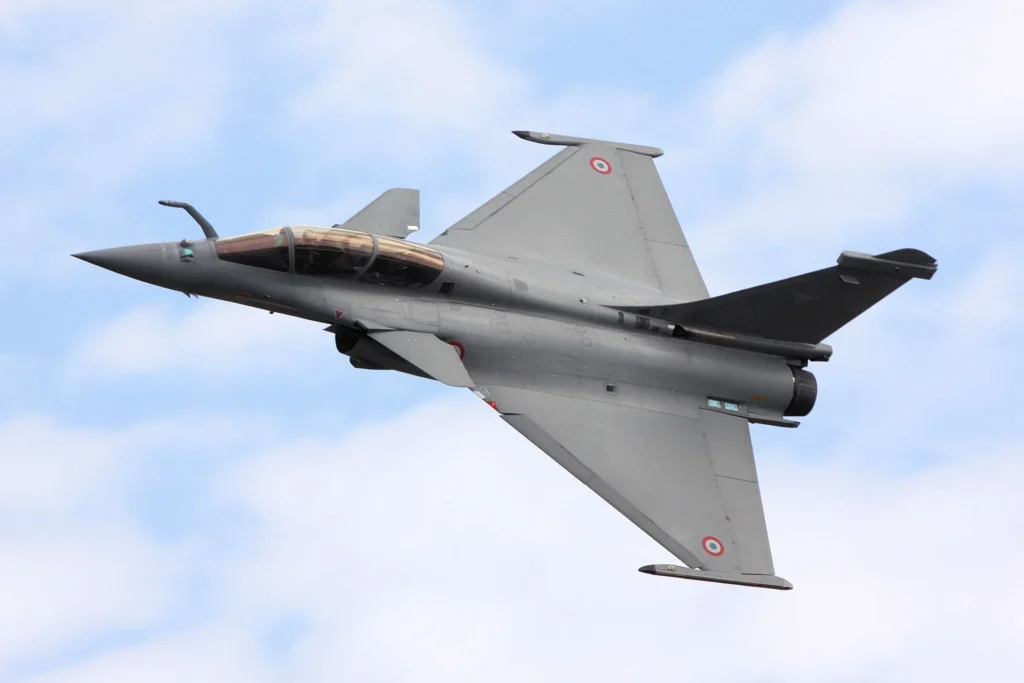
Dassault Aviation specifically highlights the Rafale’s ability to remain agile at high angles of attack. The close-coupled canards interact aerodynamically with the delta wing, giving the aircraft strong control authority across a wide portion of its flight envelope.
Dassault Rafale Agility at a Glance
| Feature | Dassault Rafale |
| Generation | 4.5 |
| Engines | 2 × Safran M88 |
| Maximum thrust | 2 × 7.5 tonnes |
| Maximum speed | Mach 1.8 |
| Maximum load factor | +9G / -3.2G |
| Thrust vectoring | No |
| Design | Delta wing + close-coupled canards |
| Flight control | Digital fly-by-wire |
The Rafale’s two M88 engines provide a combined maximum thrust of roughly 15 tonnes, while its empty weight is around 10 tonnes. Dassault lists a maximum takeoff weight of 24.5 tonnes and a top speed of Mach 1.8.
But raw numbers only tell part of the story. The Rafale’s real strength is usable maneuverability. Its flight-control system constantly manages the aircraft’s stability, allowing the pilot to exploit its aerodynamic design without manually fighting the airplane.
That makes the Rafale particularly interesting among the most maneuverable fighter jets. It may lack the dramatic post-stall capabilities associated with thrust-vectoring fighters such as the Su-57 and Su-35, but it offers highly responsive handling, strong high-angle-of-attack performance, and impressive agility while remaining a versatile multirole platform.
For that balance of maneuverability, speed, control authority, and combat versatility, the Rafale earns fifth place on our list.
Which Is the Most Agile Fighter Jet?
So, which aircraft deserves the title of the most agile fighter jet in the world in 2026?
Based on the criteria used in this ranking, the Sukhoi Su-57 takes the top position. Its combination of thrust-vectoring capability, aerodynamic design, high-angle-of-attack control, and powerful engines gives it an unusually broad maneuvering envelope.
The Su-57’s biggest advantage is that its agility does not depend on a single feature. Its airframe is designed around maneuverability, while its thrust-vectoring system provides additional control authority when conventional aerodynamic surfaces become less effective.
That makes it particularly capable during extreme low-speed and high-AoA maneuvers. However, calling it the undisputed best in every possible measure would be misleading. Open-source performance data for modern fighter aircraft can be incomplete, classified, or measured under different conditions.
How the Top Five Compare
| Fighter | Main Agility Advantage | Overall Assessment |
| Sukhoi Su-57 | Multi-axis thrust vectoring | Exceptional high-AoA agility |
| F-22 Raptor | Aerodynamics + thrust vectoring | Outstanding control and energy performance |
| Sukhoi Su-35 | Thrust vectoring + power | Extreme supermaneuverability |
| Eurofighter Typhoon | Delta-canard + high thrust-to-weight | Excellent sustained maneuverability |
| Dassault Rafale | Delta-canard + fly-by-wire | Highly responsive multirole performance |
The F-22 Raptor comes very close. Its combination of low-observable design, powerful F119 engines, thrust vectoring, and excellent aerodynamic characteristics makes it arguably one of the most complete air-superiority fighters ever developed.
The Su-35, meanwhile, may produce some of the most dramatic post-stall maneuvers of the group, while the Typhoon and Rafale demonstrate how far conventional aerodynamic design can go without thrust-vectoring engines.
Ultimately, there is no single maneuverability statistic that settles the debate. The Su-57 ranks first here because of the breadth of its high-AoA and thrust-vectoring capabilities, but the F-22, Su-35, Typhoon, and Rafale each excel in different aspects of fighter agility.
And that is what makes comparing the world’s most agile fighter jets so fascinating: the fastest aircraft is not automatically the best turner, and the aircraft capable of the wildest maneuver is not necessarily the most effective combat fighter.
