

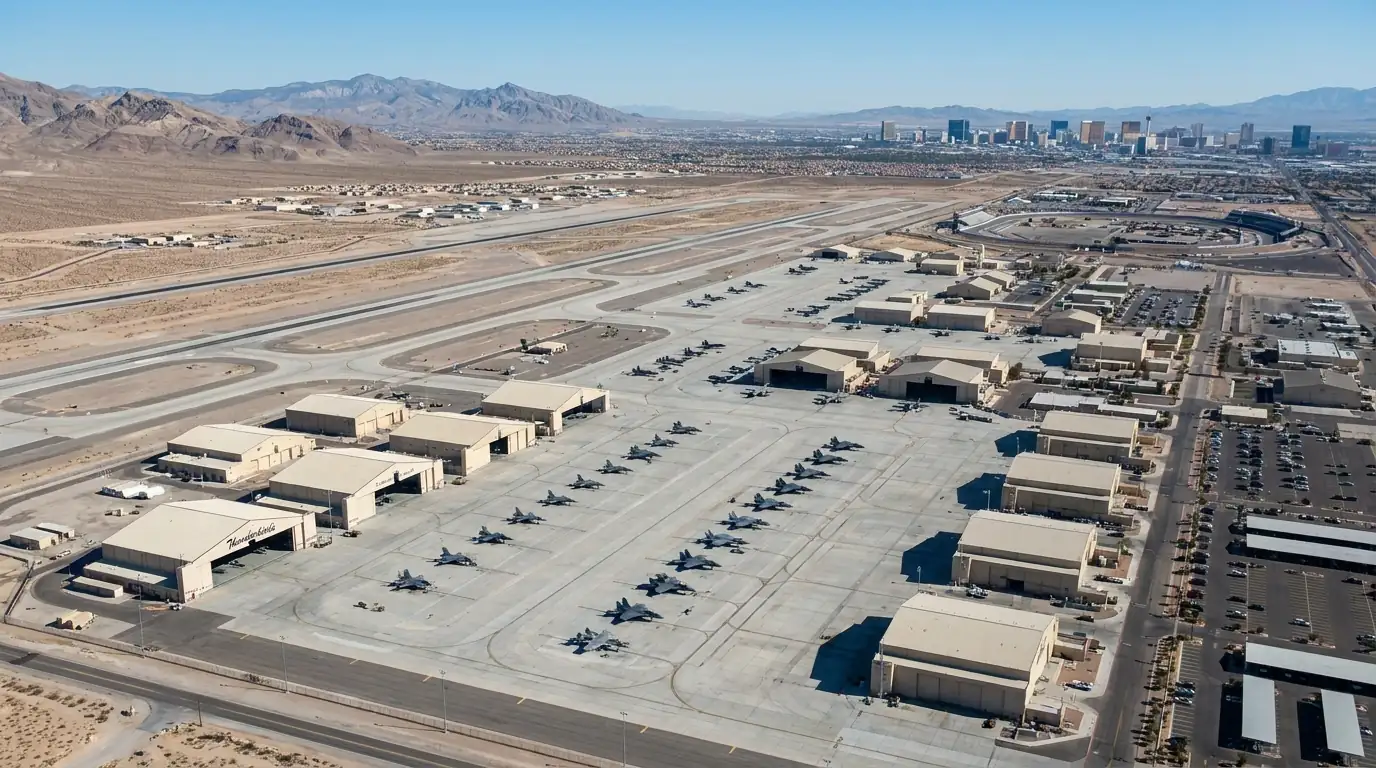
What does the largest US Air Force base actually look like?
Imagine standing on a runway where the horizon seems endless, fighter jets streak overhead, and entire sections of the installation remain off-limits because they’re reserved for missile tests, live-fire exercises, or the next generation of military aircraft. Some Air Force bases are so vast that they cover more land than many major American cities.
When people think of military bases, they often picture rows of hangars and a handful of aircraft. The reality is far more impressive. America’s largest Air Force installations are essentially self-contained military ecosystems.
They include sprawling airfields, test ranges, weapons laboratories, housing communities, forests, deserts, and restricted airspace stretching for hundreds of square miles. Every acre serves a purpose, whether it’s training fighter pilots, developing cutting-edge aircraft, or preparing forces for missions around the globe.
Yet “largest” isn’t always as straightforward as it sounds. One base may dominate in physical size, another may host the most aircraft, while a different installation serves as the Air Force’s premier combat training center. That’s why simply comparing acreage doesn’t tell the whole story.
In this post, we’ll rank the top five largest US Air Force bases by size while also exploring what truly makes each one remarkable. You’ll discover their approximate land area, the aircraft that call them home, and the critical roles they play in defending the United States and supporting military operations worldwide.
How We Ranked the Largest US Air Force Bases
Ranking the largest US Air Force bases isn’t as simple as measuring the footprint inside the front gate. In fact, that’s where many articles get it wrong.
A modern Air Force installation extends well beyond its runways and hangars. Some bases oversee vast bombing ranges, restricted airspace, electronic warfare zones, and training complexes that are just as essential as the airfield itself.
Read also: Top 5 Biggest US Military Bases: By Size, Troops & Impact
For this ranking, the primary factor is physical land area, the total acreage or square mileage controlled by the installation. However, land size alone doesn’t tell the whole story, so we’ve also considered the base’s operational scale and strategic importance.
Here are the criteria used:
- Total land area (acres and square miles)
- Military training ranges managed or directly supported by the base
- Number and types of aircraft regularly stationed there
- Primary mission, such as combat training, flight testing, logistics, or special operations
- Strategic value to the U.S. Air Force and national defense
It’s also worth clearing up a common misconception. The largest Air Force base by land area isn’t necessarily the busiest.
For example, a base dedicated to weapons testing may cover hundreds of square miles but host fewer aircraft than a major operational fighter base. Conversely, an installation with thousands of personnel and constant flight activity may occupy a much smaller footprint.
Geography plays a major role as well. Desert landscapes in California and Nevada provide ideal conditions for supersonic testing and live-fire exercises, while Florida’s coastal environment allows weapons to be evaluated safely over the Gulf of Mexico.
Alaska, meanwhile, offers enormous training areas and unique Arctic conditions that can’t be replicated anywhere else in the continental United States.
Read also: Top 5 Biggest Army Bases in the US and Why They Matter
In other words, these installations weren’t built to impress with their size, they grew because their missions demanded room to operate. That combination of vast space, specialized infrastructure, and strategic purpose is what earns them a place among the top five largest US Air Force bases.
1. Eglin Air Force Base, Florida
If one Air Force base deserves to be called a giant, it’s Eglin Air Force Base. Covering approximately 724 square miles (more than 463,000 acres) across Florida’s Panhandle, it is widely recognized as the largest US Air Force base by land area.
To put that into perspective, Eglin is larger than the entire city of Houston by land managed for military purposes, and its vast reservation includes forests, wetlands, test ranges, and miles of Gulf Coast shoreline.

Located near Valparaiso in northwest Florida, Eglin was established in 1935 and has evolved from a modest bombing and gunnery range into one of the Air Force’s most important centers for weapons development and operational testing.
Today, nearly every major Air Force aircraft eventually passes through Eglin for evaluation, upgrades, or training before entering widespread service.
One reason Eglin requires so much land is safety. Testing precision-guided bombs, cruise missiles, and advanced munitions demands enormous buffer zones where aircraft can release weapons without endangering nearby communities.
Much of the base’s territory remains undeveloped, serving as protected military testing areas rather than traditional airfields.
Key Facts
| Feature | Details |
| Location | Florida Panhandle |
| Approximate Size | 724 sq mi (463,000+ acres) |
| Established | 1935 |
| Major Command | Air Force Materiel Command |
| Primary Mission | Weapons testing, evaluation, pilot training, special operations support |
Eglin is also home to an impressive mix of aircraft, reflecting its diverse mission set.
Depending on operational requirements, visitors may spot F-35A Lightning II stealth fighters, AC-130J Ghostrider gunships, CV-22 Osprey tiltrotor aircraft, HH-60W Jolly Green II combat rescue helicopters, and various test aircraft sharing the same skies.
This variety makes Eglin less like a conventional fighter base and more like a living laboratory where new technologies are refined before reaching front-line squadrons.
Perhaps the most remarkable aspect of Eglin isn’t its sheer size, it’s how that space is used. Every runway, weapons range, and stretch of restricted airspace contributes to developing the capabilities that keep the U.S. Air Force prepared for future conflicts.
Read also: Top 5 Largest US Naval Bases: Size, Fleet, and Strategic Role
That’s why Eglin consistently ranks not only as the largest US Air Force base, but also as one of the most strategically valuable military installations in the world.
2. Edwards Air Force Base, California
When aviation history is written, Edwards Air Force Base almost always has a chapter of its own. Nestled in California’s Mojave Desert, about 100 miles northeast of Los Angeles, Edwards covers approximately 470 square miles (more than 301,000 acres), making it the second-largest US Air Force base by land area.

Unlike Eglin, which is best known for weapons testing, Edwards has earned its reputation as America’s premier flight test center. If an aircraft is pushing the limits of speed, stealth, endurance, or technology, there’s a good chance it has flown over the desert skies of Edwards.
At the heart of the base lies Rogers Dry Lake, a massive natural lakebed stretching for thousands of acres. Its smooth, hard-packed surface has served as a natural emergency runway for decades.
In fact, the dry lake provides dozens of potential landing areas, offering pilots an extra margin of safety during experimental flights. It’s one of the reasons Edwards became the ideal location for testing aircraft that had never flown before.
The base’s legacy is woven into some of aviation’s greatest milestones. In 1947, Captain Chuck Yeager made history here by breaking the sound barrier in the Bell X-1, forever changing aerospace engineering.
Decades later, Edwards became the primary landing site for NASA’s Space Shuttle, with missions touching down on the vast desert lakebed after returning from orbit.
Key Facts
| Feature | Details |
| Location | Mojave Desert, California |
| Approximate Size | 470 sq mi (301,000+ acres) |
| Established | 1933 (as Muroc Field) |
| Major Command | Air Force Materiel Command |
| Primary Mission | Flight testing, aerospace research, experimental aircraft development |
Today, Edwards remains where the future takes shape. Advanced fighters, bombers, drones, and experimental aircraft all pass through its facilities before entering operational service.
Whether testing a new radar system, evaluating next-generation engines, or integrating cutting-edge software, Edwards provides the controlled environment needed to push aviation technology to its limits.
If Eglin is where weapons are perfected, Edwards is where aircraft themselves prove they’re ready to fly into the future.
3. Hill Air Force Base, Utah
At first glance, Hill Air Force Base doesn’t seem like an obvious contender among the largest US Air Force bases. The installation itself occupies roughly 6,700 acres near Ogden, Utah, far smaller than Eglin or Edwards. So why does it appear on this list?
The answer lies beyond the main gate.

Hill Air Force Base serves as the primary support installation for the Utah Test and Training Range (UTTR), an immense military complex covering approximately 2.3 million acres of restricted land in northern Utah.
Together, the base and the UTTR form one of the largest and most sophisticated air combat training environments in the United States.
Unlike Edwards, where engineers test experimental aircraft, or Eglin, where new weapons are evaluated, Hill specializes in something equally important: keeping the Air Force’s combat fleet ready to fight.
The base is home to the Ogden Air Logistics Complex (OO-ALC), one of only three Air Force Air Logistics Complexes in the country. Here, thousands of engineers, technicians, and civilian specialists perform depot-level maintenance on some of America’s most advanced aircraft.
A fighter arriving at Hill may leave months later with upgraded avionics, structural repairs, new radar systems, or an extended service life.
Key Facts
| Feature | Details |
| Location | Ogden, Utah |
| Installation Size | ~6,700 acres |
| Associated Range | Utah Test and Training Range (2.3+ million acres) |
| Established | 1940 |
| Major Command | Air Force Materiel Command |
| Primary Mission | Aircraft maintenance, logistics, sustainment, and combat training support |
Hill also serves as the home of the 388th Fighter Wing and 419th Fighter Wing, both operating the F-35A Lightning II. These squadrons combine operational flying with access to the nearby UTTR, where pilots can practice realistic combat scenarios over an area large enough to simulate modern battlefields.
This combination of world-class maintenance facilities, frontline fighter operations, and one of America’s largest military training ranges makes Hill Air Force Base far more significant than its footprint alone would suggest. Its true strength isn’t measured by the acreage inside its fences, it’s measured by the combat capability it sustains for the entire U.S. Air Force.
4. Nellis Air Force Base, Nevada
If there’s one place where fighter pilots earn their reputation before heading into combat, it’s Nellis Air Force Base.
Located on the northern edge of Las Vegas, Nevada, Nellis isn’t the largest installation by acreage alone, but when paired with the Nevada Test and Training Range (NTTR), an immense military complex spanning nearly 2.9 million acres (about 4,500 square miles), it becomes one of the most capable air combat training environments anywhere on Earth.

While tourists visit Las Vegas for entertainment, military aviators arrive at Nellis for something far more demanding. Here, mistakes become lessons before they can become casualties in wartime.
Established in 1941, Nellis has evolved into the Air Force’s premier center for advanced tactical training.
The base hosts some of the military’s most challenging exercises, where pilots face simulated enemy aircraft, integrated air defenses, electronic warfare, cyber threats, and realistic battlefield scenarios. The goal isn’t simply to teach pilots how to fly, it’s to prepare them to survive and win against sophisticated opponents.
Key Facts
| Feature | Details |
| Location | Las Vegas, Nevada |
| Base Size | Approximately 11,300 acres |
| Associated Training Area | Nevada Test and Training Range (≈2.9 million acres) |
| Established | 1941 |
| Major Command | Air Combat Command |
| Primary Mission | Advanced air combat training and tactical development |
The surrounding Nevada desert offers another advantage: space. With thousands of square miles of restricted airspace, pilots can fly high-speed intercepts, coordinate large strike packages, and conduct live or simulated weapons employment without the limitations found near densely populated areas.
Nellis is also home to the world-famous Red Flag exercise, often described as the closest experience to actual aerial combat without going to war.
Aircrews from across the United States and allied nations come here to sharpen their skills against realistic threats, building experience that can make a decisive difference during real-world operations.
For that reason, Nellis isn’t simply one of the largest US Air Force bases in terms of operational reach, it’s widely regarded as the place where America’s most capable combat aviators are forged.
5. Joint Base Elmendorf-Richardson (JBER), Alaska
When most people imagine an Air Force base, they picture warm-weather flight lines or sprawling desert ranges. Joint Base Elmendorf-Richardson (JBER) breaks that stereotype completely.
Located just outside Anchorage, Alaska, JBER operates in one of the harshest military environments in the world, where winter temperatures can plunge well below freezing, daylight can disappear for weeks, and missions often take place over remote mountains, glaciers, and the Arctic Ocean.

Although the installation itself occupies roughly 64,000 acres, its operational reach extends across millions of acres of Alaskan training airspace and access to the Joint Pacific Alaska Range Complex (JPARC), the largest combat training range in the United States, spanning approximately 77,000 square miles of airspace and land.
This enormous training environment allows pilots to conduct realistic exercises that would be impossible in most other parts of the country.
Created in 2010 through the merger of Elmendorf Air Force Base and Fort Richardson, JBER combines Air Force and Army capabilities into a single joint installation. Its location places American forces within hours of the Arctic, the North Pacific, and the Indo-Pacific region, making it one of the most strategically positioned military bases in North America.
Key Facts
| Feature | Details |
| Location | Anchorage, Alaska |
| Installation Size | Approximately 64,000 acres |
| Associated Training Area | Joint Pacific Alaska Range Complex (≈77,000 sq mi) |
| Established | Joint base created in 2010 |
| Major Command | Pacific Air Forces (PACAF) |
| Primary Mission | Arctic defense, homeland defense, air mobility, Indo-Pacific operations |
Geography is JBER’s greatest advantage. Aircraft launching from Alaska can quickly reach the Arctic, monitor activity in the North Pacific, or support operations across the Indo-Pacific.
As global attention increasingly shifts toward the Arctic due to changing shipping routes, resource competition, and growing military activity, JBER’s importance has expanded dramatically.
Unlike bases focused primarily on testing or pilot instruction, Joint Base Elmendorf-Richardson serves as an operational frontline installation.
Every mission flown here contributes directly to protecting U.S. airspace, supporting allies, and maintaining a rapid-response capability across one of the world’s most strategically significant regions.
In an era of renewed great-power competition, that mission has never been more relevant.
Comparison Table: Top 5 Largest US Air Force Bases
After exploring each installation individually, it’s easier to see that “largest” means more than just acreage. Every base on this list has developed around a different mission.
Some focus on testing the next generation of military aircraft, others prepare pilots for combat, while some ensure the Air Force’s existing fleet remains ready to deploy at a moment’s notice.
The table below compares the top five largest US Air Force bases based on their approximate size, primary aircraft, and strategic role.
| Rank | Air Force Base | State | Approximate Size | Notable Aircraft | Primary Mission |
| 1 | Eglin Air Force Base | Florida | 724 sq mi (463,000+ acres) | F-35A, AC-130J, CV-22 Osprey | Weapons testing, research, special operations, pilot training |
| 2 | Edwards Air Force Base | California | 470 sq mi (301,000+ acres) | F-35, F-22, B-52H, T-7A | Flight testing, aerospace research, aircraft development |
| 3 | Hill Air Force Base | Utah | Supports the 2.3-million-acre Utah Test and Training Range | F-35A, F-16 | Aircraft maintenance, logistics, fighter operations |
| 4 | Nellis Air Force Base | Nevada | Supports the 2.9-million-acre Nevada Test and Training Range | F-35A, F-22, F-16, A-10 | Advanced air combat training and tactical development |
| 5 | Joint Base Elmendorf-Richardson | Alaska | 64,000 acres with access to JPARC (≈77,000 sq mi training complex) | F-22A, C-17A, KC-135R | Arctic defense, homeland security, global mobility |
What the Comparison Reveals
A closer look at these bases highlights an interesting pattern.
The largest US Air Force base, Eglin, owes its enormous footprint to the vast safety zones required for weapons testing. Edwards relies on the open Mojave Desert to test aircraft at the edge of technological possibility.
Hill serves as the Air Force’s industrial backbone, keeping combat aircraft mission-ready while leveraging one of the country’s largest training ranges.
Nellis, meanwhile, is the classroom where elite fighter pilots sharpen their skills before deployment, while Joint Base Elmendorf-Richardson projects American airpower into the Arctic and Indo-Pacific from one of the most strategically important locations on the continent.
Despite their different missions, these installations share one common characteristic: space creates capability.
Whether it’s room for supersonic flight tests, large-scale combat exercises, depot-level maintenance, or rapid-response operations across thousands of miles, each base demonstrates that in modern air warfare, having enough room to train, innovate, and operate can be just as important as the aircraft themselves.
