

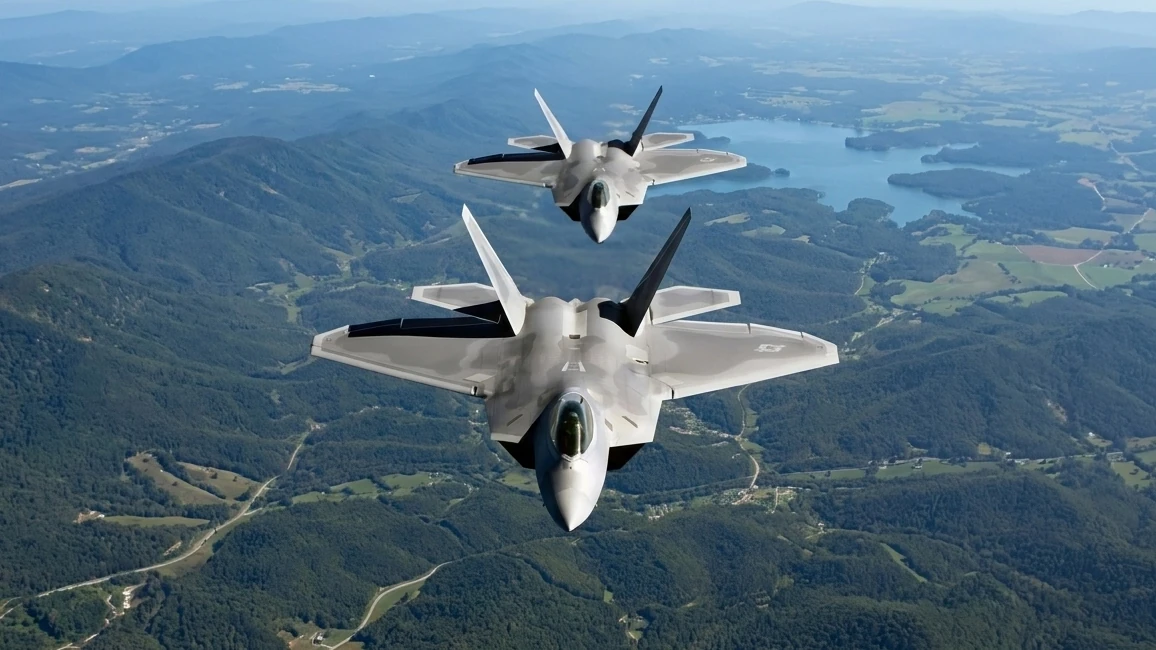
There’s something almost unsettling about modern stealth fighter jets, like watching a machine that technically shouldn’t be “there,” yet somehow owns the sky anyway.
One moment the radar screen is clean, the next it’s… not. No warning, no drama. Just disappearance and dominance.
That’s the strange reality of today’s best stealth fighter jets. They’re not just faster or more armed than older aircraft, they’re designed to rewrite the rules of detection itself.
In modern air combat, seeing first often means winning first, and stealth is the closest thing to invisibility that engineers have ever managed to build into metal and carbon composites.
If you zoom out and look at global military aviation in 2026, you’ll notice a pattern: the strongest air forces aren’t just chasing speed anymore. They’re chasing silence on radar, heat suppression, and digital dominance.
The new generation of fighters doesn’t just fly, they think, share data, jam enemy systems, and sometimes even coordinate with drones like a floating command center.
And here’s where it gets interesting. The debate around the top stealth fighter jets in the world isn’t just about specs on paper. It’s about philosophy.
The F-22 Raptor leans into pure air superiority like a razor blade. The F-35 Lightning II feels more like a flying sensor network.
Meanwhile, China’s J-20 and Russia’s Su-57 bring entirely different design instincts to the table, some prioritizing range, others agility, and a few still chasing true stealth perfection.
So instead of just listing aircraft, we’re going to break down what actually makes these machines the best stealth fighter jets on the planet, and why the sky in 2026 feels more like a chessboard played at Mach speeds than ever before.
Criteria Used for Ranking the Best Stealth Fighter Jets
If you’ve ever wondered why debates over the best stealth fighter jets get so heated, it’s because there’s no single “perfect” metric. A jet that dominates in dogfights might not be the best at long-range strike missions. Another might be extremely stealthy but expensive to operate or limited in combat experience.
Read also: How Do Stealth Aircraft Work? Stealth Tech Breakdown
So instead of relying on hype or marketing claims, analysts usually break performance into a mix of measurable and real-world factors. Think of it like judging elite athletes, you don’t just look at speed, you also consider endurance, intelligence, consistency, and adaptability under pressure.
For this ranking of the top stealth fighter jets in the world, we use five core criteria:
1. Stealth effectiveness (Radar + Infrared Signature)
This is the foundation. It includes radar cross-section reduction, engine heat suppression, and shaping. Some jets excel head-on but struggle in rear detection scenarios, which matters in real combat geometry.
2. Sensor Fusion & Situational Awareness
Modern air combat is basically information warfare at Mach speed. The best jets combine radar, infrared sensors, electronic intelligence, and data links into a single battlefield picture. The F-35 is especially known for this “pilot-as-a-node” concept.
3. Combat Performance & Mission Flexibility
Air superiority, ground strike, suppression of enemy air defenses (SEAD), the more roles a jet can handle without compromise, the more valuable it becomes.
4. Speed, Range, and Energy Management
Supercruise capability (sustained supersonic flight without afterburners) is a major advantage. So is combat radius, especially for countries operating across vast territories.
5. Operational Reality (Not Just Prototypes)
Some aircraft look incredible on paper but have limited deployment or production numbers. Real-world readiness often separates legends from experiments.
One important nuance: no single jet “wins” all categories. That’s why comparisons like F-22 vs F-35 vs J-20 vs Su-57 never truly end, they’re built for different philosophies of warfare.
With that in mind, we can now step into the real heart of the topic: the actual ranking of the best stealth fighter jets in the world, starting with the aircraft that many pilots quietly call the benchmark of modern air dominance.
1. F-22 Raptor – The Benchmark of Air Superiority
If there’s one aircraft that keeps showing up in every serious discussion about the best stealth fighter jets, it’s the F-22 Raptor. Not because it’s the newest, and not because it’s the most widely used, but because it still feels slightly ahead of its time.
The F-22 was built with a very specific idea in mind: win the sky first, ask questions later. It’s not a multirole “do everything” machine like newer fighters. Instead, it focuses on one thing with almost obsessive precision, air dominance. And in that role, it’s still widely considered unmatched.
What makes it so dangerous isn’t just stealth or speed, it’s the combination of both working in harmony. The aircraft can supercruise at around Mach 1.8, meaning it can stay supersonic without afterburners. That might sound like a technical detail, but in combat, it translates into energy advantage, faster positioning, and less detectable heat signature.
Its radar cross-section is often estimated to be extremely small (comparable to a metal marble on radar from certain angles), though exact figures are classified. Combined with thrust vectoring, basically the ability to “bend” its engine thrust mid-air, it can perform sudden, almost unnatural maneuvers that make it a nightmare in close-range engagements.
But here’s the twist: the F-22 is also a product of limitation. It was never exported, and production stopped at just over 180 units. That makes it rare, almost exclusive, like a prototype that accidentally became a legend.
Quick snapshot:
| Feature | F-22 Raptor |
| Role | Air superiority |
| Speed | Mach 2.0+ (top), Mach 1.8 supercruise |
| Strength | Stealth + agility combo |
| Weakness | Limited multirole capability, no export |
| Status | Active but not produced anymore |
In real-world exercises, the F-22 has consistently outperformed older-generation fighters in simulated combat scenarios, often achieving “kill ratios” that sound almost unreal, but it’s important to remember those are controlled environments, not full-scale wars.
Still, even with newer jets entering service, the F-22 remains the reference point. When engineers design new stealth fighters, they’re often trying to beat it, or at least match it.
And that alone says a lot.
2. F-35 Lightning II – The Digital Battlefield Workhorse
If the F-22 is the quiet predator of the skies, the F-35 Lightning II is something closer to a flying command center that happens to carry missiles. It doesn’t try to out-dogfight everything it sees. Instead, it changes the way battles are even understood in the first place.
This is why the F-35 is always ranked among the best stealth fighter jets, even when critics argue about its speed or cost. It was never designed to “win by itself” in the traditional sense. It was designed to make an entire network win.
Read also: F-35 Lightning II vs F-22 Raptor: Side-by-Side Capabilities
At the core of its advantage is sensor fusion. The jet pulls in data from radar, infrared sensors, electronic warfare systems, and even other friendly aircraft, then merges it into a single, real-time tactical picture for the pilot. The result is almost eerie, pilots don’t just “see” enemies; they see a curated battlefield map that updates instantly.
The F-35 also comes in three main variants:
- F-35A: Conventional takeoff (Air Force)
- F-35B: Short takeoff/vertical landing (Marines)
- F-35C: Carrier-based operations (Navy)
That flexibility is rare in modern aviation. Few stealth jets can operate from runways, ships, and short improvised fields without major redesigns.
Performance-wise, the F-35 is not the fastest jet in this list, it tops out around Mach 1.6. But speed is not its primary survival tool. Its survival comes from being hard to detect, hard to isolate, and extremely hard to out-think electronically.
| Feature | F-35 Lightning II |
| Role | Multirole stealth fighter |
| Max Speed | ~Mach 1.6 |
| Strength | Sensor fusion + network warfare |
| Variants | A, B, C |
| Weakness | Lower speed, high cost, software complexity |
In real-world operations, the F-35’s biggest strength is coordination. It can act like a “data hub in the sky,” guiding missiles launched by other platforms, sharing targeting information with ground forces, or silently mapping enemy air defenses before a strike even begins.
There’s also a subtle shift it represents: modern air combat is no longer just pilot vs pilot. It’s system vs system. And the F-35 thrives in that environment.
It’s not flashy in the old-school sense. But it’s persistent, connected, and quietly everywhere at once.
3. Chengdu J-20 Mighty Dragon – China’s Long-Range Stealth Challenger
The moment you bring up the best stealth fighter jets, the conversation almost always expands beyond the U.S., and the Chengdu J-20 Mighty Dragon is the reason why. It represents a different design philosophy altogether: less about close-range dogfights, more about reaching far, striking first, and controlling wide airspace before the enemy even realizes what’s happening.
Unlike the F-22 and F-35, the J-20 is built with a noticeable emphasis on range and missile delivery capacity. That matters a lot in the Indo-Pacific region, where distances are huge and mid-air refueling isn’t always guaranteed or safe. The J-20 leans into that reality with a large airframe and internal weapon bays designed to carry long-range air-to-air missiles.
From a stealth perspective, the J-20 is interesting because it reflects an evolving system rather than a finished “perfected” design. Early versions had more visible compromises, especially around engine performance and certain rear-aspect signatures.
Newer variants, often discussed as upgrades like the J-20A, are believed to improve those weaknesses significantly, particularly with more advanced domestic engines gradually replacing earlier imports.
One of the J-20’s biggest strengths is not just the aircraft itself, but how it fits into a broader networked air defense strategy. It’s increasingly seen as part of a layered system involving ground-based radar, satellites, and long-range missile systems working together.
| Feature | J-20 Mighty Dragon |
| Role | Long-range stealth interceptor/strike |
| Estimated Speed | ~Mach 2 class (unconfirmed operational variation) |
| Strength | Range + missile capacity |
| Weakness | Less combat-proven, evolving engine tech |
| Design focus | First-shot advantage in large theaters |
In real-world terms, the J-20 hasn’t been tested in open combat, so much of its evaluation comes from analysis, exercises, and observed capabilities rather than battlefield proof. That’s an important distinction when comparing it to platforms like the F-22 or F-35, which have decades of operational refinement.
Still, ignoring it would be a mistake. The J-20 signals a shift: stealth dominance is no longer concentrated in one region or doctrine. It’s becoming a global competition of engineering philosophies.
4. Sukhoi Su-57 Felon – Russia’s Agile but Controversial Stealth Fighter
The Sukhoi Su-57 Felon is one of those aircraft that sparks instant disagreement whenever it appears in a “best stealth fighter jets” ranking. Some analysts see it as an ambitious leap forward for Russian aviation. Others call it a compromise-heavy design trying to balance stealth, agility, and cost constraints all at once.
Either way, it deserves attention because it represents a very different idea of what a modern fighter should be.
Where Western stealth jets often prioritize low observability and sensor fusion, the Su-57 leans heavily into supermaneuverability. This is the ability to perform extreme aerial movements, tight turns, sudden pitch changes, and post-stall maneuvers that can break traditional flight expectations.
In a close-range dogfight scenario, this kind of agility can still be a serious advantage, even in an age dominated by beyond-visual-range missiles.
However, stealth performance is where debates begin. The Su-57 uses shaping and internal weapon bays, but it does not achieve the same level of radar signature reduction associated with the F-22 or F-35. Some design elements, like exposed fasteners or certain airframe geometries, are frequently pointed out in technical discussions as potential compromises.
Read also: Su-57 vs F-22 Battle Analysis: Which Fighter Has the Edge?
The aircraft also reflects Russia’s broader industrial reality: limited production scale and slower rollout of advanced engines. That means the Su-57’s full intended performance envelope is still evolving rather than fully realized.
| Feature | Su-57 Felon |
| Role | Multirole stealth + air superiority hybrid |
| Strength | Extreme agility and maneuverability |
| Estimated Speed | ~Mach 2+ class |
| Weakness | Inconsistent stealth performance, limited production |
| Operational status | Limited deployment |
Despite its controversies, the Su-57 introduces an important reminder: not all air forces define “best” the same way. Russia’s approach still values dogfight survivability and aerodynamic dominance, even in a radar-dominated era.
And interestingly, that philosophy creates a fighter that feels almost transitional, part legacy design thinking, part next-generation ambition.
Now, for the final entry in our top 5, we step into a category of aircraft that represents not just an individual fighter, but an entire ecosystem still under development, where stealth capability is being shaped alongside future warfare doctrine itself.
5. Emerging Stealth Fighters – The New Wave Beyond 5th Generation
The final spot in a list of the best stealth fighter jets is where things get a little less “finished product” and a lot more “future in motion.” Unlike the F-22 or F-35, this category isn’t a single dominant aircraft; it’s a cluster of emerging platforms that hint at where air combat is heading rather than where it already is.
Here’s the reality: the global race for stealth supremacy didn’t stop at 5th-generation fighters. It’s already drifting into 5.5-generation and early 6th-generation concepts, where manned fighters, drones, and AI-assisted systems operate as one coordinated combat network.
One of the most frequently mentioned contenders is the KF-21 Boramae from South Korea. While technically classified as a 4.5 to early 5th-generation hybrid, its design includes partial stealth shaping and future upgrade paths that could push it closer to full low-observable capability. It represents a “bridge fighter”, not fully stealth like the F-35, but clearly moving in that direction.
Another important name is China’s FC-31 (J-35 in its carrier-based evolution). This platform is widely viewed as a potential carrier-compatible stealth fighter designed to complement the larger J-20. Its exact capabilities are still developing, but it signals China’s push toward a more diversified stealth fleet.
Then there’s the bigger picture, programs like the U.S. Next Generation Air Dominance (NGAD) initiative, Europe’s FCAS, and the UK–Japan–Italy GCAP program. These aren’t just jets; they’re envisioned as “systems of systems,” where a piloted fighter might coordinate multiple unmanned drones acting as sensors, decoys, or weapons carriers.
| Program / Jet | Region | Role | Status |
| KF-21 Boramae | South Korea | 4.5–5th gen transition fighter | In testing / early production |
| FC-31 / J-35 | China | Carrier stealth fighter | Development / limited deployment |
| NGAD | USA | 6th gen air dominance system | In development |
| FCAS | Europe | Next-gen fighter ecosystem | Concept / development |
| GCAP | UK/Japan/Italy | Future combat air system | Early development |
What makes this category fascinating is that “stealth” is no longer just about radar invisibility. It’s becoming about information dominance, drone coordination, and battlefield networking at scale. The fighter jet is slowly turning into a mobile command node rather than a standalone weapon.
So while these platforms may not yet dethrone the F-22 or F-35 in a strict ranking, they represent something more important: the direction of air warfare itself.
And that naturally leads into the bigger question, when you compare all these machines side by side, what actually separates them in practical terms, beyond headlines and reputation?
