

They compared Homer’s battle descriptions with archaeological evidence to determine how much could be accepted as historically likely, and what should be disregarded as poetic license.
The Iliad “does describe aspects of battle we know to be true of the Mycenaean world,” says co-author and archaeologist Ken Wardle of the UK’s University of Birmingham; and their combat simulation protocol accounted for other aspects of the conditions for a warrior some 3,300 years ago.
Simulated combat protocol
The combat simulation protocol was put in action by the 13 volunteers, who’d been selected as the suitable height, weight, and age of late Bronze Age warriors.
The volunteers prepared for the protocol by eating only carefully weighed food under a nutrition plan that consisted of dried bread, beef, olives, goat cheese, onions, red wine, and water—a diet researchers deemed typical for a Mycenaean army on the move.
They were then woken before dawn and given a measured breakfast; at which time urine and blood samples were taken, and sensors to measure their body temperatures and vital signs during the experiment were placed on their bodies.
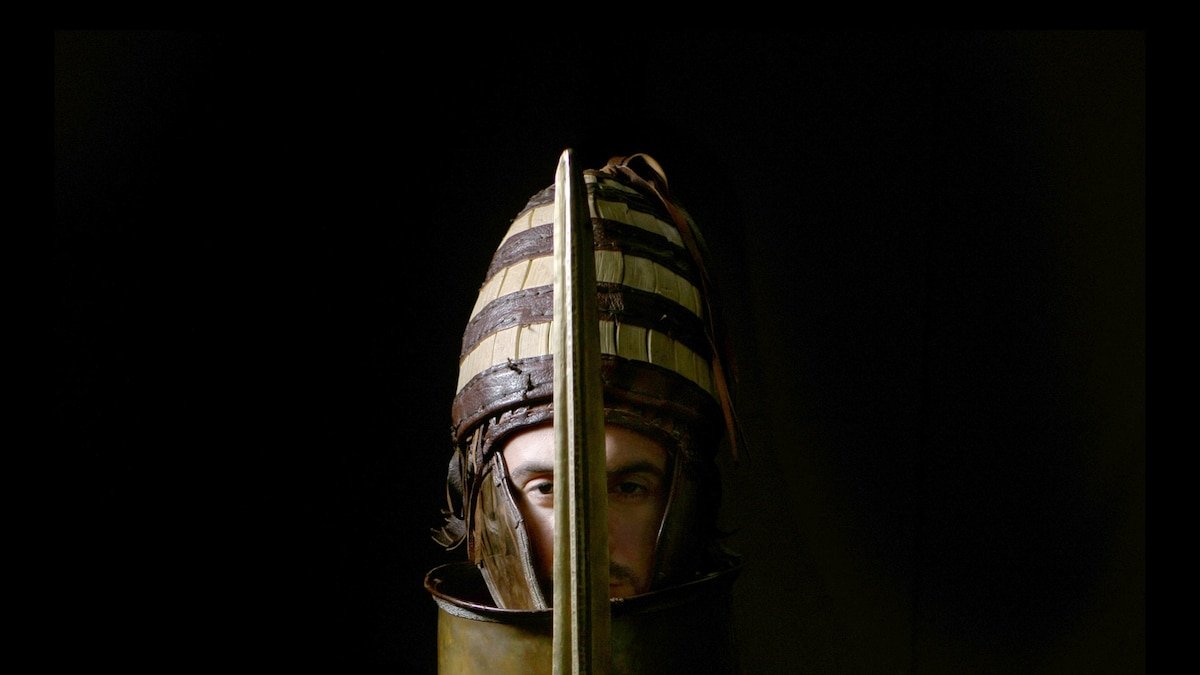
All the marines were equipped with a close replica of the Dendra armor, made of copper alloy and weighing roughly 60 pounds; a replica of the famous boar-tusk helmet; and replicas of Bronze Age spears and swords, which they wielded for the next 11 hours of simulated combat, featuring high-intensity-interval exercises such as sprinting and striking blows, with timed brief breaks for rest or food.
All of the volunteers completed the combat simulation successfully, and only one showed signs of low blood sugar after the “battle”—which indicates the study’s estimate of about 4,400 calories of food per Mycenaean warrior is about right.
Many of the volunteers also reported suffering high levels of fatigue, a sore upper body from the weight to the armor, and foot pain from walking, running, and fighting barefoot.
After the 11-hour combat simulation, a study volunteer reveals armor-related bruises and sensors measuring skin temperature. Photograph By Andreas Flouris
Armor’s advantages
The research shows the Dendra armor gave better protection than the other type of armor typically used in the late Bronze Age, which consisted of small bronze scales on a linen backing, Wardle says —but at the cost of mobility, which was prized in later eras.
Tell-tale features that show the Dendra armor was designed for combat include the triangular plates attached on the inside of the shoulder pieces, which make sense only to protect the armpit when an arm is raised; and the armor’s extensions over the upper arms to provide flexibility and protection during close combat, says study co-author Yiannis Koutedaki, a professor emeritus of applied physiology at the University of Thessaly in Greece.
