


What if a rifle could replace a machine gun, not by firing more bullets, but by making every shot count more?
That question sits at the heart of the M27 IAR story. When the U.S. Marine Corps began searching for a new infantry automatic rifle, many expected another heavier, higher-capacity weapon.
Instead, Marines chose a rifle built around precision, mobility, and reliability. It was a decision that surprised observers across the military world and sparked years of debate.
The M27 Infantry Automatic Rifle (IAR) was developed from the Heckler & Koch HK416 platform and initially entered service as a squad-level support weapon. Unlike traditional belt-fed systems, the M27 uses standard magazines and a short-stroke gas piston operating system.
On paper, that seemed like a step backward to some critics. After all, how could a magazine-fed rifle compete with the sustained firepower of a weapon designed to pour rounds downrange?
The Marine Corps saw things differently.
Combat experience in Iraq and Afghanistan highlighted a growing need for lighter equipment, faster movement, and more accurate fire.
Marines often found that carrying less weight and hitting targets more consistently could be just as valuable as carrying hundreds of extra rounds. The M27 fit that philosophy perfectly.
Today, the M27 IAR has evolved far beyond its original role. What began as a specialized automatic rifle is now widely fielded throughout Marine infantry units and has influenced how modern squads fight. Its rise reflects a larger shift in military thinking, one that values precision over volume and adaptability over tradition.
In this guide, we’ll explore the M27’s history, specifications, combat performance, and why it remains one of the most discussed rifles in modern military service.
What Is the M27 IAR?
Strip away the military acronyms for a moment, and the M27 IAR is surprisingly easy to understand. It’s a lightweight, magazine-fed automatic rifle designed to give infantry squads a weapon that can deliver accurate, sustained fire without the bulk of a traditional machine gun. Simple idea. Big consequences.
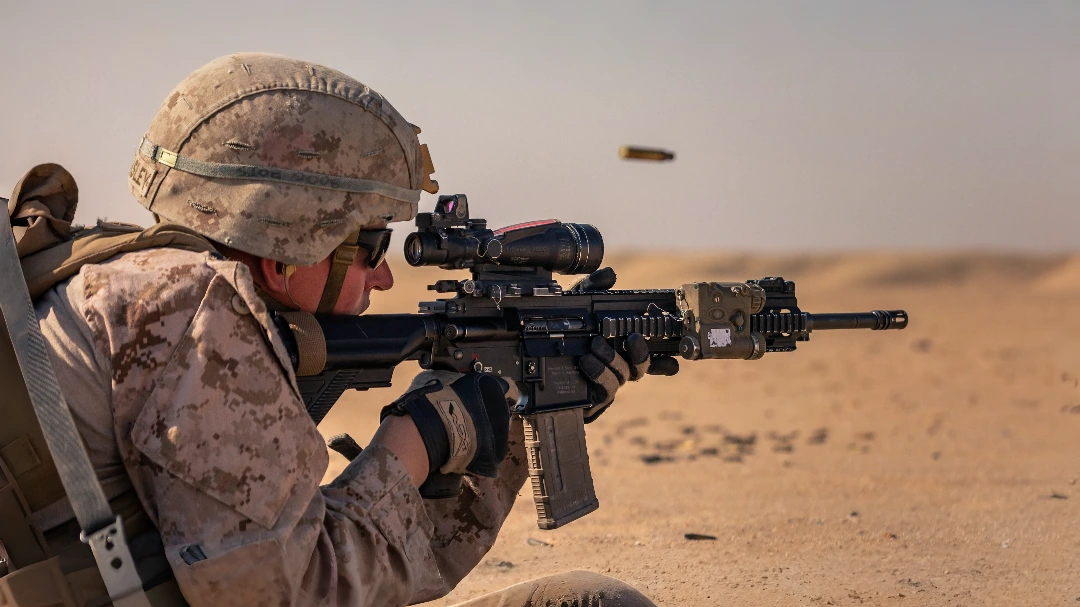
The “IAR” stands for Infantry Automatic Rifle, a concept that dates back decades. Instead of relying on one heavy belt-fed weapon to provide covering fire, an automatic rifleman carries a firearm that’s lighter, quicker to handle, and capable of keeping pace with the rest of the squad.
Think of it less as a portable machine gun and more as a precision workhorse that can still lay down effective suppressive fire.
The M27 is manufactured by Heckler & Koch and is based on the combat-proven HK416 design. It chambers the standard 5.56×45mm NATO cartridge and operates with a short-stroke gas piston system, a mechanism known for running cleaner and more reliably than traditional direct-impingement designs in harsh conditions. That matters when sand, mud, and dust become part of the day’s routine.
Here’s a quick look at the basics:
| Feature | M27 IAR |
| Caliber | 5.56×45mm NATO |
| Operating System | Short-stroke gas piston |
| Feed System | STANAG magazines |
| Barrel Length | 16.5 inches |
| Manufacturer | Heckler & Koch |
| Primary User | U.S. Marine Corps |
One of the biggest misconceptions about the M27 IAR is that it’s simply a replacement for the M249 Squad Automatic Weapon. It isn’t, at least, not entirely.
The Marine Corps envisioned a weapon that could support the squad while also being accurate enough for ordinary rifle tasks. That flexibility turned out to be one of its greatest strengths.
In fact, the M27 proved so capable that Marines gradually expanded its mission.
What started as a specialized weapon for the automatic rifleman eventually found its way into the hands of standard infantry and designated marksmen. That’s a rare career path for any military firearm.
The M27 IAR isn’t trying to be the biggest gun on the battlefield. It’s trying to be the one that can do a little bit of everything, and do it well. As military technology evolves, that kind of versatility has become increasingly valuable.
M27 IAR Specifications
Military rifles often get judged by a list of numbers, weight, barrel length, rate of fire, and effective range.
The M27 IAR certainly has impressive figures, but its real strength lies in how those specifications work together. Rather than chasing maximum firepower, the rifle was engineered to balance accuracy, reliability, and mobility for modern infantry combat.
Built by Heckler & Koch, the M27 is based on the HK416 platform and chambers the standard 5.56×45mm NATO cartridge. Its short-stroke gas piston operating system helps keep carbon buildup away from the bolt, improving reliability during extended firing sessions and reducing maintenance demands in the field.
Here’s a quick look at the M27 IAR’s key specifications:
| Specification | M27 IAR |
| Manufacturer | Heckler & Koch |
| Caliber | 5.56×45mm NATO |
| Operating System | Short-stroke gas piston |
| Action | Rotating bolt |
| Weight (unloaded) | Approx. 7.9 lbs (3.6 kg) |
| Barrel Length | 16.5 inches (420 mm) |
| Overall Length | About 36.9 inches |
| Feed System | 30-round STANAG magazine |
| Fire Modes | Semi-automatic and fully automatic |
| Effective Range | Up to 600 meters |
| Stock | Adjustable and collapsible |
One detail that often gets overlooked is the free-floating barrel. Since the handguard doesn’t place pressure on the barrel, the rifle maintains impressive accuracy, especially during rapid follow-up shots.
Combined with quality optics, many Marines have reported reliable target engagement well beyond the distances typically associated with standard carbines.
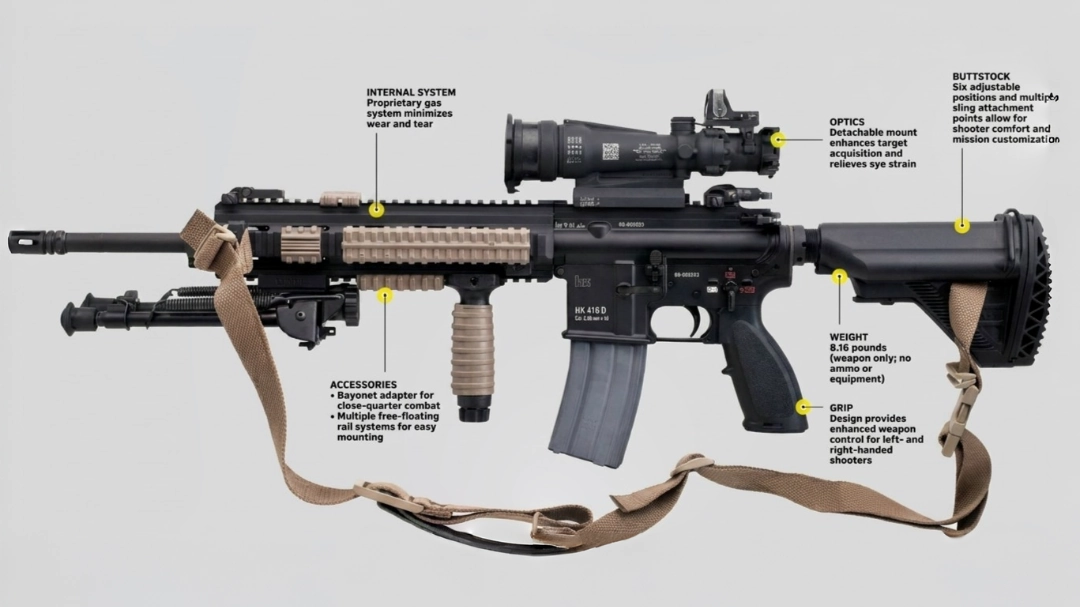
The M27 also features a full-length Picatinny rail system, allowing it to accept a wide range of accessories, including combat optics, laser aiming devices, bipods, foregrips, suppressors, and night-vision equipment. This modularity means the same rifle can be adapted for different missions without major modifications.
On paper, the M27 IAR may look like another 5.56 NATO rifle.
In practice, its carefully chosen specifications create a weapon that’s lightweight enough for long patrols, durable enough for harsh conditions, and accurate enough to support an entire Marine fire team, a combination that explains why its role has steadily expanded across the Corps.
Why the Marine Corps Chose the M27 IAR
The M27 IAR wasn’t adopted because the Marine Corps wanted a newer rifle. It was adopted because Marines believed they could fight smarter with a different kind of weapon. That’s an important distinction.
For decades, the M249 Squad Automatic Weapon was the backbone of a Marine fire team’s suppressive fire capability. It could send a high volume of rounds toward an enemy position, forcing opponents to keep their heads down while the squad maneuvered.
The downside? The M249 was heavy, bulky, and required belt-fed ammunition that added even more weight to a Marine’s load.
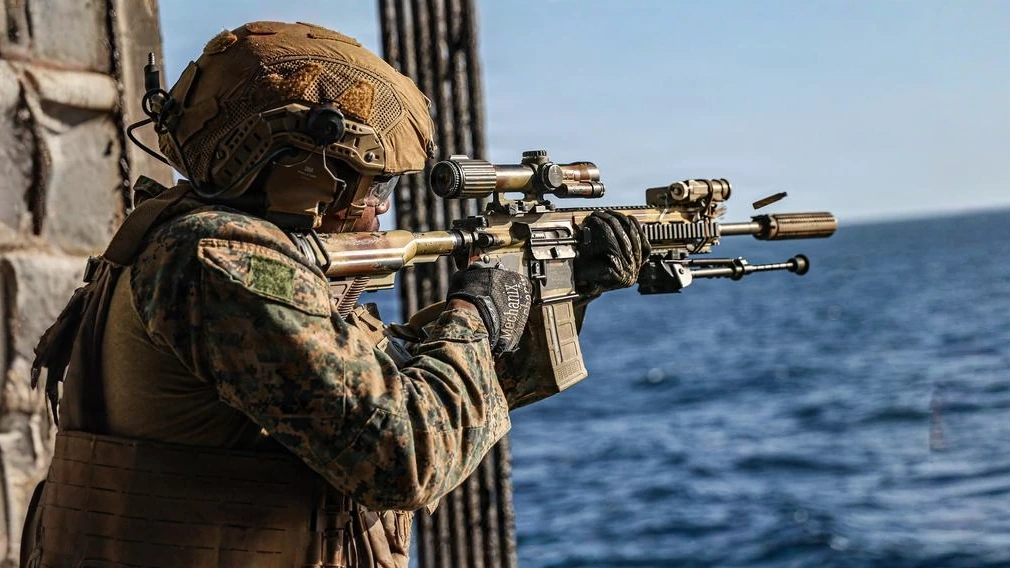
The M27 offered a different solution. Instead of relying on sheer volume of fire, it emphasized accurate, sustained fire.
A lighter weapon meant Marines could move faster, react more quickly, and carry additional ammunition or equipment. At roughly 7.9 pounds unloaded, the M27 weighs less than half as much as a fully equipped M249, making a noticeable difference during long patrols or mountain operations.
Accuracy was another major selling point. The free-floating barrel, quality manufacturing, and short-stroke gas piston system gave Marines confidence that they could engage targets at longer distances with greater precision.
In combat, a few well-placed shots can sometimes achieve the same effect as a much larger burst of fire while conserving ammunition.
Reliability also played a role in the decision. Built on the proven HK416 platform, the M27 demonstrated strong performance during testing and field deployments.
Marines reported that the rifle handled dust, mud, and harsh operating conditions while maintaining dependable function.
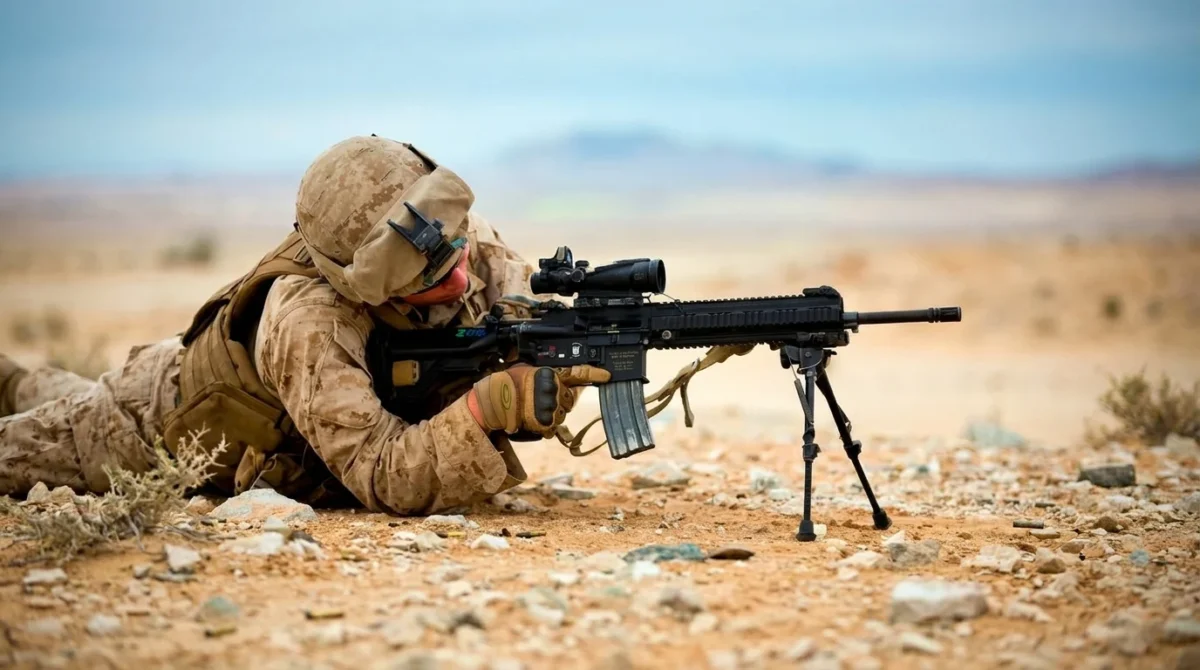
Perhaps the biggest reason for adopting the M27 IAR was a shift in battlefield doctrine. The Marine Corps embraced the idea of “suppression through precision.”
Rather than overwhelming an enemy with hundreds of rounds, accurate and controlled fire could effectively disrupt enemy movement and create opportunities for friendly forces to advance.
That philosophy paid off. What started as a specialized automatic rifle eventually proved versatile enough to equip entire infantry units.
In many ways, the M27 wasn’t just a new firearm; it represented a new way of thinking about how Marines fight, balancing mobility, precision, and firepower for the realities of modern combat.
M27 IAR vs HK416: How Similar Are They?
One of the most common questions about the M27 IAR is also one of the easiest to answer: Isn’t it just an HK416?
Well… yes and no.
The M27 owes its existence to the famous Heckler & Koch HK416, but the two aren’t completely identical. Think of the HK416 as the blueprint and the M27 as a version tailored to meet the unique demands of the U.S. Marine Corps.
The HK416 was developed by German manufacturer Heckler & Koch in the early 2000s as an improvement over the traditional AR-15 and M4 platform. Its standout feature was a short-stroke gas piston system that increased reliability by keeping heat and carbon away from the rifle’s internal components. The design quickly gained attention among military and special operations units around the world.
When the Marine Corps launched its Infantry Automatic Rifle program, Heckler & Koch submitted a variant of the HK416. After rigorous testing, the design won the competition and was officially designated the M27 Infantry Automatic Rifle.
| Feature | M27 IAR | HK416 |
| Manufacturer | Heckler & Koch | Heckler & Koch |
| Base Design | HK416 variant | Original platform |
| Caliber | 5.56×45mm NATO | Multiple variants |
| Barrel Length | 16.5 inches | Various lengths |
| Gas System | Short-stroke piston | Short-stroke piston |
| Primary User | U.S. Marine Corps | Military and law enforcement worldwide |
The biggest differences come from military customization.
The M27 features a heavy free-floating barrel optimized for accuracy and sustained fire, along with specific rail systems, furniture, and accessory configurations requested by the Marine Corps. It’s also paired with optics and equipment selected to fit Marine infantry doctrine.
Mechanically, however, the rifles share the same DNA. Both use the reliable piston-driven operating system and rotating bolt that made the HK416 famous for dependable performance under tough conditions.
Perhaps the more interesting comparison isn’t technical but historical. The HK416 was designed as a highly capable combat rifle.
The M27 IAR took that proven foundation and evolved it into something broader, a weapon that could serve as an automatic rifle, a standard infantry rifle, and even the basis for a designated marksman platform.
In that sense, the M27 isn’t merely an HK416 with a new name. It’s a specialized evolution of one of the most successful military rifle designs of the 21st century.
Advantages and Disadvantages of the M27 IAR
No military rifle is perfect. Every design is a series of compromises, balancing firepower, weight, reliability, and practicality.
The M27 IAR is no exception. Its growing popularity within the U.S. Marine Corps highlights its strengths, but understanding its limitations gives a more complete picture of why it remains such a debated weapon.
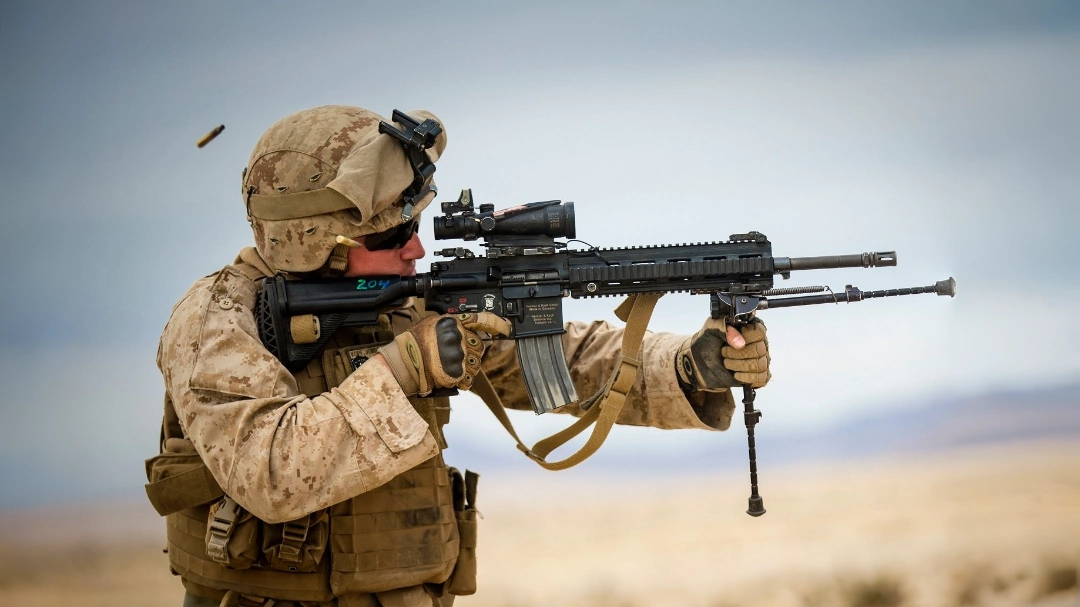
Advantages of the M27 IAR
The first advantage is accuracy. Thanks to its free-floating barrel and high-quality manufacturing, the M27 consistently delivers precise shots at extended ranges. For Marines, this translates into greater confidence during combat and more effective target engagement.
Another major benefit is mobility. At around 7.9 pounds unloaded, the M27 is significantly lighter than the M249 SAW. Less weight means Marines can move faster, react quicker, and carry additional ammunition or essential gear.
The rifle’s short-stroke gas piston system also contributes to its reputation for reliability. By keeping heat and carbon away from the bolt assembly, the M27 performs well in dusty, muddy, and demanding environments while requiring less intensive cleaning.
Versatility deserves a mention, too. The same platform can function as an infantry rifle, automatic rifle, or designated marksman weapon with the right optics and accessories.
Disadvantages of the M27 IAR
The biggest criticism of the M27 IAR is its magazine-fed design. Standard 30-round magazines cannot match the sustained fire capability of a belt-fed machine gun like the M249, requiring more frequent reloads during prolonged engagements.
Barrel heat can also become a concern under heavy automatic fire. While the rifle is designed for durability, it wasn’t intended to replicate the continuous firing role of a dedicated machine gun.
Another drawback is cost. The M27 and its associated optics and accessories represent a greater investment than many standard service rifles, both in procurement and maintenance.
| Pros | Cons |
| Excellent accuracy | Limited magazine capacity |
| Lightweight and mobile | Less sustained fire than belt-fed systems |
| Reliable piston operation | Barrel heats during prolonged firing |
| Highly modular | Higher acquisition cost |
| Multiple battlefield roles | Not a direct replacement for every machine gun task |
The M27 IAR’s strengths and weaknesses reveal an important truth: it wasn’t designed to be everything for everyone.
Instead, it was built to prioritize precision, mobility, and adaptability over sheer volume of fire. For the Marine Corps’ evolving combat doctrine, that trade-off has proven worthwhile, even if the debate over magazine-fed versus belt-fed firepower is far from settled.
