

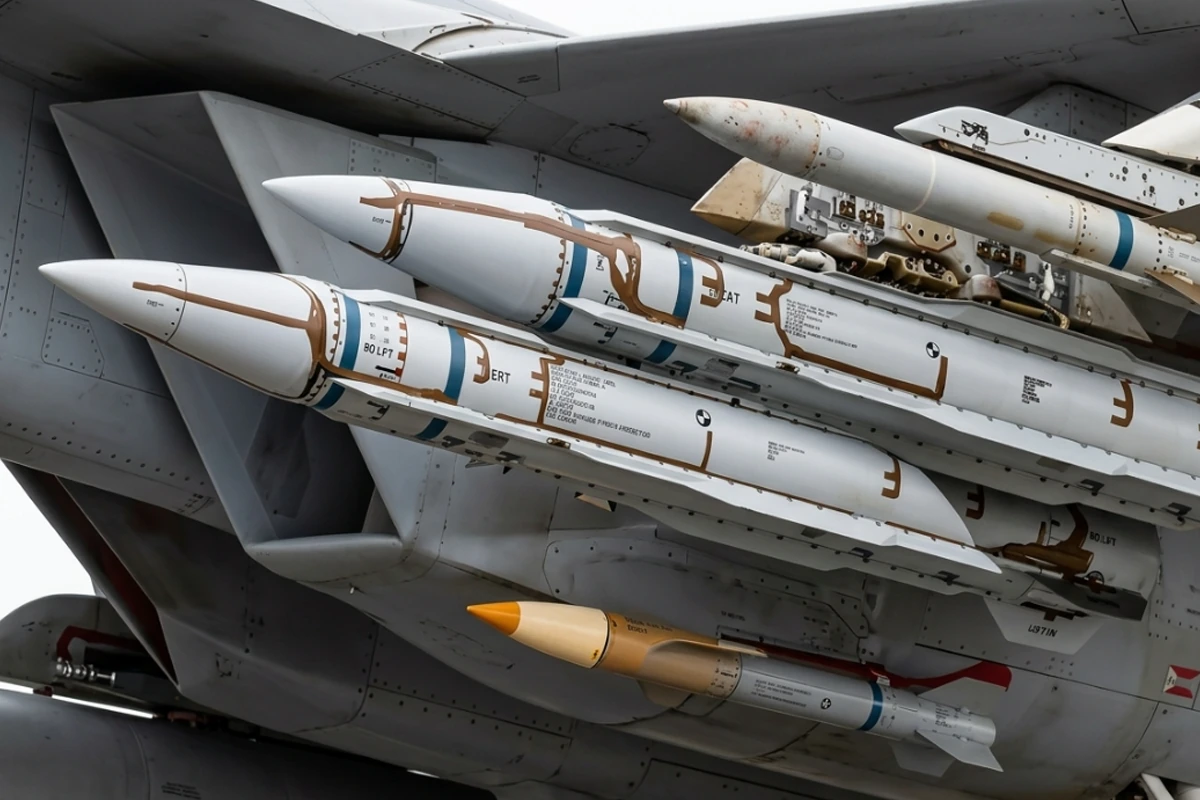
The U.S. Navy has just revealed a missile that could push the air battle hundreds of miles farther from the carrier.
The AIM-424 Malice, officially designated the Long Range Air-to-Air Missile (LRAAM), is being developed as a next-generation weapon for Navy and Marine Corps aviation. The Navy lists its range as more than 250 nautical miles, or about 463 kilometers, a figure that puts it firmly in the long-range air-to-air category.
But the range is only the beginning.
The AIM-424 Malice missile weighs around 1,500 pounds and measures 13.5 feet long. More importantly, the Navy says it is being designed for fourth-, fifth- and sixth-generation aircraft, suggesting that this is not simply another replacement missile for today’s fighters. It is intended to remain relevant as carrier aviation evolves.
Publicly released imagery makes the concept even more interesting. The missile has been shown on an F/A-18E/F Super Hornet, while imagery has also shown AIM-424 Malice associated with the F-35C Lightning II. USNI News reported that the Super Hornet imagery showed four missiles, while two could be accommodated in the F-35C’s internal weapons bay.
That combination changes the conversation.
A long-range missile on a fighter is useful. A long-range missile carried internally by a stealth fighter is potentially something else entirely.
The key question, then, isn’t simply “Can AIM-424 Malice reach 250 nautical miles?”
It’s what happens when a carrier air wing can potentially detect and engage threats at distances where the carrier itself is much harder to reach.
And that could reshape how future naval air combat is fought.
What Is the AIM-424 Malice Missile?
The AIM-424 Malice is a U.S. Navy long-range air-to-air missile being developed to give naval fighters a much larger engagement envelope. Officially designated AIM-424 LRAAM, the weapon is intended to provide greater range, lethality and survivability against increasingly capable airborne threats.
The Navy’s fact sheet lists Raytheon as the contractor and describes the AIM-424 Malice as a weapon for fourth-, fifth- and sixth-generation aircraft. That is an important clue about its intended lifespan. Rather than being designed around one fighter, the missile is being positioned as part of a broader transition in naval aviation.
The weapon is also notably large for an air-to-air missile. At around 13.5 feet long and 1,500 pounds, AIM-424 Malice is closer in physical scale to a very-large air-to-air weapon than to the compact missiles traditionally carried by fighter aircraft.
Its intended targets have not been publicly defined in exhaustive detail, but the basic mission is clear: provide naval and Marine aviation with a long-range air-to-air engagement capability.
That could become increasingly important as carrier strike groups face aircraft equipped with their own long-range weapons and increasingly capable sensors. A fighter that must approach close to an opponent to launch its missile can expose itself to more threats. A weapon with substantially greater reach offers another option.
There is still plenty the public doesn’t know.
The Navy has disclosed basic dimensions, weight, propulsion, warhead and range, but important details such as the complete seeker architecture, guidance algorithms, maximum speed and precise engagement envelope remain undisclosed.
So it is best to view AIM-424 Malice as a developing capability rather than a finished operational weapon.
Its significance lies in the direction it points: longer-range air combat, tighter integration with modern fighters and a carrier air wing designed to fight farther from the ship.
Read also: AGM-158 JASSM Missile: America’s Precision Strike Weapon
AIM-424 Malice Specifications and 250-NM Range
The numbers surrounding the AIM-424 Malice immediately explain why the missile has attracted attention. It is a large weapon by air-to-air standards, designed around a range requirement that could significantly extend the distance at which U.S. naval fighters can threaten airborne targets.
| Specification | AIM-424 Malice |
| Type | Long-range air-to-air missile |
| Designation | AIM-424 LRAAM |
| Contractor | Raytheon |
| Length | 13.5 ft (4.11 m) |
| Diameter | 13.5 in (0.34 m) |
| Wingspan | 26.2 in (0.67 m) |
| Weight | 1,500 lb (680.4 kg) |
| Propulsion | Solid-propellant rocket motor |
| Published range | More than 250 nmi (463 km) |
| Warhead | Blast fragmentation |
These figures come from the U.S. Navy’s current fact sheet for the weapon.
The 1,500-pound weight is particularly notable. An AIM-424 Malice is substantially larger than the air-to-air missiles normally associated with fighter aircraft, reflecting the amount of propulsion and warhead capacity required for a weapon intended to engage targets at extreme distances.
But there’s an important catch with the headline 250-nautical-mile range.
It should not be interpreted as a guaranteed 250-mile combat kill zone. Missile range varies according to factors such as launch altitude, aircraft speed, target movement and the amount of energy the missile retains during the terminal phase.

Think of the published figure as the outer edge of the weapon’s potential reach, not a circle on a map where every target is automatically vulnerable.
That distinction becomes particularly important for long-range air combat.
At hundreds of miles, finding and maintaining a sufficiently accurate target track can be harder than simply getting the missile there. The AIM-424 Malice missile therefore has to be considered as part of a larger sensor and communications network rather than as a standalone projectile.
And that is perhaps the most interesting thing about its specifications.
The 250-nautical-mile figure gets attention, but the real military value of Malice will depend on how effectively the Navy can turn that theoretical reach into a usable engagement opportunity.
Why 250 Nautical Miles Changes Carrier Air Combat
A missile that can reach beyond 250 nautical miles (463 km) changes more than the distance at which a fighter can launch an attack. For the U.S. Navy, the bigger issue is the space between an aircraft carrier and the threats trying to reach it.
Traditional carrier air defense depends on layers of fighters, surface-to-air missiles and sensors. A very-long-range air-to-air missile adds another layer by allowing carrier-based fighters to challenge hostile aircraft much farther from the ship.
That could be especially valuable against aircraft that don’t need to attack the carrier directly.
Think about the support aircraft behind an enemy strike package. Tankers keep fighters airborne. ISR aircraft build the targeting picture. Airborne command-and-control platforms help coordinate the attack. Bombers and strike aircraft may launch weapons from significant distances.
A missile such as AIM-424 Malice missile potentially gives the carrier air wing the ability to threaten parts of that network before they get close enough to endanger the carrier.

The Navy itself describes the AIM-424 Malice as intended to support a “first look, first shot, first kill” advantage through increased reach and survivability.
But range doesn’t magically create that advantage.
At 250 nautical miles, the launching fighter needs a reliable picture of what is happening far beyond its own immediate sensor horizon. The target could maneuver, change altitude, employ electronic warfare or simply disappear from the track.
This is why the AIM-424 Malice should be viewed as part of a networked engagement system rather than a standalone weapon.
Sensors, datalinks, airborne early-warning aircraft and other fighters could all contribute to the targeting picture.
The strategic effect, then, isn’t simply that an American fighter can shoot farther.
It’s that the potential engagement zone around a carrier becomes much larger, forcing an opponent to consider threats from farther away and potentially complicating an entire air operation before it ever reaches the carrier strike group.
How the F-35C Turns the AIM-424 Malice Into a Bigger Threat
The most interesting part of the AIM-424 Malice may not be its 250-nautical-mile range. It is the possibility of combining that reach with the F-35C’s low-observable design and internal weapons carriage.
The Navy has shown the AIM-424 Malice Missile associated with the F-35C, with the missile sized to fit inside the fighter’s internal weapons bay. That matters because carrying weapons externally can increase an aircraft’s radar signature and reduce some of the advantages that stealth provides.
The basic concept is straightforward: detect the opponent while remaining difficult to detect, then launch a long-range weapon without immediately exposing the fighter through a large external missile load.
That combination could be particularly valuable in a contested maritime environment.
The F-35C is already designed around sensor fusion, allowing information from its onboard sensors and external sources to be combined into a broader tactical picture. Pairing that sensing capability with a missile intended to engage targets at extreme distances could extend the fighter’s role from simply launching weapons to becoming part of a much larger networked engagement.
There is an important caveat, though.

The missile’s maximum published range doesn’t mean an F-35C can routinely detect and destroy an aircraft 250 nautical miles away. Target identification, track quality, electronic warfare and guidance throughout the engagement all remain critical.
Still, internal carriage gives the concept an interesting advantage.
An F-35C carrying AIM-424 Malice Missile internally could potentially approach the engagement area with a smaller radar signature than a fighter loaded with large external missiles. That creates a useful combination of stealth, sensing and long-range weapons.
In other words, the AIM-424 Malice could make the F-35C more than a stealthy strike and reconnaissance platform.
It could turn the aircraft into a long-range air-combat node, capable of helping shape the battlespace well before hostile aircraft reach the carrier’s immediate defensive perimeter.
Four AIM-424 Malice Missiles Give the Super Hornet a New Reach
The AIM-424 Malice becomes a different proposition when it moves from the F-35C’s internal weapons bay to the F/A-18E/F Super Hornet’s external stations. Instead of emphasizing stealth and internal carriage, the Super Hornet approach puts more emphasis on missile volume and flexibility.
Publicly released imagery has shown a Super Hornet carrying four AIM-424 Malice missiles, giving the carrier fighter a substantial long-range air-to-air load.
That creates an interesting division of labor within the carrier air wing.
| Aircraft | Malice carriage concept | Main advantage |
| F-35C | Internal carriage | Stealth and long-range sensing |
| F/A-18E/F | Four external missiles | Missile volume and flexibility |

The Super Hornet doesn’t offer the same low-observable characteristics as the F-35C, but it remains the Navy’s mature carrier fighter and can carry a substantial external weapons load.
With four AIM-424 Malice missiles, a formation of Super Hornets could potentially bring a considerable amount of long-range air-to-air firepower into an engagement. That matters in scenarios where the carrier air wing needs to deal with multiple airborne threats rather than a single target.
The important point, however, is not to treat the two aircraft as competitors.
They could complement each other.
An F-35C could operate farther forward as a lower-observable sensor and targeting platform, helping build the tactical picture. Super Hornets could then contribute additional missile capacity. The exact operational concept remains dependent on testing, tactics and classified capabilities, but the basic idea fits the broader move toward networked naval aviation.
And the AIM-424 Malice’s size makes this especially interesting. A weapon weighing around 1,500 pounds is a substantial payload for a fighter, so carrying four represents a meaningful commitment of aircraft weight and external stations.
The result is a carrier air wing with two very different ways to exploit the same missile.
The F-35C brings stealth; the Super Hornet brings numbers. The AIM-424 Malice potentially gives both aircraft the reach to contest the airspace much farther from the carrier.
The Real Challenge Is Turning 250 NM Into a Kill
The headline range of the AIM-424 Malice is impressive, but distance alone doesn’t win an air battle. The difficult part is building a reliable kill chain that allows a fighter to find, identify, track and engage a target hundreds of miles away.
At extreme range, the launching aircraft may not have enough information to maintain the entire engagement using its own sensors. That makes the missile part of a much larger network involving fighters, airborne early-warning aircraft, ships, satellites and other sensors.
The basic chain looks something like this:
Detect → Identify → Track → Target → Launch → Guide → Intercept
Every step matters.
A fighter might detect an aircraft at long range, but detection doesn’t necessarily provide enough information to launch a weapon. The target must be identified and tracked with sufficient accuracy, while the missile may require guidance updates during its flight. Meanwhile, the target can maneuver, change altitude or use electronic warfare to complicate the engagement.
This is why the 250-nautical-mile figure should not be treated as a 250-mile guaranteed kill zone.

The Navy has publicly disclosed AIM-424 Malice’s range, dimensions, propulsion and warhead, but important details about its seeker, guidance architecture, datalink and precise engagement envelope remain undisclosed.
That uncertainty is significant.
A long-range missile can potentially give a carrier air wing a much larger engagement zone, but only if the surrounding sensor network can provide the information needed to exploit it.
This also explains why the F-35C integration is so interesting. Its value may not simply be carrying Malice; the aircraft could contribute sensing and targeting information to a wider network.
So the real breakthrough may not be a missile that flies 250 nautical miles.
It may be the ability to connect that missile to a sensor network capable of making those 250 miles operationally useful.
What Malice Means for Future F/A-XX Carrier Aviation
The AIM-424 Malice appears to be designed with the next generation of naval aviation in mind, not just today’s fighters. The U.S. Navy identifies the missile as being intended for fourth-, fifth- and sixth-generation aircraft, placing it alongside the future F/A-XX program.
That matters because F/A-XX is expected to operate in an environment where carrier aircraft may have to fight at much greater distances than previous generations.
Future naval aviation is increasingly moving toward a combination of stealth, longer-range weapons, distributed sensors and manned-unmanned teaming. In that environment, the fighter doesn’t necessarily need to fly directly toward an opponent to contribute to an engagement.
Instead, it could become one node in a larger combat network.

The AIM-424 Malice fits that direction surprisingly well. Its long-range design could allow a future F/A-XX aircraft to engage targets from considerable distance, while the aircraft itself potentially receives targeting information from other platforms.
That could include another fighter, an airborne early-warning aircraft, a surface ship or an unmanned system.
The result is a different concept of carrier airpower.
Instead of thinking about the carrier air wing as a collection of individual fighters, imagine it as a distributed web of sensors and weapons. One aircraft finds the target. Another provides additional tracking information. A third launches the missile. The weapon then completes the engagement.
The exact F/A-XX configuration and the AIM-424 Malice integration remain subjects of ongoing development, and the Navy has not publicly disclosed every detail.
But the direction is clear.
A missile designed for multiple generations of aircraft gives the Navy an opportunity to carry the long-range air-combat concept forward as its carrier aviation fleet changes.
And that could prove more important than the missile’s headline range.
If the AIM-424 Malice eventually becomes a core weapon for F/A-XX, its greatest contribution may be helping turn the future carrier air wing into a longer-reaching, more distributed fighting force rather than simply giving one fighter a bigger missile.
