

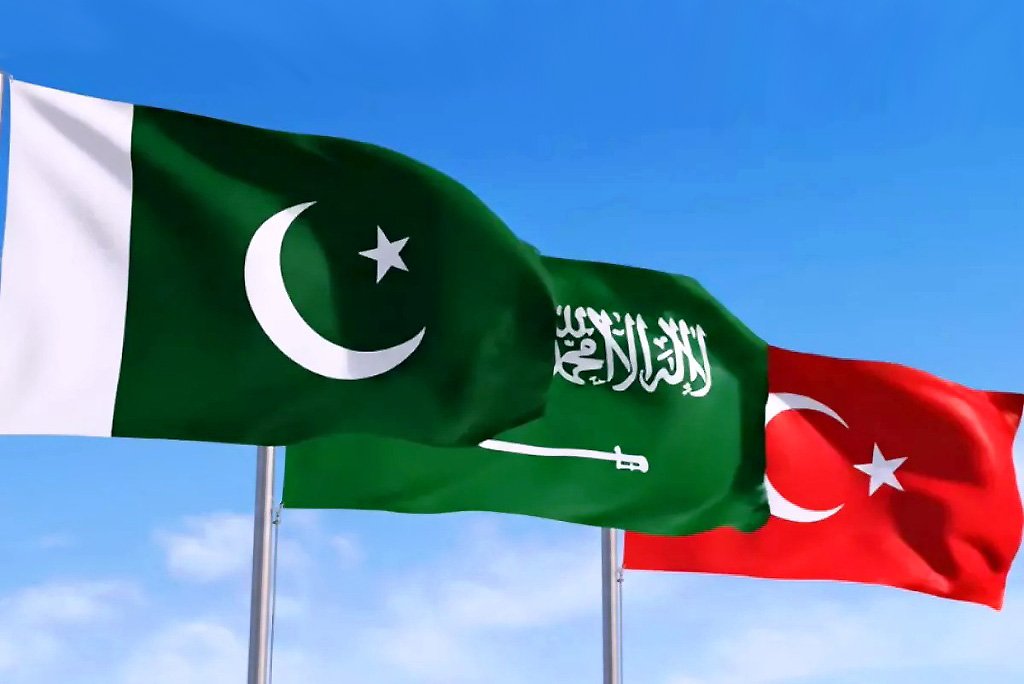
The signing of the trilateral pact between Saudi Arabia, Turkey, and Pakistan on 7August 2026, has sparked interests, leading to suggest that a new “Atlantic Alliance” is taking shape in a geopolitical arena of primary importance for the balance of power not only regionally but globally
This new pact joins a long series of treaties and alliances which marked the region, starting from the Arab League, all falling short of initial expectations and promises, or miserably failed or forgotten.
The Joint Defence Agreement and foremost appears to combine the hegemonic ambitions and strategic anxieties and concerns of its signatories, while simultaneously risks the ignition of further frictions.
This agreement expands the Strategic Mutual Defence Agreement signed between Pakistan and Saudi Arabia on 17 September 2025 (which stabilize the entente of the ‘70s and consolidated since the second Gulf War in 1991) to include Turkey.
The idea is to put together political, economic, militarily and ethical (religious) elements that would be an element of stability in a region in disarray. In theory all the signatories, together, have remarkable military power (one with nuclear capability, like Pakistan, or semi strategic, like the IRBM Chinese-built missiles, without nuclear warhead of Saudi Arabia and now with the possible adoption by Ankara forces of the Yildirimhan, the first intercontinental ballistic missile developed by Turkey), important demographic weight, relevant economic influence (energy, industry, agriculture). The Agreement aims to unify these capabilities, representing a deterrent for Iran, Israel and India, according to the security priorities of each of the signatories and reassure them in the face of diverse, multifaceted, and interconnected security threats.
Saudi Arabia
The wars with Iran, uncertainty over the future of US security commitments, and the emergence of new regional security landscapes urged Saudi Arabia to rethink how to protect its interests and advance its geopolitical and economic ambitions. The agreement demonstrates the attempt to pursuit a new security (defence and foreign) policy, looking into balancing relations with regional powers while seeking to position itself as a central architect of the Middle East’s emerging political and security order. The future of the US-Saudi partnership is central in this recalibration, as well the questions raised about the depth and direction of this bilateral relationship and Riyadh’s long-term strategic choices, like the controversial adhesion to the Abraham Accords (and consequently normalize the relation with Israel) and/or what to do with the Beijing-brokered normalization agreement with Iran, signed on 10 March 2023, and now buried under a rain of missiles and drones launched by the Pasdaran.
The war against Iran, initially by US and Israel, and lately by US alone, deeply changed Saudi perceptions about deterrence, regional security, as well the limits of its diplomacy and armed forces. This is proved by the fact that Riyadh did not establish a serious control over the restive Houti’s Yemen (operation ongoing since 2015). This paradox is furtherly witnessed by the desperate call to the US support, till now rejected by Washington, in order to block the Houti forces offensive in the Mokkah region and threatening the Bab-el-Mandeb area maritime traffic, adding another choke point crisis in the collapsing world straits network.
The new pact shows that Saudi Arabia looks into moving toward a more autonomous regional security policy, in which Riyadh seeks to shape the security architecture rather than rely exclusively on US support.
The true leader
The Mecca Agreement appears to cement Ankara’s role as a connecting link within global security architectures, and thus as an indispensable pivot of the post-American order and strengthens its strategic link with NATO (or with what remains of it, given the reduction of the American marking within it). In the debate surrounding the pact, Turkey seems to hold a strategic advantage over the other two signatories, even though its vulnerabilities and unresolved issues remain, especially in the domestic dimension. Erdoğan is exploiting the American disengagement and Saudi vulnerability to forge a new regional balance that transcends the Israel-Iran conflict and the Teheran regional challenge and add another element to the multi-alignment policy followed by Ankara since the mid-60s, starting with the confrontation with Greece about Cyprus. The Agreement is only the most recent example of it, and highly probably other will follow, confirming the orientation of the present country’s leadership.
The tie between Middle East and South-Central Asia
Pakistan, the third member of the Agreement, faces since its independence (1947) severe internal and regional security challenges, driven by a sharp surge in militant violence, active separatist insurgencies, and strained border relations with Iran and Afghanistan and a constant condition of major crisis with India. These multi-front pressures intersect with chronic economic vulnerability and political instability, heavily test state capacity. For the Agreement, like within the Atlantic Alliance, the problem is the threat perception of each signatory. For Islamabad, joining the agreement answer the need to the two threats which the country face, the first is India; the recent, short, but brutal war of the last week of May 2025 proved the overwhelming capacity of New Delhi armed forces. A pact which involves Saudi Arabia, one of the key components of the IMEC (India–Middle East–Europe Economic Corridor) is perceived by Islamabad as a security insurance in order to moderate the threat from India. The other element of the adhesion from Pakistan, is the still open issue of Baluchistan, divided between Islamabad and Teheran and the armed independence movements operating there are frequently used proxy war.
The architecture
The Agreement—the full text of which has not been made public yet requires the state under attack to request assistance to other partners and specify its nature (such as intelligence, logistics, ammunition, or weapons systems), while the deployment of military units is subject to separate decision-making procedures. Furthermore, the scope and intensity of any intervention are determined by the institutions established under the pact: the political-military committee comprising the foreign and defence ministers and the chiefs of staff of the three countries and the permanent secretariat, that will be located in Riyadh (the first secretary-general will be designated from Pakistan for an initial three-year term and tasked to oversee the implementation of decisions made by the alliance’s Strategic Political and Defence Committee). Differently NATO, there are not yet planned integrated operational commands and pre-designated forces to operate together within the pact.
The Egypt incognita
At least according to statements (and wishes?) by President Erdoğan, Ankara would like Egypt to join the pact as well. The objective is multifaceted: to extend the sphere of influence into Africa and along the southern Mediterranean coast, and to further enhance military capabilities of the pact. However, the prospect of Egypt’s accession also threatens to undermine the pact’s strategic stability. Cairo has had a difficult relationship with Türkiye in recent years Ankara suspended diplomatic ties between 2013 and 2021 in protest against the ousting of President Morsi and the subsequent crackdown on the Muslim Brotherhood, a movement close to President Erdoğan’s party and the strategic alignment among Israel, Greece, Egypt, and Cyprus regarding the management of Eastern Mediterranean hydrocarbons resources is seen by Ankara as an existential threat to its economic security. Furthermore, the Libyan issue where Cairo backs Haftar’s government while Ankara is a key partner of the albeit shaky internationally acknowledged government of Tripoli risks becoming a source of division.
Conclusions
The potential strategic consequences of the agreement emerge clearly from US expectations, uncertainties, and weaknesses. The Agreement reflects the brutal reality outlined by the Trump Doctrine. The Turkish-Saudi-Pakistani agreement holds no intrinsic anti-American nor pro-American significance; instead, it reflects the current, and plausibly future, “a-American” world. Following the war in Iran, the Saudis that they lost whatever residual confidence they had in US security guarantees a confidence that the ongoing crisis in Yemen is now completely eroding thereby paving the way for the military agreement with Turkey and Pakistan, despite its evident shortcomings.
The credibility of an alliance, pact, or agreement is a fundamental element of any architecture. The survival, consolidation, and potential expansion of the Mecca Agreement will depend on how the contradictory approaches among the signatories which existed well before the negotiations leading to its signing will be addressed. Collective-defence pacts are focused to reduce the risk of war. Paradoxically, pacts not well conceived and designed may led to increase these risks. Despite a generous dose of words by the signatory parts, the Agreement as of now lack real military integration, clear, efficient and defined decision-making mechanisms, and escalation controls schemes. All of it may invite adversaries to test the boundaries of these promises. The agreement’s ability to adversaries and, most importantly, developing a credible deterrence or to manage escalation once deterrence fails remains weak. Giving the unclear convergent objectives, limited only to face the Iranian threat, the Mecca Agreement a mere, weak, military pact and not a credible security architecture.
