

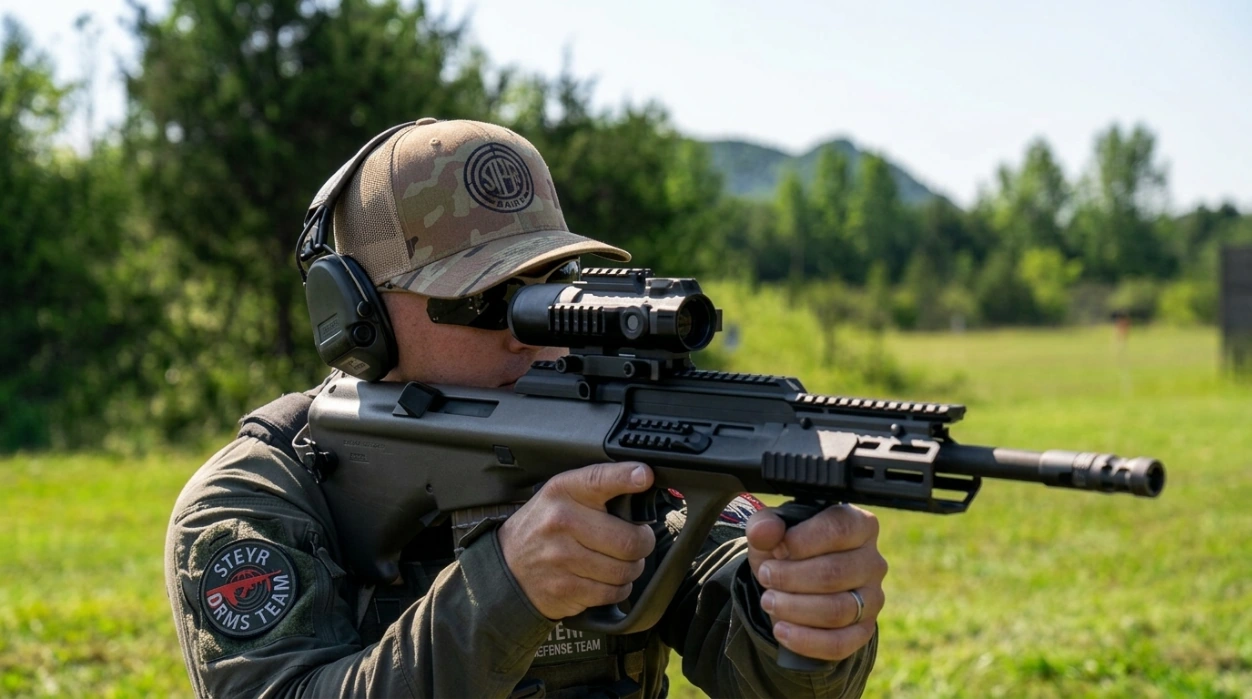
A rifle introduced in the 1970s still looks like it came from a science-fiction movie. That is part of what makes the Steyr AUG so distinctive. Its green polymer body, bullpup layout and integrated optic looked radically different when most military rifles followed far more conventional designs.
But the AUG was more than an unusual-looking rifle.
Austria adopted it as the StG 77 in 1977, replacing the 7.62×51mm StG 58 and moving to the 5.56×45mm NATO cartridge. Steyr combined the new caliber with a compact bullpup configuration, polymer construction, integrated optics and an interchangeable barrel system.
More than four decades later, the Steyr AUG remains in military and law-enforcement service and continues to evolve. So what made this unconventional Austrian rifle durable while many newer designs disappeared?
The answer starts with what the AUG actually is and why Steyr designed it so differently.
What Is the Steyr AUG?
The Steyr AUG is an Austrian-designed family of 5.56×45mm NATO rifles best known for its bullpup configuration, where the magazine and action sit behind the trigger. That arrangement allows Steyr to fit a relatively long barrel into a shorter overall rifle, giving the AUG a compact profile without simply shortening the barrel.
Developed by Steyr-Daimler-Puch, the rifle was designed as a modular military weapon rather than a conventional rifle with a few accessories added later. Its architecture combines a short-stroke gas-piston operating system, a rotating bolt and interchangeable barrels. Steyr’s current AUG A3 family continues to use this basic concept while adding modern accessory interfaces and updated sighting options.
The rifle’s original design also placed unusual emphasis on materials and ergonomics. Its polymer receiver housing helped reduce weight and gave the AUG its unmistakable appearance, while early versions incorporated an integrated optical sight directly into the carrying handle. At a time when military rifles were still largely associated with conventional metal construction and iron sights, that was a bold choice.
Another defining feature is the AUG’s modularity. Barrels can be changed to create different configurations, while the platform has also been adapted into compact, heavy-barrel and 9mm versions over its service life.
That means there isn’t really one “Steyr AUG specification.” The rifle has evolved through several generations and national derivatives, but the basic idea remains recognizable: a compact bullpup rifle designed around modularity rather than a traditional rifle layout.
And that unusual architecture makes more sense when you look at the problem Austria was trying to solve in the 1970s.
Read more: Top 5 Best Assault Rifles and What Makes Them Stand Out
History and Development of the Steyr AUG
The Steyr AUG’s history begins in the late 1960s, when Austria was looking for a new generation of infantry weapons. At the time, the Austrian Armed Forces relied on the StG 58, a 7.62×51mm NATO rifle based on the FN FAL design. The military environment was changing, however, and lighter 5.56mm rifles were beginning to attract attention.
Steyr responded with something considerably more ambitious than a lighter conventional rifle. Development of the AUG began in the late 1960s, with engineers working on a compact bullpup architecture that could combine a relatively long barrel with a shorter overall weapon.
The result was not simply a new rifle chambered for a smaller cartridge. Steyr brought several ideas together: a polymer housing, integrated optical sight, quick-change barrel system and a compact bullpup layout. In isolation, none of these concepts was entirely unprecedented. The interesting part was putting them together into a rifle intended for widespread military service.
In 1977, the Austrian Federal Army selected the AUG A1 as its new standard assault rifle. It entered Austrian service as the StG 77, short for Sturmgewehr 77.
That decision effectively turned the AUG from an experimental-looking design into a genuine military platform.
The timing was important, too. Austria was not merely adopting a new rifle; it was moving from a full-power 7.62mm battle rifle toward the lighter 5.56×45mm NATO class while embracing a completely different layout.
That combination explains why the AUG became so distinctive. Its real innovation was not one futuristic feature, but the decision to make compactness, modularity and modern materials part of the rifle’s basic architecture from the beginning.
What Makes the Steyr AUG’s Bullpup Design Different?
The most recognizable feature of the Steyr AUG is its bullpup layout, with the magazine and action positioned behind the trigger. This allows Steyr to use a relatively long barrel while keeping the rifle compact.
For example, the current AUG A3 with a 16.4-inch barrel is about 725 mm long, while the 20-inch configuration measures approximately 790 mm. That compactness can be particularly useful for troops operating in vehicles or confined environments.
The rearward placement of the action also shifts more of the rifle’s weight closer to the shooter. This can make the AUG feel more compact and easier to maneuver than a conventional rifle with a similar barrel length.

But the design comes with trade-offs. The rear-mounted magazine can feel unfamiliar to users trained on conventional rifles, while the trigger requires a mechanical linkage between the trigger and firing mechanism. The ejection configuration is another consideration for left-handed shooters.
That balance is what makes the AUG interesting. Its bullpup design wasn’t simply about making the rifle look futuristic. It was a deliberate trade-off: sacrificing some conventional ergonomics to achieve a shorter overall weapon without dramatically shortening the barrel.
More than four decades later, that same engineering choice remains central to the AUG’s identity.
Steyr AUG Specifications That Make This Rifle Still Dominate
The Steyr AUG has evolved through several generations, so specifications can vary depending on the model and barrel configuration. The current AUG A3 provides a useful baseline for understanding the platform.
| Specification | Steyr AUG A3 |
| Origin | Austria |
| Caliber | 5.56×45mm NATO |
| Operating system | Short-stroke gas piston |
| Bolt | Rotary bolt, seven locking lugs |
| Barrel options | 15, 16.4 and 20 inches |
| Magazine capacity | 9, 30 or 42 rounds |
| Weight | Approx. 3.2–3.6 kg |
| Overall length | Approx. 690–790 mm |
| Rate of fire | Approx. 680–750 rounds/min |
Steyr’s current specifications list interchangeable 15-, 16.4- and 20-inch barrels, allowing the same basic platform to be configured for different requirements. Weight and overall length naturally change with the selected barrel.
The AUG’s 5.56×45mm NATO chambering also reflects the direction of Western infantry weapons since the 1970s. Austria moved away from the heavier 7.62×51mm StG 58 and adopted a lighter intermediate-caliber service rifle with the StG 77.

One important point when comparing AUG specifications is that not every AUG is identical. National derivatives can have different configurations, equipment, and performance figures. Australia’s F88 Austeyr, for example, is based on the AUG but has its own specifications and service modifications. The Australian Army lists the F88 at 790 mm long and 4.8 kg loaded, with a 508 mm barrel.
So, rather than treating the AUG as one fixed specification sheet, it’s more accurate to view these figures as a snapshot of the modern AUG A3 family.
Steyr AUG Variants
The Steyr AUG has never been a single, fixed rifle. Its modular architecture allowed Steyr and various military customers to develop different configurations over several decades, with changes ranging from improved sights to different barrel lengths, calibers and roles.
The AUG A1 is the classic original production version and the model most people associate with the rifle. Introduced for Austrian service as the StG 77, it featured the distinctive polymer housing and integrated 1.5× optical sight. That built-in optic was particularly unusual for a standard infantry rifle of the late 1970s.
The AUG A2 introduced a more conventional receiver and sight arrangement, allowing users to mount different optical systems instead of relying on the original integrated optic. This reflected a broader change in military thinking as detachable optics and accessories became increasingly common.
The AUG A3 took that idea further with Picatinny rails, making the platform much easier to integrate with modern sights and accessories. Steyr’s current A3 family remains available with several interchangeable barrel configurations.

There are also more specialized members of the family. The AUG HBAR uses a heavier barrel for sustained-fire applications, while the AUG 9mm and related configurations adapt the platform to 9×19mm. The AUG LMG takes the concept further toward a light-machine-gun role.
Australia developed its own licensed derivative, the F88 Austeyr, which became a major service rifle for the Australian Defence Force. It later evolved into the EF88, incorporating additional changes for modern infantry requirements.
Taken together, these variants show why the AUG has survived for so long. The platform’s defining feature isn’t one particular stock, optic or barrel — it’s the ability to change around a common bullpup architecture while keeping the basic rifle recognizable.
Steyr AUG Military Users and Operators
The Steyr AUG’s military career extends well beyond Austria, with the rifle and its derivatives adopted by armed forces across Europe, Asia-Pacific, and other regions. What makes its service history particularly interesting is that many countries did not simply import the standard Austrian rifle. They adapted the AUG to their own requirements, creating a family of national configurations.
Austria remains the starting point. The Austrian Armed Forces adopted the AUG as the StG 77 in 1977, replacing the 7.62×51mm StG 58. The rifle became the country’s standard infantry weapon and established the AUG as a genuine military platform rather than an experimental bullpup.

Australia became one of the most significant foreign users. The Australian Defence Force adopted a licensed version known as the F88 Austeyr, which became a long-serving standard combat weapon. The Australian Army says the F88A2 served as its standard combat weapon from 2009 to 2016 before the Enhanced F88 became the replacement.
Ireland is another notable operator, having used the AUG as its standard military rifle for decades. The platform has also been adopted or used by military and security forces in countries including New Zealand, Luxembourg, Malaysia and Tunisia, although configurations and service roles vary.
The broader lesson is more interesting than the country count. The AUG’s export success came partly from its ability to be adapted rather than simply copied. Australia turned it into the F88 family, while other users selected configurations suited to their own requirements.
For Defense Feeds, it’s also worth separating confirmed military adoption from reported or photographic use. A rifle appearing in the hands of a country’s security personnel does not automatically mean it was formally selected as a service weapon.
That careful distinction matters because the AUG’s real legacy is not how many countries have photographed it, but how many militaries have kept some version of the design in service for decades.
Read more: M27 IAR: The Rifle That Changed the Marine Corps
The Steyr AUG in Modern Military Service
For a rifle that first entered Austrian service in 1977, the Steyr AUG has shown unusual staying power. Its continued relevance isn’t simply a result of military nostalgia. The platform has been repeatedly updated to accommodate the way modern infantry forces use rifles today.
The AUG A3 is a good example. Compared with the original AUG A1, the A3 incorporates modern accessory interfaces, including Picatinny rails, while retaining the bullpup architecture and interchangeable barrel concept. Steyr currently offers A3 configurations with different barrel lengths, giving users more flexibility than the original integrated-optic design.
Optics are another major part of that evolution. The original AUG was notable because it integrated an optical sight into the rifle’s carrying handle at a time when iron sights were still standard on many service rifles. Modern AUG configurations instead allow users to select contemporary sighting systems and accessories according to their requirements.

The platform has also continued expanding beyond its original 5.56×45mm configuration. Steyr’s current military and law-enforcement material lists 5.56mm and 9×19mm AUG configurations, while its 2026 catalog includes customized variants in 5.56×45mm and .300 Blackout.
That evolution is perhaps the best explanation for the AUG’s longevity. Steyr did not need to abandon the original design every time infantry technology changed. Instead, newer optics, accessory systems, barrel configurations and other updates could be integrated around the same basic platform.
The result is an unusual timeline: a rifle conceived during the Cold War continues to appear in modern military and law-enforcement catalogs.
The Steyr AUG has survived not because its 1970s design remained untouched, but because the design left enough room to keep changing.
