

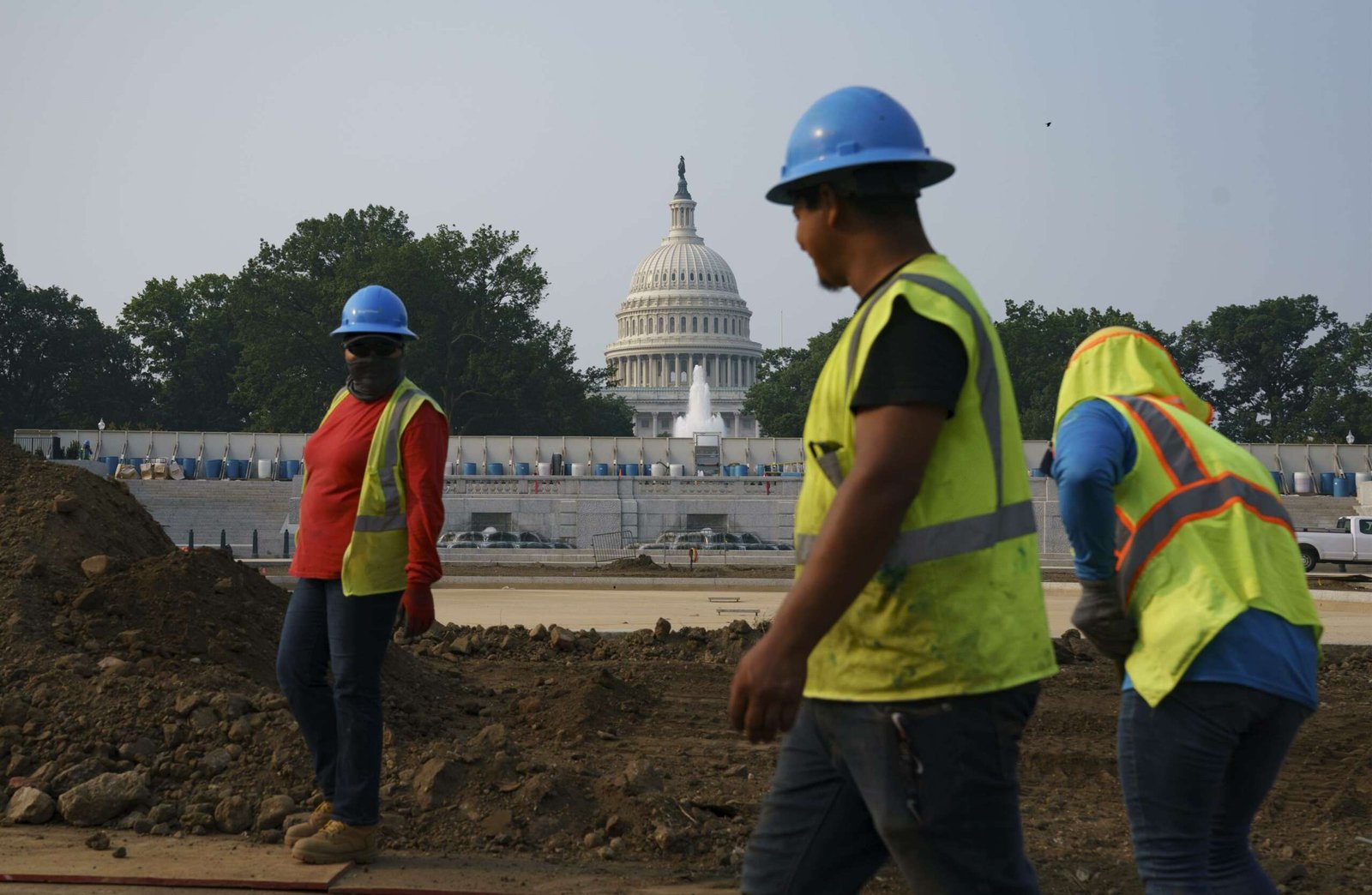
Maureen Conway, the vice president at the Aspen Institute, explains how Congress and agencies can pull certain policy levers to support essential workers.
Every Labor Day, politicians and cabinet secretaries praise American workers and recognize their importance to our nation. Yet millions of those workers remain excluded from the prosperity they helped create, trapped in jobs that offer low wages, unstable schedules, unsafe conditions and little opportunity to advance. In 2024, over 39 million workers in the United States, roughly one in four, earned low wages, defined as less than $17 an hour, and the American Job Quality Study found that 60% lacked quality jobs.
Policymakers have largely responded to this crisis by helping workers survive bad jobs or escape them through training, rather than improving the jobs themselves. The question, then, should be: Instead of helping workers escape bad jobs, why aren’t Congress and federal agencies working to make the jobs our economy depends on better?
One response has been to provide public benefits to people who work in bad jobs so that perhaps they might survive them. Nutrition assistance, income support and now health insurance safety net benefits are all conditioned on people working. The idea is that this will “encourage work.” But such policies can also enable jobs that pay so little that workers must rely on taxpayer-provided benefits for basic survival.
The other response has been to offer workers education and training and a chance to leave these jobs. Unfortunately, the math on this one doesn’t pencil out. Nearly 60% of jobs don’t require education or training beyond a high school degree, and that is not projected to change much in the coming decade. Many of these jobs offer low wages and poor working conditions. Unless the jobs themselves improve, a large share of workers will remain in them regardless of their skill level. Education and training have many benefits, and there are good arguments for investing more, but they cannot provide people with a pathway into jobs that are simply not there.
But helping workers endure or leave bad jobs is not the only option available to the federal government. Using public policy to improve essential jobs is not a new idea. For much of the 20th century, as the country was industrializing and manufacturing employment grew, factory work was often dangerous and involved low pay for long hours. Policymakers didn’t suggest that workers go to school and try to move into something better. They recognized that the work of manufacturing was critical and that the goal of public policy should be to make those jobs safer, fairer and better paid. Congress enacted landmark protections, from the National Labor Relations Act and the Fair Labor Standards Act to Title VII of the Civil Rights Act of 1964 and the Occupational Safety and Health Act, while federal agencies turned those protections into workplace standards and enforcement. Together, these efforts contributed to improved wages and working conditions and a more inclusive economy.
These policies were imperfect, but they demonstrated that federal agencies and Congress together can make work better. What are the levers policymakers can pull today? Obviously, setting minimum standards is important. Revisiting and modernizing some of the regulations that set standards for basic livelihoods and the health and well-being of the country’s workforce sits within policymakers’ power and purview, and they should stop shirking their duty in this regard.
Policymakers should also build support for better jobs into the business and economic development programs that they currently invest in. For example, Manufacturing Extension Partnerships (MEPs) are public-private partnerships supported by the Department of Commerce that provide consulting services to support manufacturers’ growth and competitiveness. These partnerships often focus on cutting waste and eliminating production bottlenecks. But an evaluation of one MEP that added job quality strategies to its advising found better outcomes for manufacturers as well as better jobs for workers.
Through the Small Business Administration, the country invests hundreds of millions in advising services, loan guarantees, grant programs and other initiatives intended to support small business. As major contributors to our economy, small businesses are responsible for employing nearly half the US workforce. Why not also help small businesses make their jobs better? In our work with Community Development Financial Institutions, we found that job coaching and advising helped small businesses improve the quality of their jobs and that jobs could be improved in ways that also were good for the business.
Making work better needs to once again be an explicit goal of public policy. The quality of our working lives has a profound influence on the quality of our lives. If we want a stronger economy and a healthier society, if we want to rebuild the middle class, then essential jobs need to be better.
Work is a human institution, governed by human decisions, laws, and norms. The state of work in the U.S. is not good, and policymakers have the tools to make it better. It’s time to make dignity at work an explicit goal of public policy. So let’s get to work.
Maureen Conway serves as vice president at the Aspen Institute and executive director of the Institute’s Economic Opportunities Program (EOP). EOP works to expand individuals’ opportunities to connect to quality work, start businesses, and build economic stability that provides the freedom to pursue opportunity. Maureen founded EOP’s Workforce Strategies Initiative and has headed up workforce research at the Institute since 1999. Maureen also curates a public discussion series at the Institute, Opportunity in America, which brings together voices from business, labor, policy, human services, media, academia, and others to discuss the challenges experienced by many in today’s labor markets and new ideas for addressing these challenges. In addition, Maureen oversees EOP’s leadership development programs, which connect innovators, both within communities and from across the country, to peers working to help low- and moderate-income Americans access opportunity.
Copyright
© 2026 Federal News Network. All rights reserved. This website is not intended for users located within the European Economic Area.
