Contents But until the fullscale war in Ukraine in 2022, there was not a great willingness among politicians to speed up defence investments also because they were struggling with the Corona epidemic at the same time. The review in 2022 was also critical about the Danish defence investments and it was decided to keep the reviews classified in the future, Denmark had previously published the reviews. However, considering the current security policy situation and Russia’s aggression, the Danish Defence Intelligence Service assessed that the reviews should not be published in its entirety, as it contains information about Denmark’s military capability. In 2024 the Danish Ministry of Defence released a statement saying “that Denmark has shown a willingness to comply with NATO’s force goals and has made significant decisions in the new defence agreement. But the decisions must now be implemented and implemented before the agreed capabilities are available to NATO. Against this background, a new NATO report provides a better evaluation of Denmark’s defence planning than in 2022.“ So far so good, Denmark was once again in alignment with NATO.
DPQ and Article 3 Before going into more detail about the Danish Armed Forces, it is worth mentioning a topic that is sometimes overlooked in the debate about NATO’s Article 5, also known as the Musketeer Clause. Before Article 5 can work, however, the prerequisite is Article 3. It states that “In order more effectively to achieve the objectives of this Treaty, the Parties, separately and jointly, by means of continuous and effective self-help and mutual aid, will maintain and develop their individual and collective capacity to resist armed attack.” In other words, countries need to have sufficient defence capabilities to enable them, together with other NATO members, to mount either a retaliation or a denial operation against an aggressor.
Denmark stated in 2024 that it had shown a willingness to comply with NATO’s annual Defence Planning Questionnaire (DPQ), in which it reports its forces, plans, budgets and capability goals. As mentioned earlier, it is used by NATO to assess Denmark’s ability to meet the Alliance’s force goals and to prepare the official Defence Planning Capability Review. The question then arises: what was Denmark doing before? The opposite of willingness is unwillingness, and perhaps Robert Gates was right in his 2011 speech when he suggested that some nations were content for the American taxpayer to foot the bill created by reductions in European defence budgets.
Danish Army Artillery Regiment acquired the Elbit Atmos 155/52 mm artillery system to replace the Caesar artillery systems that were donated to Ukraine. Denmark also acquired PULS rocket artillery systems from Elbit. (Image: Forsvarets Mediearkiv) Danish Defence Policy Denmark is now in the midst of the largest military build-up since the Cold War, driven by an acute threat environment and a political desire to rebuild capabilities that were phased out after 2004. There has been considerable debate about the 2004 reductions, and today politicians have finally acknowledged that they were a mistake.
At the same time, Danish defence policy is undergoing a fundamental shift. Russia’s full-scale invasion of Ukraine in 2022 and uncertainty over the transatlantic relationship have transformed the European security landscape and Denmark’s alliance relationships. Denmark is significantly increasing its defence spending, with speed taking precedence over economic efficiency. The focus is on rebuilding the Danish Armed Forces so they can effectively contribute to NATO’s collective deterrence and defence. This was reflected in the National Compromise, agreed a month after Russia’s invasion of Ukraine.
Meanwhile, the underlying processes of Danish defence policy are also changing. With the Defence Agreement for 2024–2033, the government introduced a new model centred on a 10-year financial framework agreement, with specific decisions to be negotiated through supplementary agreements over the course of the period. Below is a comprehensive overview of current capabilities and future programmes:
Overall Development of the 5% GDP With the 2024–2033 Defence Agreement, Denmark allocated DKK 155 billion, later increased to DKK 190 billion for the period. In 2025–26, an Acceleration Fund of DKK 50 billion was added, lifting defence spending to more than 3% of GDP and enabling direct contracts and faster procurement. Denmark is expected to reach 5% of GDP by 2035, following the NATO decision taken at the Hague in 2025.
Strategic Line There has been a shift in focus from expeditionary missions such as Afghanistan to high-intensity warfare in Europe, in line with NATO’s new defence concepts. The National Compromise of 2022 and the Defence Agreement for 2024–2033 set as their main objective the delivery of concrete force goals to NATO and the provision of credible deterrence in the immediate neighbourhood. In practical terms, this means shifting the priority towards heavy, resilient capabilities, larger inventories and long-term endurance rather than lean deployments. The lean concept was a mantra within the Danish Armed Forces from 2004 onwards: the thinking was that the armed forces could be managed like a Toyota factory. The Danish Armed Forces paid a heavy price for this approach.
The focus through to 2035 will be on air and missile defence, the heavy brigade structure, naval modernisation, the Arctic and North Atlantic, and critical infrastructure. To support this effort, the Danish Acquisition and Logistics Organization (DALO) issued its Procurement Plan 2026 (available only in Danish). The publication of the Procurement Plan 2026 forms part of strengthened collaboration with the Danish defence industry. It provides an overview of a large proportion of DALO’s expected future procurements. It should, however, be viewed as a snapshot that is subject to continuous change, and it primarily covers framework agreements worth between DKK 1 million and DKK 25 million. In other words, the focus is on Danish SMEs, which are expected to be important partners.
Back to top ↑
The Royal Danish Air Force – Current Capabilities The current capabilities are the F-35A Lightning II of which Denmark will receive 27 aircraft and the first were operational in 2024–25. The aircraft will all be delivered in 2026. For tactical air transport, Denmark has 4 C-130J-30 Hercules. The aircraft also has an Arctic capability. For anti-submarine warfare (ASW) and maritime surveillance Denmark has 9 MH-60R Seahawk helicopters.
Royal Danish Air Force F-35 aircraft from Fighter Wing Skrydstrup on patrol over Greenland in January 2026. This mission was supported by a French Air Force MRTT tanker aircraft. (Image: Forsvarets Mediearkiv Royal Danish Air Force – Future Programmes Denmark has long had a gap in its land-based air defence, as only its ships and fighter aircraft had an actual air defence capability. This will now be addressed through the acquisition of long-range and short-range ground-based air defence systems. From a NATO perspective, these initiatives align with the Alliance’s focus on Integrated Air and Missile Defence (IAMD). They give Denmark a more credible role in protecting critical infrastructure and force pools in the region.
Historically, this is an investment on a scale not seen for many years. Although there have been no new official announcements in today’s sources, the overall status of Danish Ground- Based Air Defence (GBAD) remains unchanged. The long-range layer will be based on SAMP/T, which Denmark has decided to procure as its top-tier system. Deliveries and implementation are planned for the period 2025–2028, based on previous political agreements.
For medium-range systems (NASAMS, IRIS-T SLM and VL MICA), Denmark has adopted a multi-system strategy to accelerate capability development. No new delivery or commissioning dates have been announced. Short-range systems (Stinger and associated sensors) continue to form part of the GBAD architecture.
Organisationally, the Air Defence Wing, established in 2025, remains the framework for the capability build-up, with no new structural changes announced to date.
To complete the picture, Denmark also plans to acquire counter-drone systems and larger missile stockpiles, alongside upgrades to its C4ISR architecture, including satellite data, sensors and a faster sensor-to-shooter chain.
Back to top ↑
The current capabilities are the three Iver Huitfeldt class frigates primarily used for air defence, but lack modern missiles, and the two Absalon class frigates designed for command and support and reconfigured as ASW frigates. And finally, the three Knud Rasmussen class inspection ships used for Arctic patrol. As with the Army, the Navy has a special operations force – the Frogman Corps. The primary role for the corps is reconnaissance.
The Royal Danish Navy – Future Programmes Briefly, the Navy’s new acquisitions in 2025–2026 focus on a large number of smaller vessels, new capabilities for underwater surveillance, coastal missile defence, and preparations for new frigates. However, the decision on the larger warships awaits NATO’s force goals. There are currently different schools of thought in Denmark. Some favour building the ships in Denmark, while others prefer cooperation with a foreign navy, such as the UK’s Royal Navy.
There have, however, been several new acquisitions during the 2025–2026 period. The government and the parties to the Defence Agreement have agreed to acquire 21 new vessels for the Naval Home Guard. These will provide a significantly stronger presence in Danish waters and will be able to carry out both surveillance and support tasks.
Four new marine environment vessels will also be procured. They will be capable of military roles, including surveillance and mine-laying operations, and are expected to be built at Danish shipyards.
Denmark is establishing an entirely new capability to monitor critical subsea infrastructure, including cables and pipelines. It will acquire one specialised vessel, underwater drones and sonar systems. The capability will be based at Naval Station Frederikshavn.
A coastal missile defence system has been acquired from Kongsberg, introducing a new capability to the Danish Armed Forces. It will strengthen Denmark’s ability to deter and engage enemy ships. The capability will be based at Naval Station Korsør.
Furthermore, the United States has approved the sale of three Boeing P-8A Poseidon maritime patrol and reconnaissance aircraft to Denmark. The aircraft will provide a better picture of activity around Greenland and the Faroe Islands. In addition, they will strengthen surveillance in the North Atlantic and the Baltic Sea. The Danish government expects to invest in new frigates, but the decision is pending NATO’s force goals, as set out in the Defence Planning Questionnaires (DPQs). The programme is currently in a preparatory phase, during which the framework, industrial model and potential partners are being examined, but no decision has yet been made on the design, number or timetable. This is confirmed by several sources. What is likely to happen next? First, capability requirements will be defined, including Anti-Access/Area Denial (A2/AD), air defence, anti-submarine warfare (ASW) and Arctic operability. This will be followed by a choice between national construction, Nordic cooperation or partnership with a foreign navy, such as the UK’s Royal Navy, Germany or France. At present, no decision is expected before 2027.
Royal Danish Army – Current Capabilities The current capabilities include 44 Leopard 2A7 tanks, PULS rocket launchers, and ATMOS 2000 self-propelled guns, replacing the Caesar artillery systems donated to Ukraine. The Army also fields 309 Piranha V armoured personnel carriers. Contracts have been signed with Sweden for 115 CV9035 MkIIIC infantry fighting vehicles and with Finland for 130 Patria Armoured Modular Vehicles. Delivery of these systems is underway. The Danish Army’s Special Operations Force is a high-readiness force deployable in both national and international operations. Together with the Frogman Corps, it forms part of NATO’s Special Operations Forces.
Royal Danish Army – Future Programmes Acquisition is initiated on short- and medium-range air defence systems. The conscription is extended from 4,700 to 7,500 annually and the length of service from 4 to 11 months. Ammunition stocks and logistics are upgraded to meet NATO requirements. Cyber and information capabilities are strengthened by the Danish Defence Intelligence Service and the Centre for Cyber Security. Satellite and communication capacities are strengthened in the Arctic.
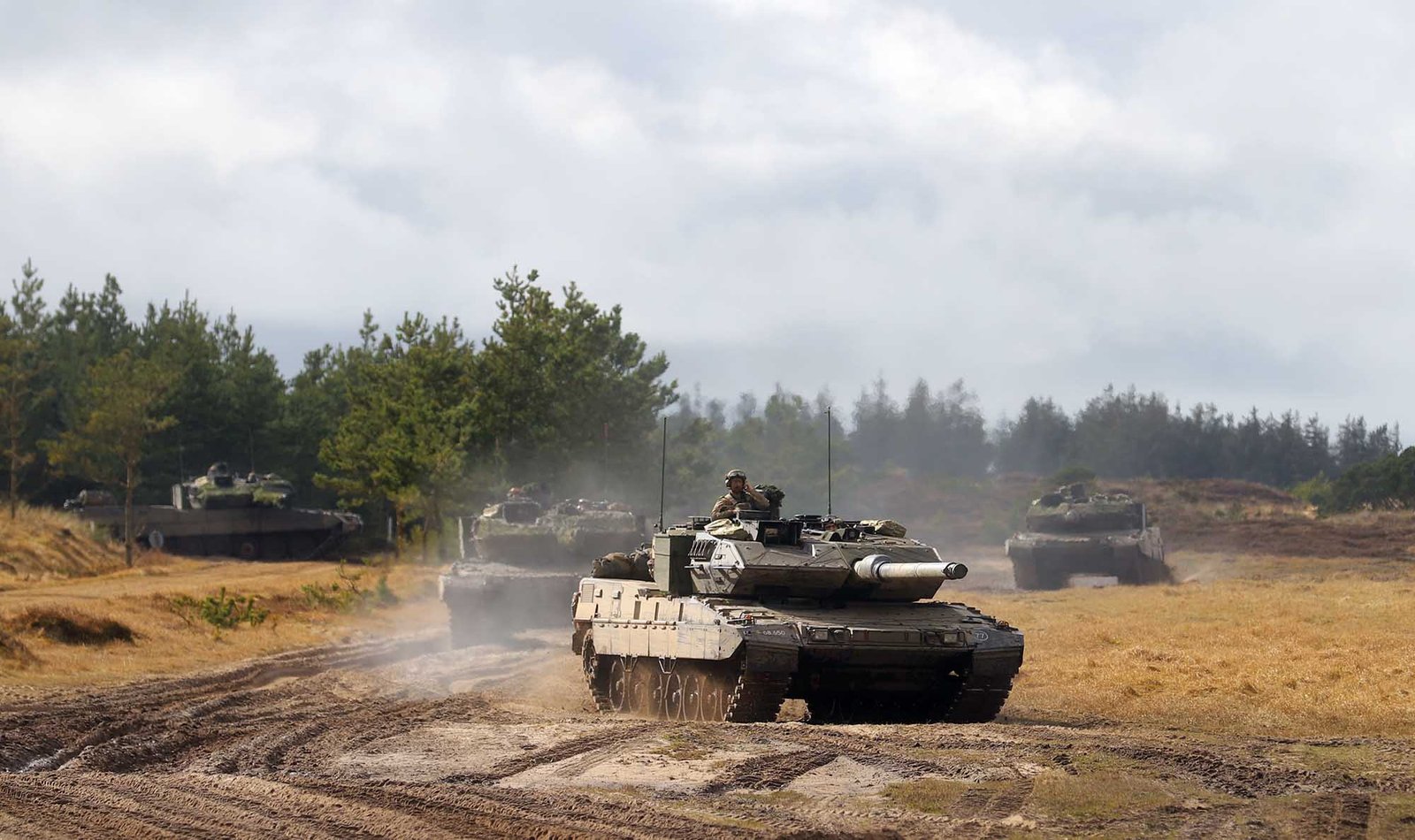
Leopard 2A7 tanks of the Panzer Battalion, Jydske Dragonregiment, at Oksbøl, preparing for NATO certification prior to deployment in Latvia in 2025. (Image: Forsvarets Mediearkiv) Arctic Command Just a few words on the Arctic Command, headquartered in Nuuk. The Arctic Command is the Kingdom of Denmark’s operational nerve centre in Greenland and the Faroe Islands, responsible for asserting sovereignty, conducting surveillance, coordinating search and rescue, supporting military operations, and cooperating with NATO in the Arctic and the North Atlantic. In recent years, its capabilities have been significantly expanded through two major sub-agreements concluded in 2025, totalling DKK 42 billion. The Arctic Command has at its disposal Arctic patrol vessels, long-range drones, Challenger and Poseidon aircraft, the Sirius Sledge Patrol, and troops deployed primarily from the Army.
The Home Guard’s Capabilities To complete the picture of the Danish Armed Forces it is equally important to mention the Danish Home Guard. The Home Guard’s activities are based on the Home Guard Act from February 2007 with subsequent amendments.
As part of the national defence of Denmark, the Home Guard participates in the performance of the mission’s incumbent on the Army, the Navy and the Air Force, including tasks that support authorities in the performance of their tasks. The Home Guard’s core assignments include guarding military and civilian objects, contributing to surveillance of Danish territory and host nation support to allied forces in connection with their stay in or transit through Denmark. The Home Guard’s other tasks include support to the police and the overall emergency response, including participation in society’s handling of major crises and disasters. The history of the Home Guard goes back to the Danish Resistance Movement during World War II. It has always been their motto; “Never again an April 9, 1940”. All the members are participating on a voluntary basis, and today more people are joining because of the threats envisaged.
Back to top ↑
Changes in Doctrine It is stated in the Goals and Results Plan for the Armed Forces 2026 that “the Armed Forces, in the framework of national and collective defence, must be able to fight and win. This will be done through strengthened combat power, preparedness and robustness. The units of the Armed Forces must be equipped with modern equipment and ammunition that can solve the task with brave and competent soldiers on relevant standby.”
In 2004, the Chief of Defence, Denmark used for the first time the formulations that Danish forces should be able to “fight and win” — but in the context of international operations, To complete the picture of the Danish Armed Forces, it is equally important to mention the Danish Home Guard. The Home Guard’s activities are governed by the Home Guard Act of February 2007, as subsequently amended.
As part of Denmark’s national defence, the Home Guard participates in carrying out the missions assigned to the Army, Navy and Air Force, including tasks that support civilian authorities in the performance of their duties. The Home Guard’s core tasks include guarding military and civilian facilities, contributing to the surveillance of Danish territory, and providing host nation support to allied forces during their deployment or transit through Denmark. Its other tasks include supporting the police and the broader emergency response system, including participation in managing major crises and disasters.
The Home Guard traces its origins to the Danish Resistance Movement during the Second World War. Its enduring motto has been: “Never again an April 9, 1940.” All members serve on a voluntary basis, and recruitment has increased in response to the growing security threats. Especially Iraq and Afghanistan. Denmark should be able to deploy combat-capable forces abroad and that the units should be able to win tactical battles against rebel groups, and that Denmark should fight and win a major war in Europe. It was the doctrine of expeditionary operations.
At the Vilnius Nato Summit 2023 in the context of the approval of NATO’s Regional Plans, the Supreme Allied Commander Europe (SACEUR) stated following: “These plans will ensure that NATO can fight and win against any adversary from day one.”
This is not a political slogan, but an operational doctrine as NATO is changing “deterrence by punishment” to “deterrence by denial” and the requirement is that NATO must be able to wage and win a high-intensity war against an equal adversary.
Challenges This doctrine is therefore not new to the Danish Armed Forces, but significant challenges remain. Denmark still has a defence force largely structured for international missions, whereas NATO now requires forces capable of fighting and winning high-intensity warfare, sustaining combat power over longer periods, defending Danish territory and the North Atlantic, and receiving and supporting allied forces.
Among the most critical challenges in Danish defence planning are personnel and equipment. The Armed Forces are short of approximately 4,000 personnel. The Army lacks soldiers, sergeants and officers, while the Navy faces shortages of crews and specialists. The Air Force lacks technicians, pilots and operators. Support functions, including IT, logistics and engineering, are also severely affected. In addition, a new force multiplier has emerged on the modern battlefield: drones. FPV drones are among the most significant force multipliers in modern warfare because they dramatically increase the combat effectiveness of small units at extremely low cost, with high precision and minimal risk.
In response, the Danish Defence is establishing a new Drone Centre at Hans Christian Andersen Airport in Odense, which will serve as the hub for training, development and lessons learned across the Armed Forces. The centre is expected to be fully staffed by 2026 with approximately 100 military and civilian personnel.
Conclusion Denmark is in the midst of the largest military build-up since the Cold War. At present, Denmark can defend itself against limited attacks and enforce its sovereignty, but it cannot withstand a major military attack without NATO reinforcements. The Armed Forces are well on their way to achieving full warfighting capability, but they are not there yet. What is often overlooked, however, is that the Danish soldier is highly adaptable, resourceful and capable of improvisation.
Author: Jørgen Bo Leimand
Click here to read the latest issue of ESD.
Back to top ↑