

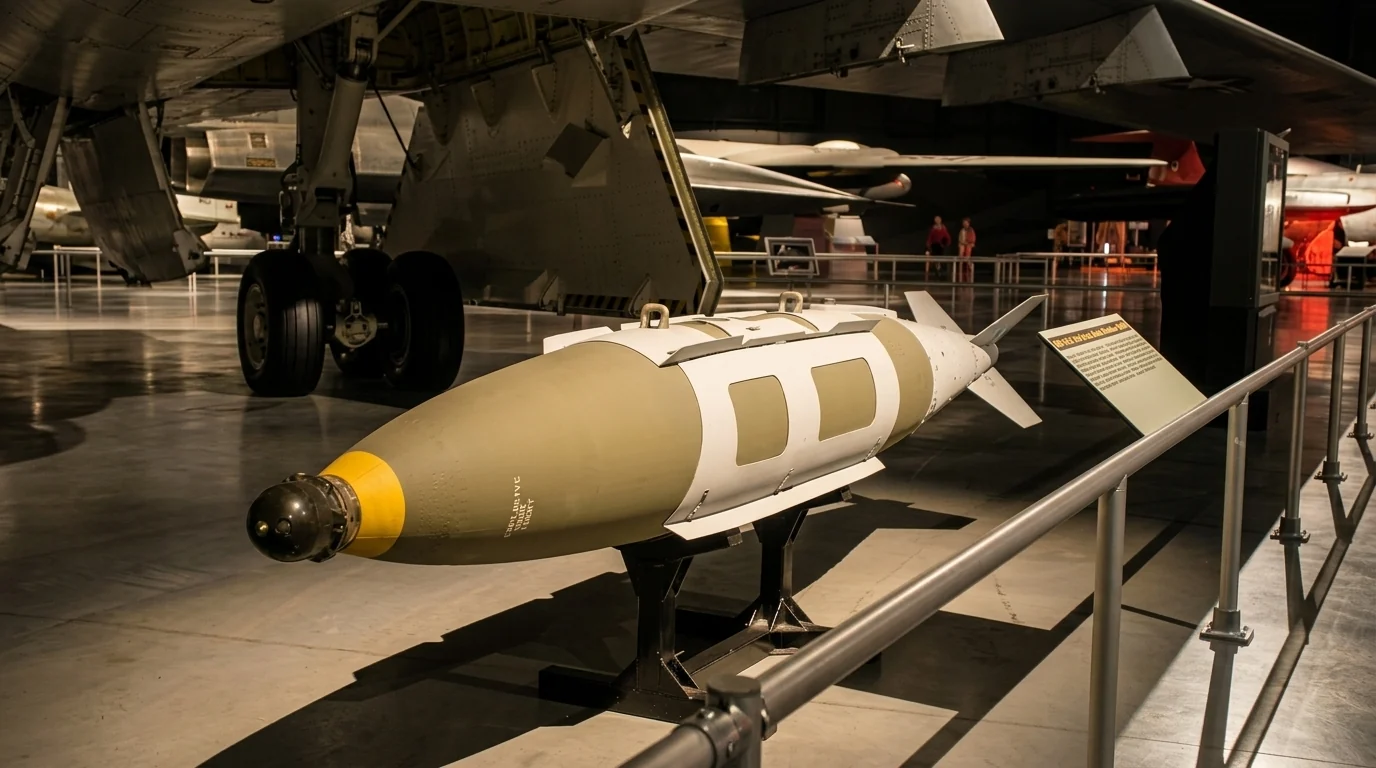
The GBU-31 JDAM looks almost boring.
It has no dramatic rocket motor. No exotic seeker sits in its nose. At its core, it is a large gravity bomb fitted with a guidance kit.
That simple idea changed air warfare.
The Joint Direct Attack Munition, or JDAM, gave aircraft a way to turn existing unguided bombs into precision weapons without designing an entirely new bomb for every mission. The GBU-31 JDAM is the 2,000-pound class member of that family, built around warheads such as the Mk 84 and BLU-109.
The clever part sits at the back.
A JDAM tail kit combines an inertial navigation system with GPS updates and movable control surfaces. Before release, the aircraft gives the weapon its target data. After release, the bomb calculates its position and adjusts its flight path toward the programmed coordinates.
No laser designator is required.
That matters because weather can make some forms of precision attack difficult. JDAM does not need to see the target through a clear optical path during its final approach. It follows navigation data instead.
The result was a weapon that could deliver a heavy warhead with far greater accuracy than a conventional gravity bomb.
And the concept proved cheap enough to use at scale.
The first JDAM flew in 1996, and the system reached initial operational capability in 1998. Nearly three decades later, the U.S. is still buying JDAM guidance kits and upgrading their resistance to GPS interference.
That’s the part I find most interesting.
The GBU-31 JDAM wasn’t revolutionary because it looked futuristic. It was revolutionary because it solved a practical problem with a relatively simple addition to a weapon the military already understood.
Sometimes the smartest weapon is the one that doesn’t need to reinvent the bomb.
What Is the GBU-31 JDAM?
The GBU-31 JDAM is best understood as an old bomb body with a smart tail attached to it.
That distinction matters. JDAM is not a completely new bomb design. It is a guidance kit that converts existing free-fall bombs into precision-guided weapons. The GBU-31 JDAM is the 2,000-pound version of that family, built around either the Mk 84 general-purpose bomb or the BLU-109 hard-target penetrator.
The key components are packed into the rear guidance section. It contains a GPS-aided inertial navigation system, a guidance control unit, and movable control surfaces. Before launch, the aircraft transfers its position, speed, and target information to the weapon. After release, the GBU-31 JDAM uses that data to navigate toward its programmed coordinates.
This is where the GBU-31 JDAM differs from a traditional gravity bomb.
A conventional Mk 84 largely follows the flight path created at release. The JDAM version can make course corrections during flight. The weapon doesn’t need a laser spot shining on the target, either. That gives crews an all-weather option when clouds, darkness, smoke, or dust make visual guidance harder.
The system can also handle more than one target during a single aircraft pass. Each JDAM can receive its own coordinates before release, allowing several weapons to be directed toward different aim points.
And there’s an interesting edge case.
If GPS signals become unavailable after release, the GBU-31 does not simply become a falling bomb. Its inertial system can continue providing navigation, though accuracy becomes lower than in GPS-aided operation. Air Force testing described an INS-only accuracy of about 30 meters CEP under defined conditions.
So, calling the GBU-31 JDAM a “smart bomb” is accurate. But the smarter part isn’t the explosive payload. It’s the guidance kit that tells an old bomb where to go.
GBU-31 JDAM Specifications and Design
The GBU-31 JDAM is a heavy precision weapon, but its design is surprisingly straightforward. Its strength comes from combining a large bomb body with a compact guidance and control system.
There are two main GBU-31 configurations worth separating. The GBU-31(V)1/B uses the 2,000-pound Mk 84 general-purpose bomb, while the GBU-31(V)3/B uses the 2,000-pound BLU-109 penetrator. The Air Force lists launch weights of about 2,036 pounds and 2,115 pounds, respectively.
Here are the core specifications:
| Specification | GBU-31(V)1/B | GBU-31(V)3/B |
| Warhead | Mk 84 | BLU-109 |
| Launch weight | 2,036 lb | 2,115 lb |
| Length | 152.7 in | 148.6 in |
| Guidance | GPS-aided INS | GPS-aided INS |
| Wingspan | 25 in | 25 in |
| Typical published range | Up to 15 miles | Up to 15 miles |
| Maximum listed launch altitude | 45,000+ ft | 45,000+ ft |
The difference between those warheads changes the weapon’s job. The Mk 84 is a general-purpose bomb designed for conventional targets. The BLU-109 is a hard-target penetrator designed for targets such as reinforced structures. So, calling every GBU-31 a “bunker buster” is a common mistake.
The guidance section is where the JDAM concept earns its name. A three-axis inertial navigation system works with GPS updates, while the tail control system moves aerodynamic surfaces to adjust the bomb’s path. The weapon can be released from different altitudes and flight paths, including level, dive, toss, and loft deliveries.

The published 15-mile range also needs context. It is not a fixed maximum distance for every release. Altitude, speed, release angle, and aircraft position all affect how far the weapon can travel.
That matters when comparing the GBU-31 JDAM with newer glide weapons. The basic JDAM was never designed to be a long-range missile. Its appeal was simpler: carry a heavy warhead, release it from a useful distance, and let GPS and INS handle the flight.
Why Was the GBU-31 JDAM Such a Big Deal?
The biggest change the GBU-31 JDAM brought was not better explosives. It was a cheaper way to make precision attack widely available.
Before JDAM, precision weapons often depended on specialized guidance systems. Laser-guided bombs, for example, needed a laser designator to keep the weapon pointed toward the right aim point. That could work extremely well, but weather, smoke, clouds, and the need for a clear laser path could complicate the mission.
JDAM took a different approach.
Instead of building an entirely new precision weapon, the U.S. military added a guidance kit to existing bomb bodies. The result was a weapon that could use GPS and inertial navigation while retaining the large payload and familiar handling of conventional bombs. The first JDAM test flight took place in 1996, followed by initial operational capability in 1998.
That timeline tells you why the system mattered.

The military didn’t have to abandon its existing stockpile of 2,000-pound bombs. A conventional bomb could be upgraded with the right tail kit and turned into a guided weapon. That made precision capability easier to scale across different aircraft and missions.
The GBU-31 JDAM became one of the most useful examples of this idea because it combined JDAM guidance with the heavy Mk 84 or BLU-109 warhead.
There was also a practical advantage in mission planning. Multiple JDAMs could be loaded with different target coordinates before release. An aircraft could therefore deliver several weapons against separate aim points without needing each bomb to be individually guided by a laser operator.
And this is where the “simple bomb” argument falls apart.
The GBU-31 JDAM may look simple compared with a cruise missile, but its value comes from the system around it. Aircraft sensors, mission computers, navigation data, targeting information, and the bomb’s own guidance system all have to work together.
That made JDAM less of a single weapon breakthrough and more of a practical shift in how precision weapons could be used at scale.
What Warheads Can the GBU-31 JDAM Carry?
The GBU-31 JDAM is not one single bomb configuration. Its guidance kit can be paired with different 2,000-pound-class warheads, and that changes what the weapon is designed to do.
The two configurations most often associated with the GBU-31JDAM are the Mk 84 and BLU-109 variants.
The Mk 84 version, designated GBU-31(V)1/B, uses the 2,000-pound Mk 84 general-purpose bomb. It is designed for conventional targets where a large blast and fragmentation effect are required. The Air Force lists the complete weapon at about 2,036 pounds.

The other major configuration is the GBU-31(V)3/B, which uses the BLU-109 penetrator. This bomb weighs about 2,115 pounds as a complete weapon. Its warhead is built for harder targets, including reinforced structures, rather than simply maximizing blast effects.
That distinction is easy to miss when people simply call every GBU-31 JDAM a “bunker buster.”
The guidance system is broadly the same idea. The warhead is what changes the weapon’s role.
| GBU-31 configuration | Warhead | Primary design purpose |
| GBU-31(V)1/B | Mk 84 | General-purpose targets |
| GBU-31(V)3/B | BLU-109 | Hard and reinforced targets |
The choice gives air planners more flexibility without requiring a completely different guidance architecture for every target type.
There’s a useful lesson here. Precision does not automatically mean the weapon is optimized for every target. A JDAM can put a bomb close to programmed coordinates, but the warhead determines what happens when it gets there.
That’s why the GBU-31 JDAM family should not be judged only by its GPS accuracy. A Mk 84 and a BLU-109 may share the same basic JDAM concept, yet they were built around very different target problems.
And that modular approach is a big part of why JDAM became so widely used. The military could pair familiar bomb bodies with a common guidance system instead of creating a new precision weapon from scratch for every mission.
Which Aircraft Can Carry the GBU-31 JDAM?
One reason the GBU-31 JDAM became so useful is that it wasn’t tied to one aircraft.
The JDAM family was designed for broad integration across U.S. combat aircraft. That means the same basic guidance concept can be used by aircraft from different generations, provided the platform has the required weapon integration and software.
The GBU-31 JDAM, as a 2,000-pound JDAM, has been integrated with several major U.S. strike platforms. These include the F-15E Strike Eagle, F-16 Fighting Falcon, B-1B Lancer, B-2 Spirit, B-52H Stratofortress, F/A-18E/F Super Hornet, F-22 Raptor, and F-35 Lightning II. The exact weapon configuration and integration status can vary by aircraft.
That mix is important.

The F-15E can carry JDAMs while performing long-range strike missions. The B-1B and B-52H can carry large numbers of precision weapons as part of their bomber roles. The F-35 brings JDAM capability into a stealth aircraft built around internal weapon carriage.
So the same basic bomb can fit very different mission concepts.
A bomber might use the GBU-31 JDAM as part of a large precision strike package. A fighter could carry fewer weapons while relying on its sensors and mission systems to generate accurate targeting data.
There is another practical point. Not every JDAM variant is compatible with every aircraft in the same way. The 2,000-pound GBU-31 JDAM is physically much larger than the 500-pound GBU-38, and internal weapon bays impose their own limits. This matters for aircraft such as the F-35, where internal carriage is constrained by bay dimensions and aircraft configuration.
That makes JDAM more than a bomb family. It’s also an integration standard.
A weapon developed in the 1990s can still appear on aircraft introduced decades later because its basic guidance architecture remains useful. The bomb doesn’t need to become futuristic. The aircraft and mission system around it keep giving the weapon new relevance.
Why Is the GBU-31 JDAM Still Relevant Today?
The GBU-31 JDAM has survived because its basic idea still solves a very practical problem: putting a large conventional warhead close to a programmed target without needing a complex missile.
That does not mean the weapon has stayed unchanged. The JDAM family continues to receive upgrades as the threat environment changes. One major concern is GPS interference. Modern electronic warfare can disrupt or degrade satellite navigation, so newer JDAM improvements focus on making the guidance system more resistant to those problems.
The U.S. military is also still procuring JDAM kits. The FY2026 budget documents include continued procurement of JDAM guidance kits for both the Air Force and Navy, showing that the family remains part of the current precision-weapons inventory rather than simply being an old stockpile item.
There’s also a bigger reason JDAM remains useful: cost and logistics.

A cruise missile can offer far greater range and more complex guidance, but it is also a very different class of weapon. The GBU-31 JDAM can be carried and released by existing combat aircraft, using infrastructure and mission systems already built around conventional air operations.
The newer JDAM-ER concept pushes the same basic idea further by adding a wing kit that gives the weapon much greater glide range. But this should not be confused with the baseline GBU-31 JDAM. A standard GBU-31 remains a relatively short-range precision bomb compared with dedicated stand-off weapons.
That distinction matters as air defenses become harder to approach.
A fighter may not always want to release a basic JDAM close to a heavily defended target. In those situations, longer-range weapons can offer a safer launch position. But once an aircraft can reach a suitable release point, a 2,000-pound JDAM remains an attractive option.
The GBU-31 JDAM’s real advantage is not that it is the newest weapon in the inventory.
It’s that the underlying concept is simple, proven, adaptable, and still useful.
A bomb body, a guidance kit, accurate coordinates, and an aircraft can accomplish a mission that once required a far more specialized weapon. That combination is hard to retire when it still works.
