

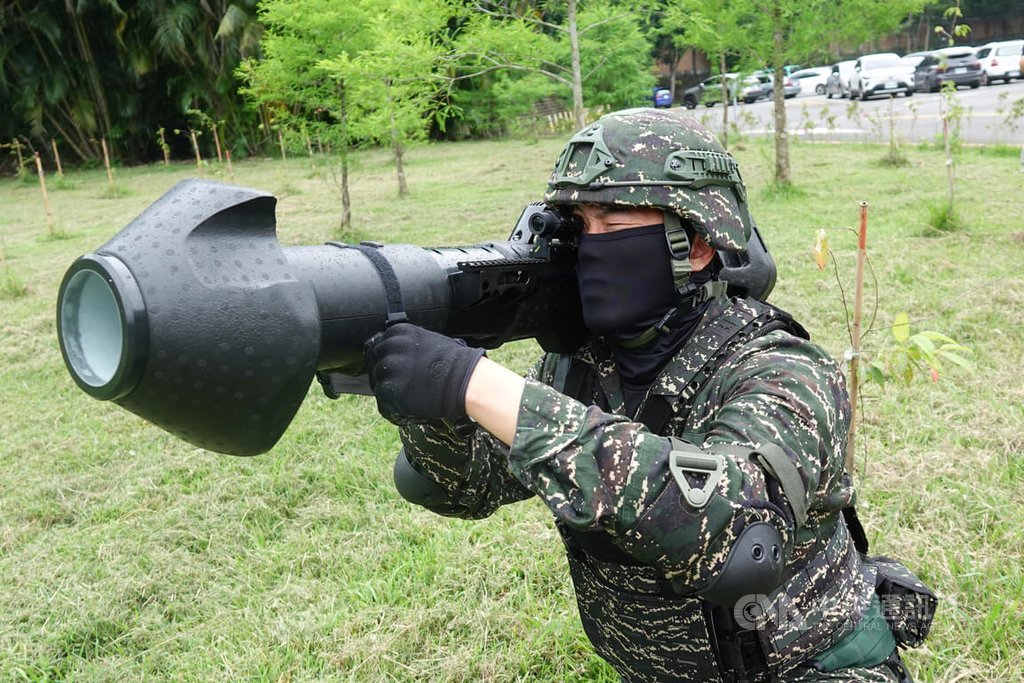
Taiwan’s National Chung-Shan Institute of Science and Technology recently presented its upgrade of the widely fielded Kestrel shoulder-fired, anti-armour rocket launcher to the country’s army and marine corps.
Development testing is under way, with evaluations being conducted by both the Republic of China Army and Marine Corps.
Called the Kestrel II, it is designed to address limitations of the previous weapon. More than 10,000 of the original Kestrel are in Taiwan’s inventory, and every conscript, soldier and marine is mandated to qualify on the weapon.
The Kestrel was introduced in 2015 as a key element in the nation’s defence tactics.
In development since 2024, the Kestrel II extends the effective range to 500m, increases armour penetration to 670mm due to its larger 96mm warhead, and it has improved accuracy against moving targets. The last factor is aided by a 5x optical-zoom sight with engraved, predicted line-of-sight lead calculation.
The Kestrel II also has a Picatinny top rail that can accept a night vision device. The weapon is a single-use, fire-and-dispose rocket launcher. Weighing 3.9kg and measuring 1.16m in length, it can be readily carried by a soldier, and has both a carrying strap and a handle.
Two versions of the Kestrel II are available, with one configured to allow it to fire from a confined space such as a room.
The “fire-from- enclosure” design releases a dispersed water vapour counter-mass in the backblast. This counter-mass makes this model slightly heavier, but both versions otherwise function the same. This fire-from-enclosure capability is offered in only a few other shoulder-fired anti-armour weapons.

The Kestrel II has a target production price of US$3,100, which would allow it to be acquired and fielded en masse.
Wide-scale fielding of the Kestrel II in large numbers would significantly improve Taiwan’s ground defence capabilities, and help counter any People’s Liberation Army post-invasion advances.
The possibility of encountering vast numbers of Kestrel armour-defeating weapons around every turn would likely cause any advancing unit to hesitate.
by Stephen W. Miller
