

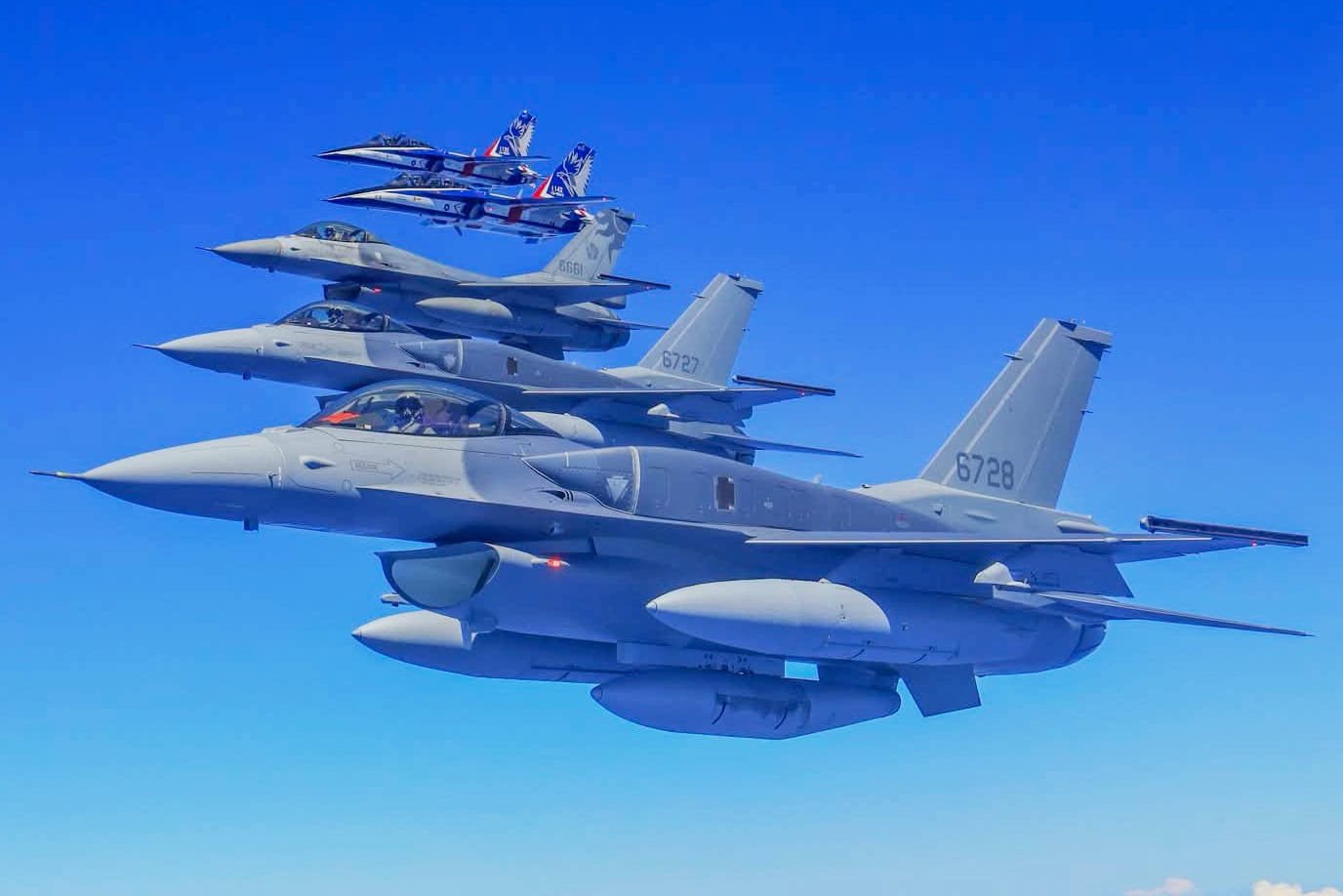
Following a lengthy wait, Taiwan has received the first pair of the 66 Lockheed Martin F-16C/D Block 70 fighters it had ordered.
The two single-seat aircraft, with tail numbers ‘6727’ and ‘6728’, arrived at their future home at the Republic of China Air Force’s (ROCAF) Chihhang Air Base – sited near Taitung on Taiwan’s southeast coast – at midday on 2 October 2026.
Just prior to their arrival, the aircraft were met by a pair each of upgraded F-16AMs and T-BE-5 advanced trainers, with the aircraft then flying in formation.
This arrival milestone took place about 18 months after the first aircraft – F-16D tail number ‘6831’ – was unveiled at Lockheed’s F-16 facility in Greenville, South Carolina on 28 March 2025.
The two aircraft began their delivery journey on 17 August, departing Greenville for Joint Base Pearl Harbor-Hickam, Hawaii; via Fort Worth, Texas; with support from a US Air Force (USAF) KC-135 tanker.
The pair remained on the ground in Hawaii for more than six weeks. This was understood to be due initially to weather along the route to Taiwan, followed by unspecified technical issues and a subsequent US-imposed delay over the optics surrounding the late-September meeting between President Donald Trump and Chairman Xi Jinping.
Prior to departing Hawaii on 1 October, the aircraft had their USAF insignia removed, revealing the ROCAF roundel. This was a departure from previous F-16 delivery flights in the 1990s and 2000s, when the national markings were only unveiled after the aircraft arrived in Taiwan due to political sensitivities.
At least for the trans-Pacific legs from Hawaii to Taiwan via Guam, the flight lead of the formation was flown by a Lockheed Martin pilot, while the second F-16 was flown by an ROCAF pilot, marking a change from previous deliveries when the aircraft were flown exclusively by American pilots.
Taiwanese Defense Minister Wellington Koo said more aircraft would arrive before the end of the year, with further deliveries to be discussed with the USA. He added that many aircraft remain on the production line, while others have already completed testing.
Procured through an estimated US$8 billion contract in 2019 under the Peace Phoenix Soaring project, initial deliveries had been anticipated around 2023, with completion scheduled for late 2026.
The three-year delay resulted from supply chain and manpower problems stemming from the COVID-19 pandemic, production line adjustments and software issues associated with the new F-16 variant.
The arrival of the new ROCAF F-16 Block 70 aircraft will, however, provide a marked capability boost as the island faces increasing military pressure from China.

Compared with the 139 surviving F-16 Block 20s from an original order of 150 delivered between 1997 and 2001, and upgraded from the late 2010s into the early 2020s, the Block 70s incorporate numerous enhancements from the outset.
These include the ability to mount conformal fuel tanks, providing additional range and loiter time. This is a valuable capability given the ROCAF’s lack of aerial refuelling tankers.
They are also powered by General Electric F110-GE-129 engines, providing more than a fifth greater maximum afterburner thrust than the Pratt and Whitney engines fitted to the older Block 20s.
The F-16C/D Block 70s are being equipped with the L3Harris AN/ALQ-254(V)1 Viper Shield electronic warfare suite, although initial aircraft deliveries are reportedly being made without the system since it is not yet ready for integration.
The new fighters will also receive Lockheed Martin’s IRST21 Legion-ES infrared search and track system, which allows it to passively detect and track airborne targets without using its radar.
The system can also detect and track low-observable targets such as J-20 and J-35 fighters of the People’s Liberation Army (PLA), while working in concert with the onboard AN/APG-83 scalable agile-beam radar to provide complementary sensing and targeting capabilities.
Future weapons that the ROCAF is due to receive – including AIM-120C-8 air-to-air missiles, AGM-84H SLAM-ER precision-guided missiles and AGM-154C Joint Standoff Weapon glide bombs – will give the Block 70s and wider F-16 fleet greater combat capability.

The arrival of the F-16C/D Block 70s also marks the first time in 25 years that Taiwan has received new fighter aircraft, since deliveries of the F-16A/B Block 20s concluded in 2001.
While Taiwan held the upper hand in the cross-strait airpower balance at the time, there remained a requirement for additional fighters. This prompted its first formal request for 66 F-16C/Ds during the 2006 Monterey Talks, but the request remained unfulfilled until the 2019 order.
With PLA aircraft and warships operating around Taiwan on an increasingly routine basis, forcing the ROCAF to maintain a more persistent operational posture, the additional F-16s will provide greater capacity for missions ranging from air defence to maritime strike.
Operated by the 7th Tactical Fighter Wing at Chihhang, the permanent basing of the aircraft in the island’s southeast corner has strategic implications, helping fill a gap in air defence in the east where PLA air activity is increasing.
Their arrival also allows the ROCAF to readily project airpower south and eastwards, especially over the Bashi Channel, which is an avenue where the PLA can gain access to the Philippine Sea and beyond.
by Roy Choo
