

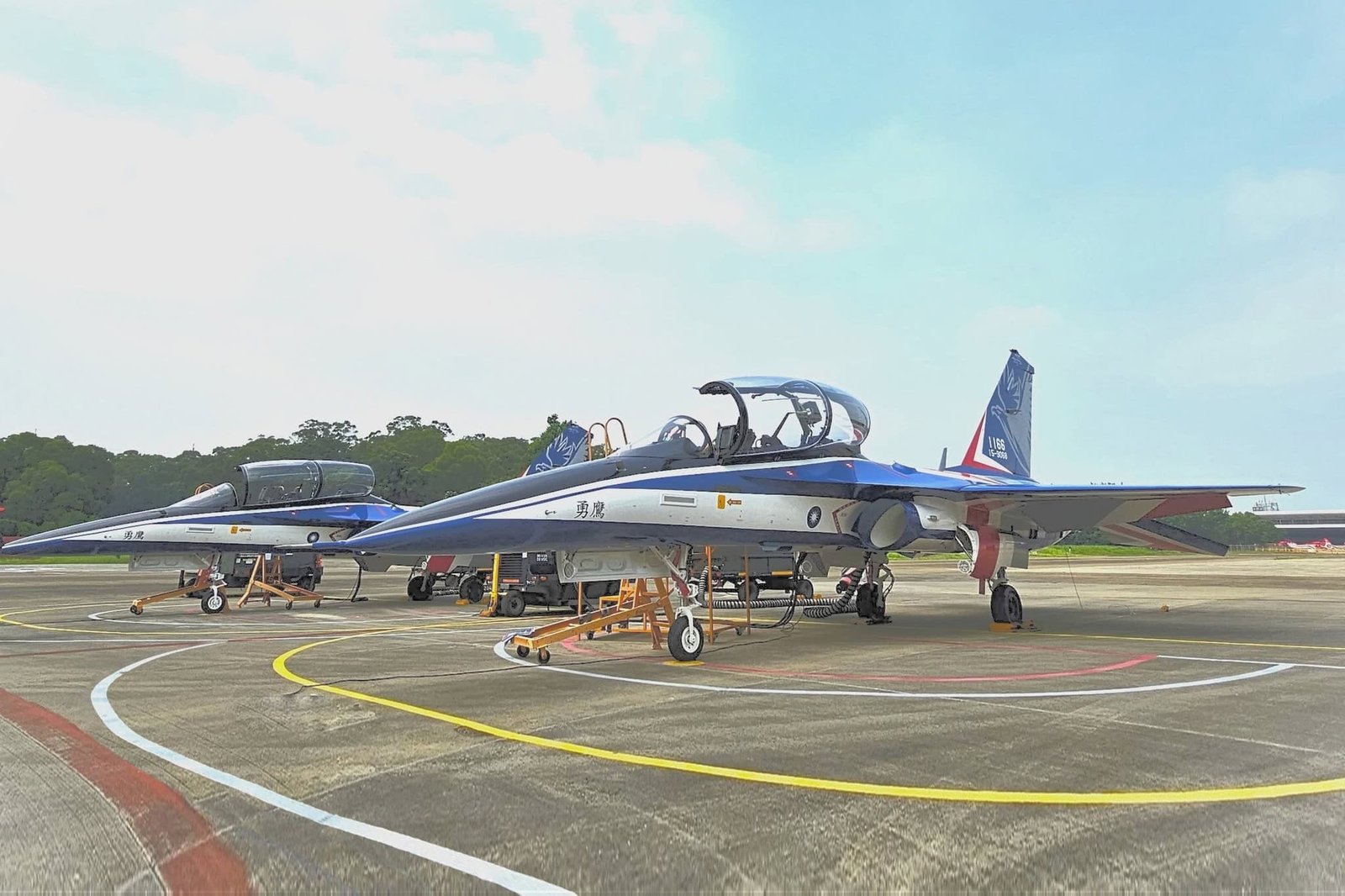
Taiwan’s Republic of China Air Force (ROCAF) received the final two examples of its 66 T-BE-5 Brave Eagle advanced jet trainers on 24 September 2026, bringing the nine-year development and production programme to a close.
In a ceremony marking the milestone, the two aircraft bearing tail numbers ‘1165’ and ‘1166’ departed Ching Chuan Kang Air Base in Taichung, which is where the Aerospace Industrial Development Corporation’s (AIDC) Shalu production complex is located.
They subsequently flew to the ROCAF Academy at Gangshan Air Force Base in Kaohsiung, with AIDC Chairman Tsao Chin-pin aboard one of the aircraft.
The delivery brought the ROCAF’s Brave Eagle total fleet to 65 aircraft, following the loss of one example off Taiwan’s east coast due to a double engine failure on 15 February 2025.
Taiwan had long sought to replace its AIDC AT-3 advanced trainers and Northrop F-5E/Fs, the latter of which had been assigned the lead-in fighter training role.
Options considered over the past two decades included converting a wing of AIDC F-CK-1 fighters to fulfil the training role, allowing the F-5s to be retired, as well as procuring new jet trainers from overseas.
The Korea Aerospace Industries (KAI) T-50 Golden Eagle and Leonardo M-346 were evaluated and, in 2014, a memorandum of understanding was signed between AIDC and Leonardo (then Alenia Aermacchi) for co-production of the M-346 fitted with substantial indigenous content.
At about the same time, AIDC also promoted a modernised AT-3 called the AT-3 Max that was fitted with updated avionics, and a jet trainer version of the F-CK-1 twin-seater dubbed the XT-5.
When President Tsai Ing-wen took office in 2016, she made indigenous defence production a central pillar of Taiwan’s defence policy, putting the M-346 at a disadvantage. A tender was subsequently issued, and the XT-5 was officially selected.
The advanced jet trainer programme was officially established in 2017 with the signing of a US$2.2 billion contract between Taiwan’s Ministry of National Defense and the government-linked National Chung-Shan Institute of Science and Technology (NCSIST) in February that year.
That contract covered 66 aircraft, ground-based training systems, mission planning systems, basic flight simulators and training support equipment. NCSIST subsequently contracted AIDC to design and produce the aircraft.
The first XT-5 prototype unveiled by Tsai on 24 September 2019 at the Shalu complex was named Brave Eagle, exactly seven years before the final delivery milestone.
Although based upon the design of the twin-seat version of the F-CK-1, over 80% of components were new.
Among changes were the increased use of composite materials for weight reduction; greater fuel capacity; a thicker wind chord for slower, more stable low-level flight; removal of the gun and radar; and the use of the non-afterburning Honeywell/ITEC F124-200TW engine.
The first pair of T-BE-5s was delivered to the ROCAF in 2021, with subsequent deliveries focused initially on replacing the F-5s and then the AT-3s. Although the programme experienced initial delays, deliveries were ultimately completed on schedule.
The introduction of the T-BE-5 saw the ROCAF streamline its three-aircraft-stage fighter pilot training system (T-34, AT-3 and F-5) into two stages (T-34 and T-BE-5), creating greater efficiencies.
AIDC also conducted weapons carriage trials on the T-BE-5 in 2022, with one of the prototype aircraft observed carrying AIM-9P4 Sidewinder and Tien Chien 1 short-range air-to-air missiles on wingtip rails, as well as BDU-50 500lb inert training bombs.
It is unclear whether the effort to arm the T-BE-5 progressed beyond these trials, with no further sightings of the aircraft carrying weapons reported since then.
Responding to questions over whether the ROCAF would order a replacement for the aircraft lost last year, AIDC President Jennifer Chuang said the company would await direction from the air force, while retaining the necessary tooling.
With production now complete, AIDC said its role in the Brave Eagle programme will shift to lifecycle support for the fleet, including spare-parts management, maintenance, upgrades and associated technical services.
by Roy Choo
