

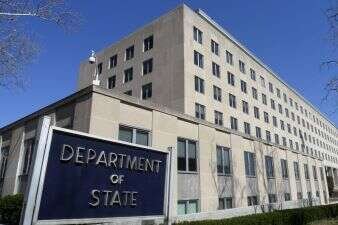
The State Department is directing some managers to go back and revise recently submitted annual performance evaluations to give employees lower scores — a model for changes that may soon impact federal employees governmentwide, according to conversations with department employees and emails obtained by Federal News Network.
A performance management reform team within the State Department’s human resources office said in an email Wednesday that it is asking managers to “review and recalibrate” employee performance reviews that are due later this month.
The department recently released a new Employee Evaluation Report (EER), the form the Foreign Services uses for annual performance assessments. The performance management reform team wrote that the department’s HR officers should soon be able to “pull back EERs individually” if they were prematurely submitted “prior to final score calibration.”
“Once this ability is live, HROs should follow their bureau/mission leadership direction to determine which EERs to pull back from the eOPF to recalibrate scores,” the email states, referring to a governmentwide system of federal employee personnel files.
Four Foreign Service officers — three current and one former — spoke to Federal News Network about changes to employee evaluations and confirmed that State Department leadership is directing managers to submit lower evaluation scores. Speaking on condition of anonymity for fear of retaliation, they said grade inflation happened under the previous evaluation system, but that this new performance system was rolled out at the last minute for this year’s performance evaluation cycle.
They also warned that this new system would push more diplomats out of the Foreign Service, which operates under an “up or out” promotion system similar to the military, and that competing for a finite number of top scores could compromise the collaborative nature of diplomatic work. The State Department did not respond to requests for comment.
“They weren’t able to get it implemented in a reasonable time beforehand. No one had any idea what the actual form would look like until just a few weeks ago. The system is broken — all kinds of errors, losing data, not doing what it’s supposed to,” one Foreign Service officer said. “The new form is drastically different than what everyone is used to.”
In light of these changes, the State Department postponed the deadline for submitting performance evaluations to May 29.
According to a second Foreign Service officer, the direction by leadership for managers to “reconsider” the scores they’ve given employees has been “extremely common.”
“In every one of these cases, there was either a specific downward revision or a conversation about the need to have a downward revision. No one’s being revised up,” the second Foreign Service officer said.
According to the second FSO, junior employees were asked to accept lower scores to the point where they are no longer in a position to be considered for promotion, but ensured higher scores are available for more senior staff competing for performance pay.
“The creation of an artificial, zero-sum game in the process has certainly pitted people against each other, including supervisors against their subordinates potentially, which in a work culture that is largely collaborative — and needs to be collaborative, because everything you do in diplomacy obviously builds on work other people are doing — I don’t think it’s helpful, and it’s certainly damaging the morale,” the second FSO said.
A third Foreign Service officer said “Senior managers who should have nothing to do with a specific employee’s evaluation are dictating what kind of scores they can receive.”
The FSO said that leadership is asking managers to lower employee evaluation scores, sometimes multiple times, so that other employees can receive higher scores.
“A lot of us were cautiously optimistic that the new forms would be a step in the right direction. But the backwards way the scores are being manipulated, combined with the secret promotions last year, erodes all confidence that this reform was about increasing merit,” the third FSO said.
Last December, the State Department retroactively promoted hundreds of Foreign Service employees, after unilaterally changing the criteria and the panels of individuals who oversee this process. In a departure from past practice, the department didn’t share the names of employees receiving these promotions, or the names of those who served on Foreign Service promotion boards.
A fourth Foreign Service officer, who was officially separated from the agency earlier this month after being put on paid administrative leave for 10 months, said that “for ages, the system has been corrupted by subjectivism, and people who do a lot of legwork sometimes don’t get recognized.”
But under this new system, the fourth FSO said that “even if somebody has done an outstanding job, you’re being forced to put them in a lower rank.”
“I think that’s what people are frustrated by, because it will turn out to be the same messy, subjective system, because you’re still being influenced by outside factors,” the fourth FSO said.
John Dinkelman, president of the American Foreign Service Association, told Federal News Network in a statement that “the last-minute changes to the employee review process were poorly conceived, poorly communicated, and deeply disruptive.”
“At a time when the Foreign Service is already strained by workforce cuts and multiple global crises, our public servants deserve a review process that is fair, transparent, and worthy of their service,” Dinkelman said.
Last summer, the State Department updated the criteria for promotions in the Foreign Service. Among the changes, Foreign Service officers will be rated on their “fidelity” to Trump administration policies. Employees will also be graded on their communication, knowledge, leadership and management skills. The Foreign Service is switching over to a numerical rating system for the first time in decades.
“Whereas now we’re fighting about threes, fours, and fives, back then, people negotiated over whether or not the rater would include some version of the magic language: ‘I recommend this person for promotion,’” the second FSO said.
In February, the Office of Personnel Management released a proposed rule that would limit how many federal employees can receive the highest ranking on their annual reviews.
The regulation removes a current ban on a “forced distribution” of performance ratings. OPM said a forced distribution system would make performance ratings “more accurate and rigorous,” hold federal employees “accountable,” and better address poor performance across agencies.
Another email obtained by Federal News Network reminds all raters and reviewers in the employee evaluation process to “strictly adhere to an average rating cap of 3.25” and that “any perceived grade inflation … may lead to a letter in the rater’s file.”
“The department hires excellent people and expects excellent work — that is the norm and warrants a rating of a 3.0 (Fully Successful),” the email states.
The email also states that rater scores “are not the only factor the boards will use to determine promotion.”
“Even a 5 (Outstanding) on one precept does not guarantee advancement. A well-supported rating of 3 (Fully Successful) with strong examples of impact can be more competitive than an inflated 5 with weak justification.”
The second Foreign Service officer called the new system “extremely demotivating.”
“I’ve been getting lots of comments of, ‘Why am I going to stay late or work especially hard if we’re all going to get threes?’ It’s almost like the administration is trying to fulfill the prophecy that federal workers aren’t particularly driven and don’t work very hard, in an institution where, historically, people work way more hours than they get paid for — and are on nights and weekends and doing everything they can to advance the mission,” the second FSO said.
Under Secretary for Management Jason Evans told employees in a March 31 email that going forward, a “fully successful” three-out-of-five score would be the “standard baseline for performance” across all five criteria.
Evans wrote that an “exceeds expectations” score of 4 or an “outstanding” score of 5 “will be reserved for those whose work clearly exceeds expectations in scope, impact, or leadership, particularly under unusually demanding circumstances.”
“In some offices — and at times, entire posts — there may be few or no 5s. This is to be expected,” he wrote.
Evans wrote that the new policy aligns with OPM’s new guidelines and that supervisors face consequences if they give too many high scores to employees.
“Supervisors who show a pattern of continual grade inflation will have that noted in their own performance files in the future, and panels will be instructed to consider that information in evaluating supervisors on leadership and management,” he wrote.
Evans wrote that the department would continue to issue 1s and 2s when warranted. Employees who receive an “unsatisfactory” score of 1 will be put on a Performance Improvement Plan (PIP).
“As many of us have observed throughout our careers, rating inflation has made it difficult to distinguish top performers and identify areas for improvement. This ultimately undermines both the department’s effectiveness and the professional development of our workforce,” he wrote.
Evans told the House Foreign Affairs Committee in March that the Foreign Service will soon resume “low-ranking” employees, a process in which personnel who don’t meet certain performance evaluation criteria are recommended for removal.
In July 2025, the State Department sent layoff notices to nearly 1,350 employees — mostly civil service employees permanently based in the United States. The Foreign Service sent layoff notices to nearly 250 employees who were temporarily serving in domestic posts. Last month, the State Department rolled out a recruitment campaign to join the Foreign Service. Current online job postings state the department has “MANY vacancies” for positions it recently eliminated through layoffs.
If you would like to contact this reporter about recent changes in the federal government, please email jheckman@federalnewsnetwork.com, or reach out on Signal at jheckman.29
Copyright
© 2026 Federal News Network. All rights reserved. This website is not intended for users located within the European Economic Area.
