

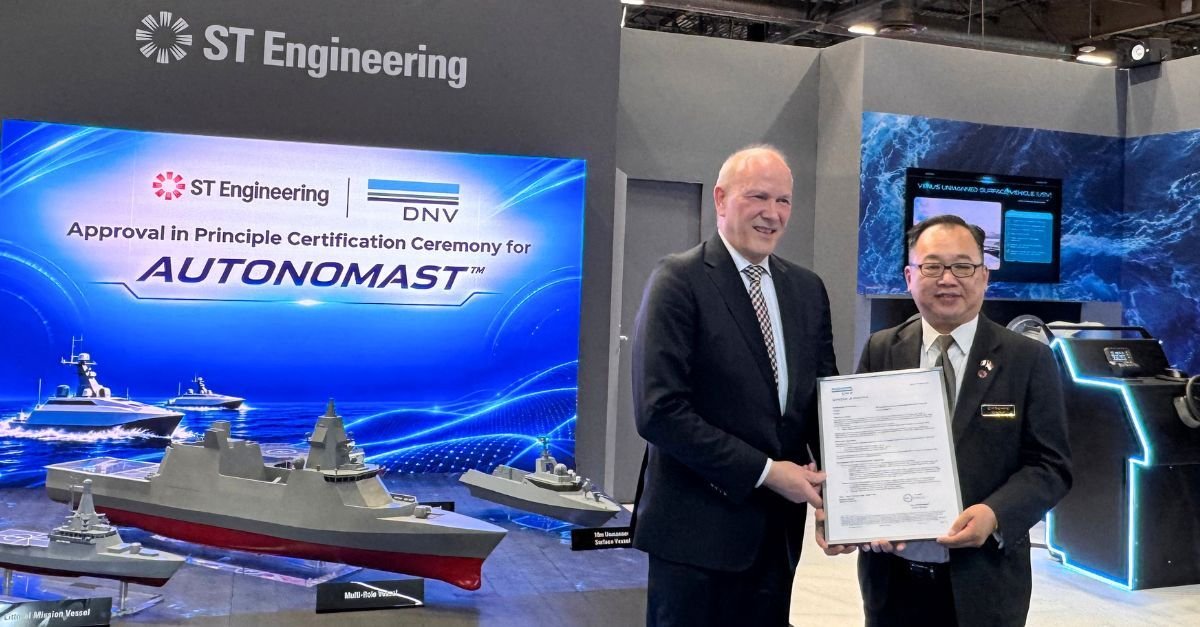
ST Engineering has announced that its AUTONOMAST vessel autonomy kit has received Approval in Principle (AiP) from DNV under its Autonomous and Remotely Operated Ships (AROS) rules. The company describes the achievement as a world first under this framework.
According to ST Engineering’s announcement, the independent assessment covers key autonomous navigation and safety functions, including human-machine teaming, remote supervision, fallback behaviours and fault management. Together with supporting risk assessments, the AiP confirms the feasibility of the AUTONOMAST design and verifies that no significant technical barriers exist to its implementation.
The announcement concerns the assessment of the autonomy solution rather than the delivery of a particular vessel or a new procurement contract. The AiP should therefore not be interpreted as blanket operational approval for every platform and mission profile. It nevertheless represents a step towards independently demonstrating the safety and reliability of autonomous vessel technology.
Converting Existing Vessels into USVs
AUTONOMAST is a modular, all-in-one system designed to convert crewed vessels into unmanned surface vessels (USVs). Adaptable to different vessel types and sizes, it integrates mission controls and payloads to support defence, public safety and maritime security operations.
The conversion approach offers navies and maritime agencies an alternative to immediately purchasing purpose-built unmanned platforms. Instead, operators can introduce autonomous capabilities through existing vessels, with the integration requirements depending on platform characteristics, compatibility with onboard systems and intended missions. This allows unmanned capabilities to be introduced incrementally rather than requiring an immediate fleet-wide transition.
An article published in Naval News in April 2024 reported that AUTONOMAST had been integrated into platforms ranging from 15-metre vessels to Ro-Ro ships. Integration was described as taking between six and 12 months, depending on complexity and compatibility. These figures reflect information provided at that time; the latest announcement does not include a revised integration schedule.

Navigation Safety and Remote Supervision
AUTONOMAST combines data from medium-range radar and 360-degree panoramic vision to provide situational awareness. According to ST Engineering, its Collision Detection Collision Avoidance function enables vessels to avoid surface obstacles while following the International Regulations for Preventing Collisions at Sea (COLREGs). These capabilities support autonomous navigation, particularly in congested waters.
Communications between the operator control station and the USV use secured data links over mesh Wi-Fi, LTE and satellite communications. The company states that the architecture incorporates end-to-end cybersecurity applications. For departure and berthing, operators can use a Portable Remote Control Unit or activate the autonomous berthing function.
ST Engineering says its USVs have been tested in the congested, high-traffic waters of the Singapore Straits since 2008. The 2024 Naval News article reported more than 10,000 hours of operations there. That figure remains historical context: the latest AiP announcement does not provide an updated cumulative operating total.
The scope of the DNV assessment is notable for extending beyond navigation alone. Human oversight, the interaction between operators and autonomous functions, and system responses to faults or abnormal conditions are also covered. These elements are central to assessing how an autonomous vessel behaves when normal operations cannot be maintained.
For navies and maritime security agencies, AUTONOMAST offers a route to adapting existing platforms for patrol, surveillance and other unmanned missions. The DNV assessment supports the feasibility of that design approach, although ST Engineering’s announcement does not identify a new customer, order or service-entry date.
