

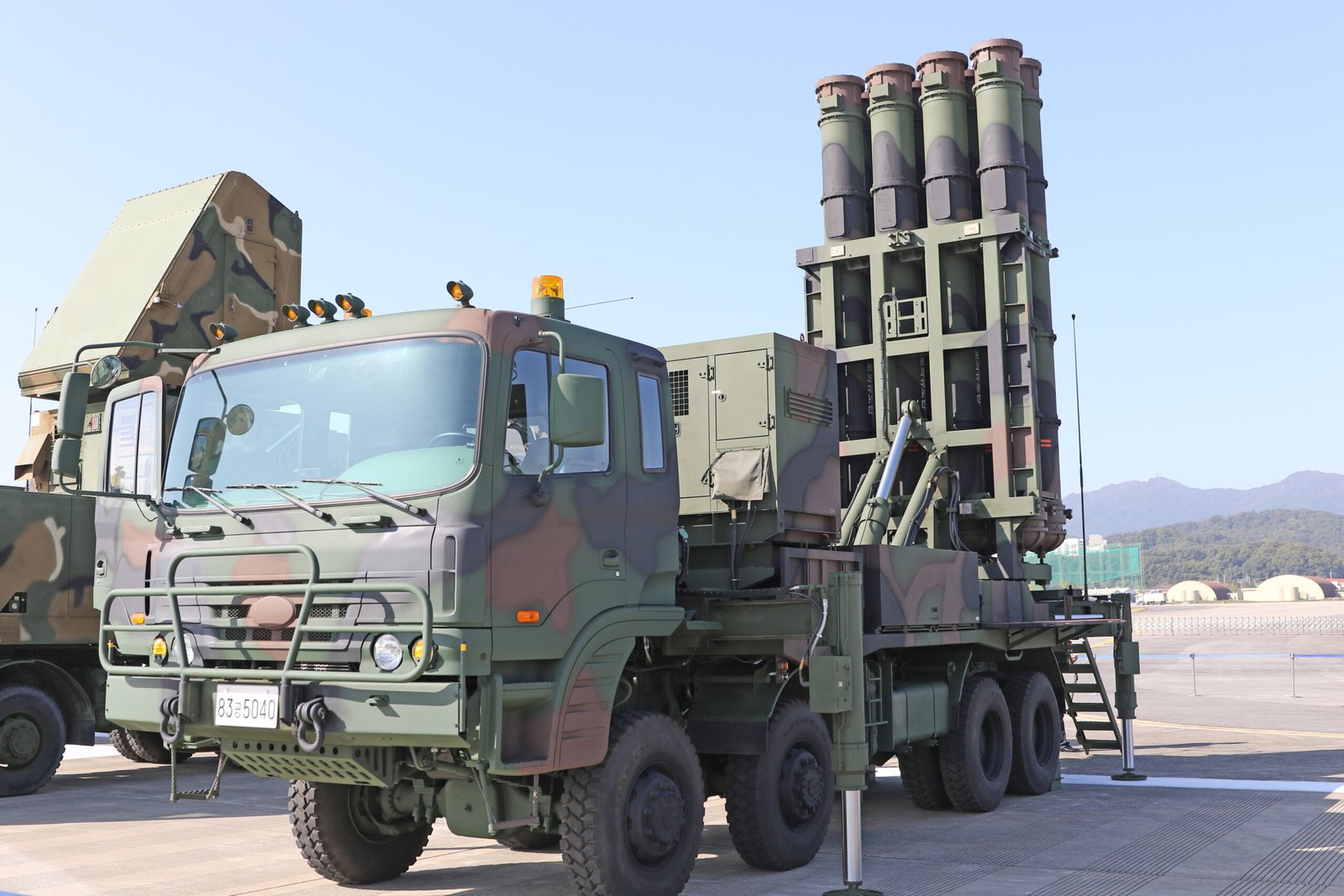
In the wake of the Israel-US attack on Iran that commenced on 28 February, South Korea is rapidly resupplying the UAE with M-SAM Block II medium-range missiles. Meanwhile, two other Middle East nations are awaiting delivery of their M-SAM air defence systems.
A UAE Air Force C-17A transport aircraft was photographed being loaded with M-SAM Block II interceptor missiles at Daegu Air Force Base, South Korea on 9 March. In response to an urgent UAE request, Seoul accelerated delivery of perhaps 30 missiles from the Republic of Korea Air Force (ROKAF) in order to replenish UAE stocks in the wake of Iranian drone and missile attacks.
A South Korean official stated, “Following the outbreak of hostilities, Iran launched a significant number of ballistic missiles and suicide drones, sharply increasing the threat level across the UAE. In response, the UAE government moved quickly to request additional Cheongung-II systems.”
The UAE asked if South Korea can transfer complete M-SAM missile systems already in ROKAF service as well.
Asian Military Review understands the UAE has two M-SAM batteries in service, even while the emirates await another eight batteries plus hundreds of missiles.
Il Sung, President of Hanwha, Middle East & Africa, told Asian Military Review, “At the time we made a contract based on the Korean version, but in Middle Eastern countries the climate is a little different: the summertime is too hot, and it’s also sandy.” He said the climate affects paint and plastic longevity, for instance. “So we made a Middle Eastern version, and then we provided it to the UAE first.”

Sung said the UAE’s upgraded active electronically scanned array (AESA) radar manufactured by Hanwha Aerospace “is already operational”. When speaking to AMR at World Defense Show in Riyadh last month, he said rather presciently, “Because the Iranian crisis is coming up, in the UAE’s case actually we provided it and they wanted to operate it as quickly as possible, so we integrated it into the existing system.”
An M-SAM battery comprises four launchers, the AESA radar and a command centre, and it allegedly costs a third of what a Patriot battery does.
Reports indicate the M-SAM has successfully intercepted Iranian weapons, marking the first time the air defence system has been used in combat. South Korean media report a successful interception rate of more than 90% for the M-SAM against Iranian ballistic missiles. One report cited the UAE as firing 60 interceptors and achieving a shoot-down rate of 94%.
The UAE ordered the M-SAM in January 2022 under a contract worth KRW4.1 trillion (US$3.5 billion). The system is manufactured by LIG Nex1, Hanwha Systems and Hanwha Aerospace. Incidentally, LIG Nex1 signed a strategic partnership with Calidus last November, aimed at eventually manufacturing missiles in the UAE.

Saudi Arabia and Iraq have also signed purchase contracts for the M-SAM, which means Korean production lines are stretched tight.
Sung said South Korean equipment comes with attendant advantages. For example, “Many Middle Eastern countries ask me, is it ITAR-free? Do you know why? Because they’re worried about American-made weapons systems. They’re trying to use them when an emergency is happening, but sometimes they can’t because the Americans block some information and block the systems; they cannot operate.”
However, the Iraq contract could prove very problematic to Seoul. An ex-military official from South Korea posed this question to AMR: “Which threat is in the airspace over Iraq, and which countries have been flying over?” The answer is obviously Israel, a close US ally, which overflies Iraq when attacking Iran.
The source then pointed out, “If Iraq uses the Korean-made M-SAM system, they could be shooting down Israeli planes.” This is politically fraught, for he said South Korea is a strong ally of the USA, as is Israel. Furthermore, South Korea and Israel enjoy strong bilateral coordination in their defence industries.
Regarding other Middle Eastern opportunities, Sung said, “Now I’m promoting the L-SAM system to many countries, not just the UAE and Saudi Arabia, but other countries as well.” He confirmed that all testing is completed on the long-range L-SAM air defence system, and that it is in mass production in South Korea. “So maybe sooner or later, some countries in this region will select this system.”
by Gordon Arthur
