

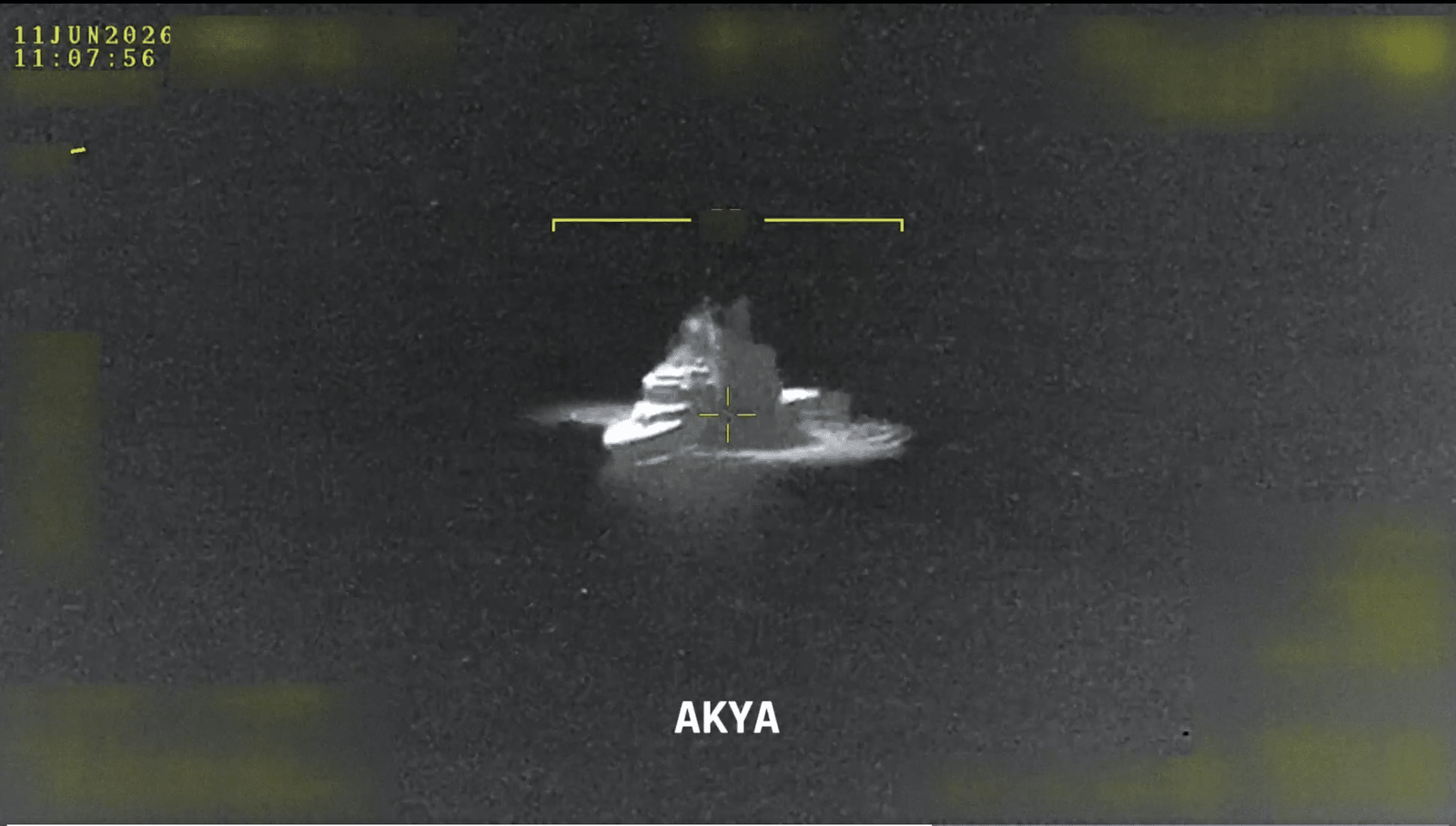
On July 11, 2026, The Turkish Ministry of Defence (MoD) has announced a successful firing of the AKYA heavyweight torpedo in the Eastern Mediterranean during the Denizkurdu II large-scale naval exercise. The MoD also released video footage from the activity as part of the exercise’s Distinguished Observers Day phase, showing the culminating live-fire events and subsequent damage assessments.
According to the MoD announcement and information obtained by Naval News from sources, the AKYA torpedo was fired from TCG Sakarya, a Preveze-class (Type 209/1400) diesel-electric submarine that has been modernized under Türkiye’s ongoing mid-life upgrade effort. The firing was conducted against a decommissioned surface target, and the impact shown in MoD footage indicates the target was destroyed.
The designated target ship was TCG Sokullu Mehmet Paşa (FGS ISAR (A-54)), a former Turkish Navy vessel that served for decades as a cadet training ship and also operated as a command ship in Standing NATO Mine Countermeasures Group 2 (SNMCMG2) missions. Following decommissioning, the ship was employed as a live-fire target. The footage shows the torpedo hit was effective enough to break the vessel into two sections, underscoring the destructive potential of modern underwater warheads against surface hull structures.
First AKYA firing on TCG Sakarya via the MÜREN CMS
A key aspect of the Denizkurdu II firing is the combat system configuration used onboard the launching submarine. TCG Sakarya is among the Preveze-class boats receiving Türkiye’s indigenous MÜREN Submarine Combat Management System (CMS). According to Naval News sources, this event represented the first AKYA firing conducted on TCG Sakarya using the MÜREN CMS, and the second AKYA firing against a real surface target overall.
MÜREN (Milli Üretim Entegre Sualtı Savaş Yönetim Sistemi – Indigenously Produced Integrated Underwater Combat Management System) is designed to replace legacy combat system elements aboard the Ay, Preveze and Gür-class submarines as part of a broader modernization push. The system integrates sensor inputs, navigation, command-and-control functions, and weapon employment processes, with a focus on indigenous control over mission-critical software and hardware. The MÜREN effort has been carried out under national institutions and Navy organizations, and it is aligned with the Preveze-class mid-life upgrade that also introduces updated sonar and associated processing capabilities.


For operators, the operational significance of a CMS transition is practical: it changes how sonar data is processed and displayed, how tracks are built and managed, how fire control solutions are generated, and how weapon guidance, particularly wire-guided torpedoes, is handled through the engagement timeline. A live firing during a major exercise therefore functions as both an operational demonstration and a high-value integration milestone.
ATMACA missile strike from TCG Kınalıada
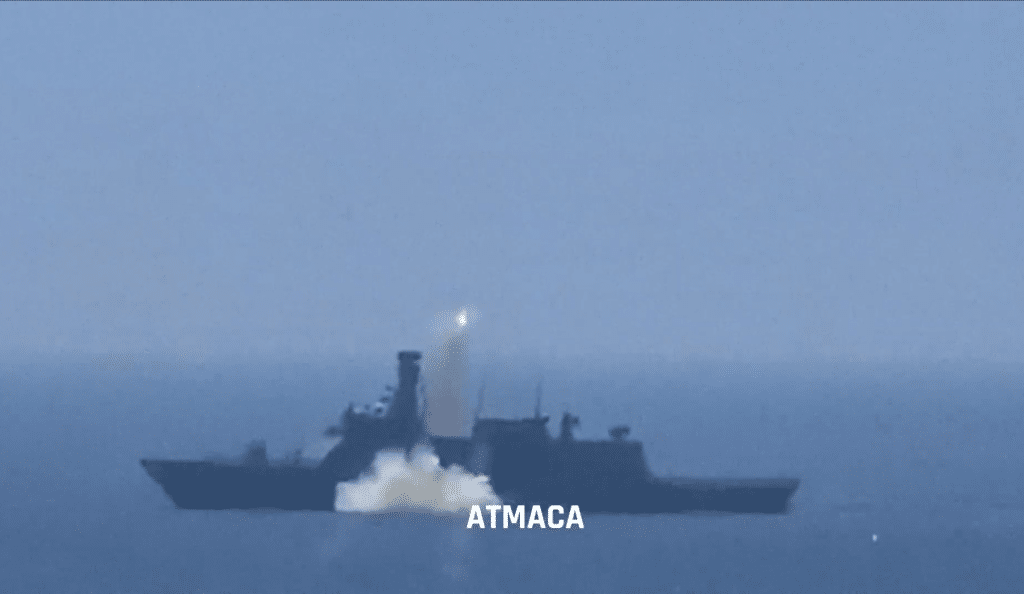
In addition to the submarine-launched engagement, the Turkish Navy demonstrated its surface-to-surface strike capabilities with the ATMACA missile. The indigenous guided missile was launched by the Ada-class corvette TCG Kınalıada. The missile successfully struck its target, the ex-TCG Akbaş, an open-sea tugboat that served in the Turkish Navy for several decades.
The simultaneous testing of AKYA and ATMACA against real surface targets underscores the increasing operational integration of Türkiye’s domestically developed missile and torpedo families.
About AKYA heavyweight torpedo

AKYA is Türkiye’s indigenous 533 mm heavyweight torpedo intended to equip submarines for engagements against both submarines and surface ships. In public specifications released by the manufacturer, AKYA is described as a high-speed, long-range design that can operate autonomously or under fibre-optic wire guidance. Its seeker suite includes active and passive sonar, with features described as providing resilience against acoustic countermeasures. For surface targets, AKYA also incorporates wake homing guidance.
Key characteristics publicly associated with the torpedo include:
- Range: 50+ km
- Speed: 45+ knots
- Guidance: active/passive sonar, wake guidance; autonomous or fibre-optic wire-guided modes
- Fuzing: proximity and impact
- Warhead: insensitive warhead type with an underwater shock effect
- Launch: swim-out
- Propulsion: electric motor with counter-rotating propellers; high-energy chemical battery
The AKYA program has progressed through a sequence of submarine-launched tests, including earlier firings without a warhead and a later live-warhead event that demonstrated the weapon’s terminal effectiveness. The Denizkurdu II firing, conducted in a high-visibility exercise setting and paired with MoD-released video, adds another data point, this time emphasizing operational integration aboard a modernized Preveze-class submarine and the use of a full-scale decommissioned target ship.
AKYA is expected to play a central role in Türkiye’s efforts to localize critical submarine weapon systems. Turkish submarines currently rely on a mix of German DM2A4 SeaHake and U.S.-made Mk48 heavyweight torpedoes. As serial production and fleet integration progress, AKYA is expected to become the standard heavyweight torpedo for the Preveze and Gür classes, as well as the Reis-class (Type 214TN) submarines. Combined with the introduction of the indigenous MÜREN combat management system, the torpedo is a key element of Türkiye’s drive to establish a nationally controlled underwater warfare ecosystem.
