

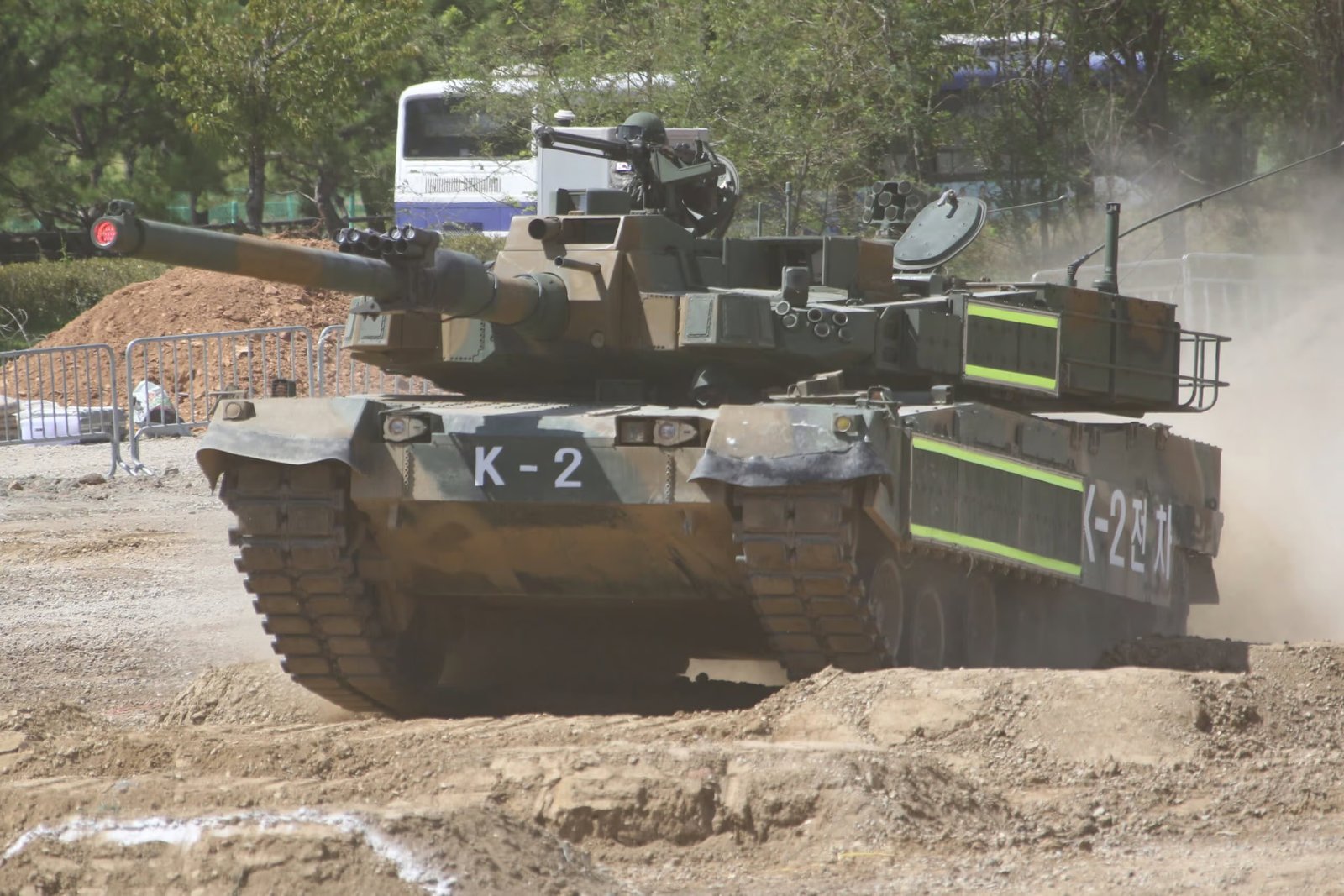
On 11 August 2026, the 177th Defense Project Promotion Committee met in Seoul to approve two new defence projects. One of these related to the K2 main battle tank (MBT) fleet of the Republic of Korea Army (ROKA).
The new project’s aim is to improve the combat performance of the K2 and to enhance its protection against adversarial threats.
The Defense Acquisition Program Administration (DAPA) stated: “Through this project, K2 tanks will be equipped with active protection systems (APS), drone and improvised explosive device jammers, and remote weapon systems. They are expected to intensify their response to future battlefield threats such as anti-tank rockets, missiles and self-destructing drones.”
The project’s basic strategy was approved at the committee meeting, and it covers the 2028-46 period. This extended time timeframe suggests a phased approach to introducing the APS and other elements. However, DAPA expects the first upgraded tanks to begin entering service in 2033.
A budget of KRW3.448 trillion (US$2.41 billion) was allocated for development of this protective suite to be installed on the army’s K2 tanks. It comes as North Korea has prioritised mass-produced loitering munitions designed to hit targets like the K2.
The K2 APS will use a radar to detect incoming missiles and threats, and hard-kill measures to counter them. Meanwhile, the RWS will allow crewmembers to address targets while staying safely inside the vehicle.

Both Hyundai Rotem and Hanwha have been working on APS suites. The former’s design has radar sensors on the turret to detect incoming threats. It displayed this system on a K2 at Seoul ADEX 2023, for example, along with a Hyundai Rotem RWS and drone jammer system.
As well, Hanwha Systems has been developing an APS for the K-NIFV infantry fighting vehicle. Its Next-Generation Active Protection System (NG-APS) integrates four radar panels plus electro-optic/infrared sensors providing 360° passive and active surveillance. Exhibited in Riyadh in February 2026, the NG-APS features artificial intelligence that automatically launches hard-kill interceptors from two vehicle-mounted launchers. These launchers can fire at high angles to address top-attack threats. Hanwha Systems said the NG-APS should begin testing in 2027.

Despite these indigenous developments, Hyundai Rotem and Rafael signed a teaming agreement last year to integrate the latter’s Trophy APS onto Polish K2PL MBTs. At the time, Rafael also said the agreement could apply to “future platforms for the Republic of Korea”.
The ROKA has ordered four batches of K2 tanks to date, totalling well over 300 vehicles. The most recent contract was in 2024, with those destined to be delivered by 2028. Overall, the ROKA wants around 600 K2 tanks in service.
In other news, DAPA launched a programme in August last year to upgrade ROKA wheeled armoured vehicles too. That KRW47.6 billion effort will install components such as RWS, tactical multiband multirole radios, omnidirectional surveillance cameras and new screen displays.
The agency did not reveal which vehicles would receive the upgrades. However, it presumably includes the K808 and K806, since the approval to proceed followed talks with Hyundai Rotem. The new equipment will start being installed by 2029 to “increase the mission performance and survivability” of troops.
The radios will likely emanate from LIG Defense & Aerospace. These software-defined radios will allow the vehicles to share information with the ROKA’s battalion-level battle command system.
by Gordon Arthur
