

Key Points
- REGENT’s Squire Seaglider drone completed a 13-day electronic warfare exercise called Silent Swarm in Michigan, ending July 24.
- The company holds a $15 million U.S. Marine Corps contract and has development ties with U.S. Special Operations Command and the Coast Guard.
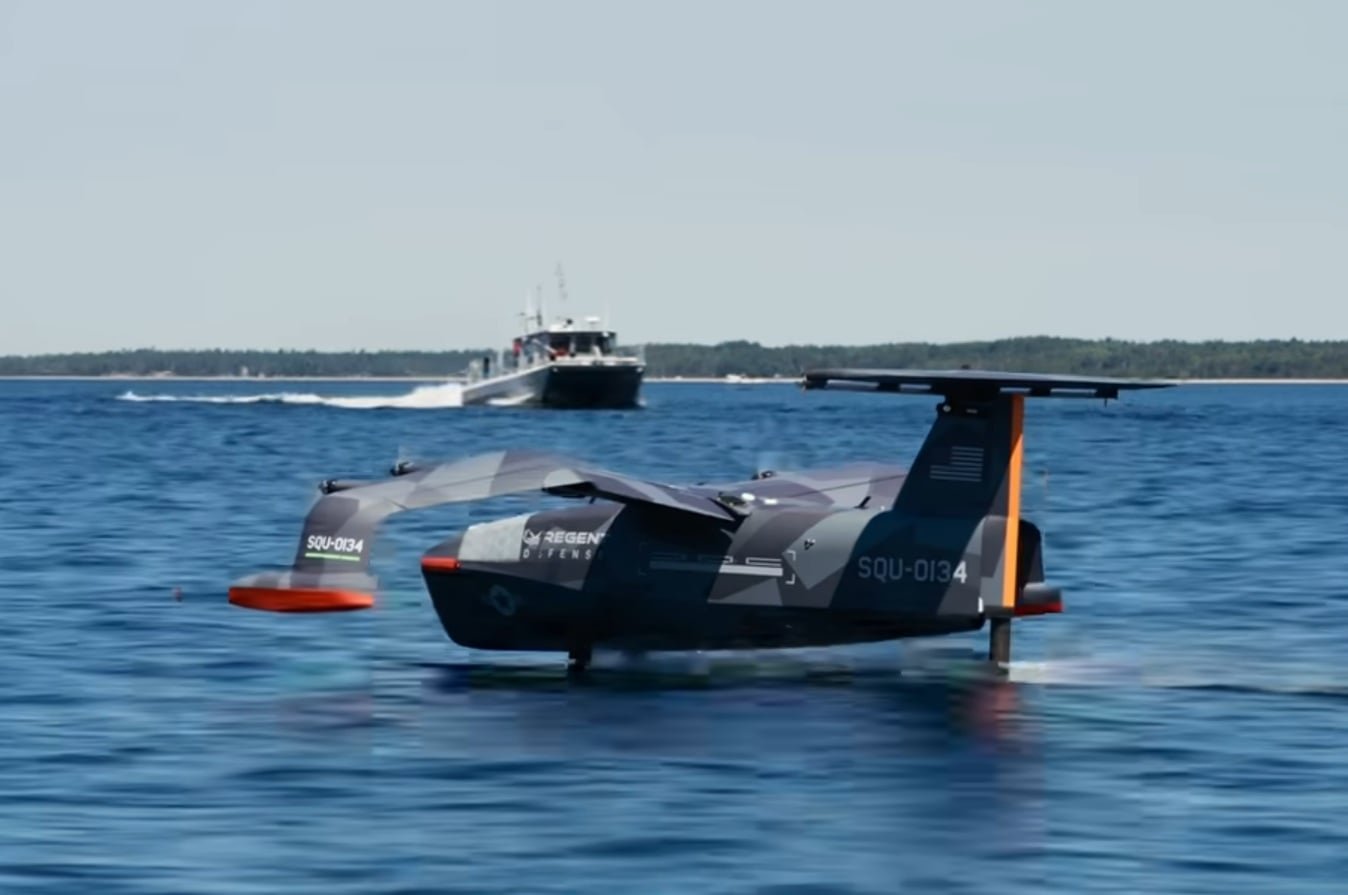
REGENT Craft’s autonomous Seaglider drone, Squire, took part in a 13-day military experimentation event called Silent Swarm in Michigan, testing electronic warfare payloads alongside uncrewed systems from across the U.S. military, the Rhode Island-based company announced Tuesday.
Silent Swarm ran July 13 to 24 across Michigan’s Northern Lower Peninsula and the Alpena Combat Readiness Training Center, using the site’s combined ranges, airspace and waterways. The event was sponsored by the Office of the Under Secretary of War for Research and Engineering’s Quantum and Battlefield Information Dominance office and led by Naval Surface Warfare Center Crane, with participation from the Michigan National Guard, Naval Information Warfare Center Atlantic, NOAA, the Army’s C5ISR Center and the Air Force Test Center.
The exercise focused on electromagnetic spectrum operations, testing how small, multi-domain uncrewed systems can employ and defend against signals including radar, communications, navigation, infrared and directed energy. Squire operated with various payloads across multiple mission types over the 13 days, testing electronic attack, electronic protection and electronic warfare support roles. REGENT said the event gave the company feedback from military and civilian experts across the Air Force, Army, Coast Guard, Marine Corps and Navy.
– ADVERTISEMENT – CONTINUE READING BELOW –
“Silent Swarm gave us the chance to show key defense stakeholders exactly what our autonomous Seaglider drone, Squire, can do in an operationally relevant setting,” said Billy Thalheimer, co-founder and CEO of REGENT. “Our team has worked relentlessly to get us here, and this demonstration proves Squire is ready to deliver the capability our warfighters urgently need.”
“I’ve seen how long it can take promising technology to reach the fleet,” said Admiral William Moran, former vice chief of naval operations for the U.S. Navy and a member of REGENT’s Defense Advisory Board. “Squire’s performance at Silent Swarm demonstrates a program moving at the speed our warfighters need. This is exactly the kind of capability and urgency the defense community should be paying attention to.”
Squire is what REGENT calls a Seaglider USA-V, a wing-in-ground-effect craft that flies within a wingspan of the water’s surface, below line-of-sight radar coverage. The company said the platform can reach speeds up to 70 knots, has a planned operational range exceeding 100 nautical miles (185 kilometers) and can carry a configurable payload of up to 50 pounds (23 kilograms). REGENT has marketed Squire for intelligence, surveillance and reconnaissance missions, tailored logistics, search and rescue, and anti-submarine warfare.
Squire flew for the first time in April, a flight REGENT said was the first U.S. test of a defense-specific wing-in-ground-effect craft. Earlier this year, REGENT also completed live rescue and logistics missions with the U.S. Marine Corps Warfighting Lab, including a dockside litter boarding, a beach extraction and an open-water life raft rescue, testing the Seaglider platform for medical and casualty evacuation.
REGENT holds a $15 million contract with the U.S. Marine Corps and has formal development relationships with U.S. Special Operations Command and the U.S. Coast Guard Research and Development Center. The company has also signed defense agreements with partners across four continents. REGENT did not disclose a timeline for when Squire might reach operational deployment.
