

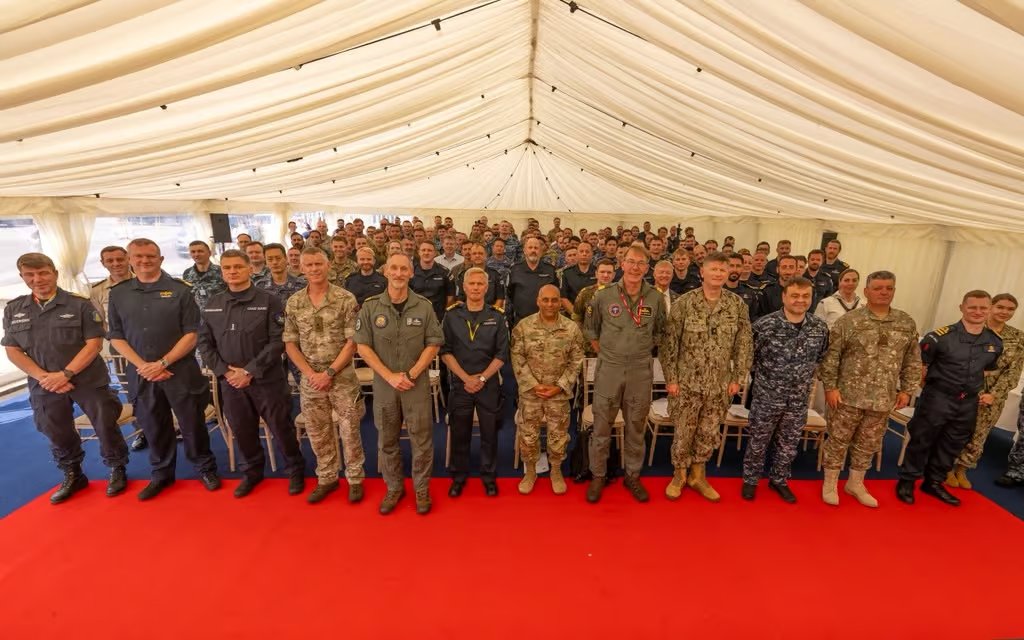

In an exercise underway off the UK, 15 countries – NATO allies, plus partners – are concentrating on enhancing combat capability in naval mine warfare (NMW) operations.
Exercise ‘Sea Breeze’, taking place in mid-July, unites NATO allies—especially Black Sea member states—and other partners to train on mine counter-measures (MCM) and other NMW tasks to enhance interoperability and operational capabilities. This second edition of ‘Sea Breeze’ in 2026, co-hosted by the United States and Ukraine and organised through US Sixth Fleet and NATO Allied Maritime Command (MARCOM), includes participants from Bulgaria, Denmark, Estonia, France, Georgia, Greece, Japan, Latvia, Poland, Spain, Sweden, Türkiye, and the UK.
The NMW exercise, which is taking place in the English Channel off Portland, will include mine-hunting operations using mine countermeasures vessels (MCMVs), explosive ordnance disposal (EOD) team tasks, dive and salvage operations, and the deployment of maritime uncrewed systems including uncrewed underwater vehicles (UUVs) and uncrewed surface vessels (USVs), US Sixth Fleet said in a statement.
The statement specifically highlighted the focus of the exercise on system interoperability and warfighting capabilities within a complex, multi-domain environment (simulated in the Black Sea region), supported by staff planning, command and control (C2), and tactical execution. Maritime skills practised and demonstrated will include mine hunting; EOD operations; developing precision diving and salvage techniques; delivering effective deployment and integration of UUVs and USVs, including to augment multi-domain maritime situational awareness; electronic warfare exploitation and countermeasures; and enhancing staff planning and targeting capabilities.
Overall, the exercise will involve the assembled navies integrating new technologies and capabilities into realistic operational scenarios, refining how to plan and fight together, and building a more ready and responsive force.
“Every evolution we conduct together strengthens the readiness and lethality of our combined force, ensuring we are prepared to defend our shared interests and maintain security across one of the world’s most strategically important maritime regions,” Vice Admiral JT Anderson, Commander, US Sixth Fleet, said in the statement.
What stands out from the US Sixth Fleet announcement is the exercise’s focus on enhancing NMW in terms of combat capability. The latest issue of NATO’s Allied Maritime Strategy (AMS), published in October 2025, highlighted the increased importance of NMW as a high-end operational output to secure sea lines of communication (SLOCs), littorals, and chokepoints in response to threats from state-based adversaries.
Furthermore, while the exercise concentrated on Black Sea developments and particularly on the NMW lessons Ukraine is learning there, its location in the English Channel near the Dover Strait chokepoint (and with NATO’s focus on securing the Kattegat/Skagerrak Straits connecting the North and Baltic Seas, too) highlights the necessity of demonstrating NMW capability on a broader geostrategic scale.
The first ‘Sea Breeze’ iteration for 2026 occurred in Romanian waters in June.
by Dr. Lee Willett
