

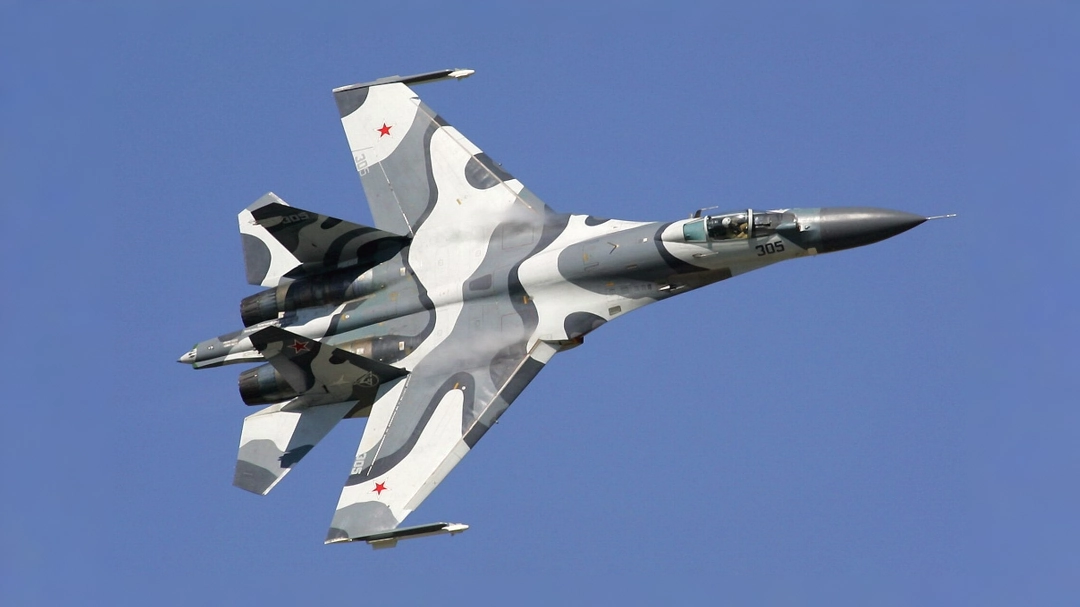
There are fighter jets… and then there are aircraft that become mythology with wings.
The Sukhoi Su-27 belongs squarely in the second category.
Even people who couldn’t identify a MiG from a mailbox have probably seen footage of a giant twin-engine jet pulling impossible maneuvers at air shows, nose pointed skyward, seemingly hanging in midair like gravity forgot to clock in.
That airplane was usually the Su-27 Flanker. And when Western pilots first saw it perform in the late Cold War years, the reaction wasn’t casual curiosity. It was concern. Real concern.
Because the Soviet Union hadn’t just built another interceptor. It had built a machine designed to chase down America’s best fighters and survive the kind of brutal air combat planners hoped would never happen.
What makes the Sukhoi Su-27 fascinating isn’t only its speed or size, though both are impressive. It’s the strange contradiction baked into the aircraft.
The jet is huge, almost shark-like in silhouette, yet dances through the sky with the agility of something much smaller. One retired NATO pilot once described watching a Flanker demonstration as “seeing a freight train perform ballet.” Oddly accurate.
And decades later, the aircraft still matters.
Modern Russian fighters like the Su-30, Su-33, and Su-35 all trace their DNA back to this airframe. China’s J-11 series? Same bloodline. Even current debates around air superiority in Eastern Europe still circle back to the Sukhoi Su-27 and its descendants.
In this post, you’ll explore how the Su-27 was developed, why it terrified Western analysts in the 1980s, how its aerodynamics changed fighter design forever, and why pilots still talk about the Flanker family with a kind of grudging admiration.
What Is the Sukhoi Su-27 Flanker?
The Sukhoi Su-27 Flanker wasn’t supposed to be merely “good enough.” Soviet engineers designed it with a much more ambitious goal: build a fighter that could outfly, outrange, and outlast America’s newest air superiority jets, especially the F-15 Eagle.
That pressure mattered. During the early 1970s, Soviet intelligence kept a close eye on Western aviation programs, and what they saw caused headaches inside the Kremlin.

The United States was producing fighters with stronger radar systems, better missiles, and pilots trained around flexible dogfighting doctrine rather than rigid command structures. Moscow needed a response. Fast.
So the Sukhoi Design Bureau went to work.
The result became the Su-27, a long-range air superiority fighter that looked unlike most Soviet aircraft before it. Earlier Soviet jets often prioritized raw speed and interception capability over pilot comfort or agility. The Flanker changed that equation. It combined brute power with elegant aerodynamics, almost a contradiction in metal form.
Its first flight came in 1977, though the aircraft suffered serious developmental problems early on. In fact, the original prototype performed poorly enough that Sukhoi engineers practically redesigned the jet from scratch. That rarely gets discussed outside aviation circles, but it’s one of the reasons the final aircraft became so refined. Failure forced innovation.
By the mid-1980s, the Su-27 officially entered Soviet service.
And Western observers noticed immediately.
The aircraft carried two Saturn AL-31F turbofan engines capable of pushing the fighter past Mach 2. It had a combat range that surprised NATO planners and maneuverability that seemed borderline absurd for such a large aircraft.
Then came the famous “Pugachev’s Cobra” maneuver, the nose lifting dramatically while the aircraft maintained forward motion. Air show crowds loved it. Military analysts, less so.
Underneath the spectacle, though, the Sukhoi Su-27 was built around a simple strategic idea: dominate contested airspace before enemy bombers or fighters could threaten Soviet territory.
Cold, practical logic. Wrapped in one of the most visually intimidating fighters ever built.
Sukhoi Su-27 Specifications
Looking at the Sukhoi Su-27 on paper is a little deceptive. The numbers suggest a heavy Cold War brute, large frame, twin engines, massive fuel capacity. Yet pilots often describe the aircraft as surprisingly “alive” in the air, more like a gymnast than a missile truck.
That’s the magic of the Flanker design.
The Su-27 measures roughly 21.9 meters (72 feet) long with a wingspan just under 15 meters. Empty, it weighs around 16,000 kilograms, but fully loaded it can exceed 30,000 kilograms. In plain language? This thing is enormous for a fighter jet. Park one beside an F-16 and the difference feels almost comical.
Yet despite its size, the aircraft was engineered around aerodynamic efficiency rather than sheer engine force alone.
| Specification | Sukhoi Su-27 Flanker |
| Role | Air Superiority Fighter |
| Length | 21.9 m |
| Wingspan | 14.7 m |
| Max Speed | Mach 2.35 |
| Combat Range | ~1,340 km |
| Service Ceiling | 19,000 m |
| Engines | 2 × Saturn AL-31F |
| Max Takeoff Weight | ~30,450 kg |
| Internal Cannon | 30mm GSh-30-1 |
The twin AL-31F turbofan engines produce about 27,500 pounds of thrust each with afterburners engaged. Together, they give the Su-27 an intimidating thrust-to-weight ratio, especially when lightly armed. Pilots have compared its acceleration to “being kicked by a building.” Subtle? Not exactly.
One reason the aircraft became legendary is its blended wing-body configuration. Instead of sharply separating the fuselage and wings, Sukhoi engineers smoothed everything together into one flowing shape.
The design generates extra lift during high-angle maneuvers, which explains why the jet can perform aerobatic stunts that still look faintly illegal.
The fly-by-wire control system also mattered. Soviet aviation traditionally lagged behind the West in avionics, but the Flanker represented a leap forward. It allowed controlled instability, meaning the aircraft was intentionally designed to be aerodynamically twitchy because unstable jets can turn faster.
Risky engineering. Brilliant payoff.
And honestly, that balance between danger and elegance defines the Sukhoi Su-27 better than any statistic ever could.
Weapons and Combat Systems
The Sukhoi Su-27 may be famous for dramatic aerobatics, but the aircraft was never designed as an air show celebrity. Its real purpose was much colder: find enemy aircraft far away, lock onto them first, and destroy them before they even understood the threat.
Everything about the Flanker’s combat systems reflects that philosophy.
At the center of the aircraft sits the N001 pulse-Doppler radar, a system built to track multiple airborne targets simultaneously. During the 1980s, this was a serious capability upgrade for Soviet aviation.
Western analysts had long assumed Soviet fighters relied heavily on ground-controlled interception. The Su-27 changed the equation by giving pilots far greater independent targeting capability.
Then came the missile package.
The aircraft typically carried combinations of R-27 medium-range missiles, R-73 short-range infrared missiles, and later compatibility with the R-77 active radar-guided missile.
The R-73 especially caught NATO’s attention because it worked with a helmet-mounted sight system. A pilot could literally look toward an enemy aircraft and cue the missile seeker using head movement. At the time, that felt almost unfair.
| Weapon System | Purpose |
| R-27 (AA-10 Alamo) | Medium-range interception |
| R-73 (AA-11 Archer) | Close-range dogfighting |
| R-77 (AA-12 Adder) | Beyond-visual-range combat |
| GSh-30-1 30mm Cannon | Internal gun system |
| Hardpoints | Up to 10 external stations |
The internal 30mm GSh-30-1 cannon deserves mention too. It fires massive high-velocity shells at roughly 1,500 rounds per minute. Compared with smaller Western aircraft cannons, the Su-27’s gun hits like a sledgehammer. Short bursts. Enormous damage.
What often gets overlooked, though, is fuel capacity.
The Sukhoi Su-27 carries an unusually large internal fuel load for a fighter aircraft, allowing long patrol durations without external tanks. Soviet planners needed fighters capable of covering huge geographic distances, Siberia alone practically demanded it. That range advantage still makes the Flanker family dangerous today.
Oddly enough, the aircraft’s weapons systems weren’t necessarily revolutionary individually. The real strength came from integration: radar, missiles, maneuverability, and endurance all working together as one coherent combat machine.
A predator built for very large skies.
Combat and Operational History
For all the fascination surrounding its aerobatics and engineering, the Sukhoi Su-27 ultimately had to answer one uncomfortable question every military aircraft faces sooner or later:
What happens when the show ends and the shooting starts?
The answer is complicated. The Su-27’s operational history stretches across collapsing empires, regional wars, political breakups, and modern drone-saturated battlefields that its original designers could never have imagined.
When the aircraft entered Soviet service in the 1980s, its primary role was defensive air superiority. The mission sounded straightforward enough: patrol enormous Soviet airspace, intercept NATO bombers, and challenge enemy fighters before they could threaten strategic targets. Given the geography involved, that was no small task. A Flanker pilot flying over Siberia could feel less like a fighter ace and more like a lonely astronaut.
After the Soviet Union collapsed in 1991, the Su-27 suddenly scattered across newly independent states. Ukraine inherited a sizable fleet. Belarus received some. Russia retained the largest share. For a while, it was oddly chaotic, one superpower’s air force chopped into pieces overnight.
| Country | Su-27 Operator Status |
| Russia | Active |
| Ukraine | Active |
| China | Operated & locally produced |
| Vietnam | Active |
| Indonesia | Active |
| Ethiopia | Active |
The aircraft later appeared in conflicts across Africa and Eastern Europe. Ethiopia used Su-27s during the Eritrean-Ethiopian War in the late 1990s, where Flankers reportedly achieved several aerial victories against MiG-29s. Those engagements became a rare modern example of Soviet-designed fighters facing each other in actual combat.
Then came the war in Ukraine.
Modern warfare exposed both the strengths and weaknesses of older fourth-generation fighters like the Sukhoi Su-27.
The aircraft still possesses speed, range, and missile capability, but increasingly lethal surface-to-air systems and networked radar environments make survival much harder than Cold War planners expected.
And yet, despite drones dominating headlines, the Flanker remains relevant.
That’s partly because the aircraft was built with extraordinary structural durability. Soviet engineers expected rough airfields, harsh climates, and long service lives. The result is a machine that keeps flying long after many analysts predicted retirement.
Not glamorous. Just stubbornly effective.
Which, in a strange way, feels very Soviet.
Su-27 vs F-15 Eagle
The rivalry between the Sukhoi Su-27 and the F-15 Eagle wasn’t born in the sky. It started in briefing rooms, intelligence reports, satellite photos, and nervous Cold War calculations made by men staring at maps under fluorescent lights.
Each aircraft existed because of the other.
When the United States introduced the F-15 in the 1970s, Soviet planners were alarmed.
The Eagle combined powerful radar, long-range missiles, and extraordinary maneuverability into a single platform. It threatened decades of Soviet assumptions about aerial combat. The Kremlin needed a counterweight, and the Su-27 became that answer.
On paper, the matchup looked surprisingly even.
| Feature | Su-27 Flanker | F-15 Eagle |
| Top Speed | Mach 2.35 | Mach 2.5 |
| Combat Radius | Longer | Shorter |
| Maneuverability | Exceptional | Excellent |
| Radar Quality | Strong | Historically superior |
| Missile Load | Heavy | Heavy |
| Airframe Size | Larger | Smaller |
The F-15 emphasized avionics, radar performance, and beyond-visual-range combat efficiency. The Su-27 leaned harder into aerodynamic agility and endurance. Different philosophies entirely.
An American pilot once described the Eagle as “a sniper rifle.” The Flanker? “A sword.”
That comparison actually fits.
At close range, the Sukhoi Su-27 gained enormous respect because of its high-angle maneuverability and helmet-mounted targeting system paired with the R-73 missile.
During joint exercises in the 1990s, some Western pilots admitted the Archer missile system genuinely worried them. If a Flanker pilot could visually acquire you, even briefly, you were already in danger.
But the F-15 had advantages too, especially in radar reliability, pilot ergonomics, and electronic warfare integration. American training doctrine also tended to produce more flexible tactical decision-making during that era.
Interestingly, neither aircraft ever achieved a clean “winner” status among aviation experts. Discussions still become borderline religious online. Forums descend into chaos. Retired pilots argue in documentaries with the energy of football fans defending rival clubs.
Maybe that’s because both jets succeeded at exactly what they were built to do.
The F-15 dominated Western air superiority doctrine.
The Su-27 proved the Soviet Union could still build a fighter capable of frightening the West.
And during the Cold War, that alone carried enormous strategic weight.
Why the Su-27 Flanker Became Legendary
The Sukhoi Su-27 Flanker didn’t become legendary because of one battle or a single technical breakthrough. Its reputation grew the way myths usually do, through moments that made people stop and stare.
When the aircraft appeared at international air shows in the late 1980s, Western audiences expected another fast Soviet interceptor. Instead, they saw a giant twin-engine fighter performing maneuvers that looked almost unreal.
The most famous was the Pugachev’s Cobra, where the jet suddenly pitched its nose upward to near vertical before recovering smoothly. Pilots watching from the ground reportedly reacted with equal parts admiration and alarm.
What made the Su-27 special wasn’t only agility. It was the contradiction of the machine itself. The aircraft was massive, heavily armed, and built for long-range combat, yet it moved with the grace of a much lighter fighter.
Its appearance helped too, and that sounds superficial until you realize military aviation has always carried symbolism. The Flanker looked intimidating even sitting still: long nose, spaced engines, broad wings, twin tails. Predatory. Almost cinematic.
The aircraft’s legacy expanded through its descendants, including the Su-30 and Su-35, which still serve in modern air forces today.
That’s the remarkable part.
Many Cold War fighters became museum pieces.
The Sukhoi Su-27 became a dynasty.
