

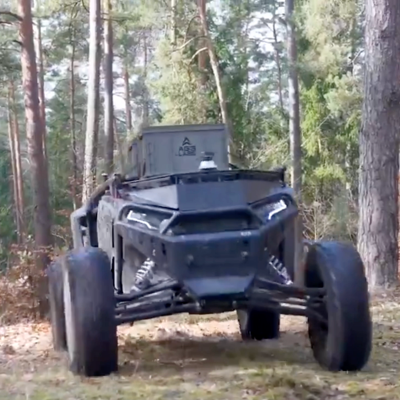
NATO is studying how to use ground and air robots to replace human soldiers in assaults, something Ukraine has been doing for more than a year. But that hasn’t stopped Russia’s continuous assault with its own, increasingly autonomous one-way attack drones.
On Tuesday, Ukrainian President Volodymyr Zelensky made a social-media splash with a video describing a historic first from last July: a skirmish in which Russian troops surrendered to Ukrainian robots.
“The future is already on the front line—and Ukraine is building it,” Zelenskyy said in the video, adding that Ukrainian robotics companies “have already carried out more than 22,000 missions on the front in just three months.”
Still, the Ukrainian president offered far fewer details than did Ukraine’s 3rd Assault Brigade in its own July 2025 post.
“Enemy fortifications were attacked” by first-person-view aerial drones and ground robots armed with explosives and made by Nazemnyi Robotychnyi Kompleks, the post said. “The next robot was already approaching the destroyed dugout when the enemy, in order to avoid being blown up, announced surrender. The occupiers who survived were taken to our lines by ‘birds’ [aerial drones] and, according to the regulations, taken prisoner.”
“The operation was carried out without infantry and without losses on our side,” it said. “The occupiers surrendered to the ground robots of the Third Assault!”
Ukraine’s ground-robot game advanced quickly in the following months, said Olena Kryzshanivska, a senior editor at the NATO Association of Canada who first relayed the news to English-language audiences.
“Already…[by the] beginning of this year, we saw several documented cases when UGVs [unmanned ground vehicles] were used for strike missions. They were either delivering grenades [or] they were sometimes … attacking trenches, attacking Russian troops,” Kryzshanivska said in February during a podcast with CNAS adjunct senior fellow Sam Bendett.
That sort of combined robotic fast maneuver is one of the ways Ukraine is forcing a reconsideration of decades of military doctrine, and NATO is taking notice. In February, its Allied Command Transformation announced the extension of a study on Force Lethality Enhancement to build out “a few practical force options and test them against realistic scenarios to see what works, and what it would take to use them on operations.”
Another alliance effort to integrate ground robots, part of the multidomain Task Force X, is being led by Brig. Gen. Chris Gent, NATO deputy chief of staff transformation and integration.
Venture capitalists are taking note as well. Eric Brock of Ondas Capital told Defense One in January that his firm is investing in “ground robots that are tailored towards defense and homeland security but also critical infrastructure protection in certain places.”
Challenges
The biggest constraint in using first-person-view drones is that an operator can generally fly just one at a time. But the drone can fly itself to waypoints, loiter in the air, and reconnect after brief communications interruptions.
Ground robots, by contrast, need constant attention because navigation remains a technical challenge, John Hardie, of the Foundation for the Defense of Democracies, told reporters in February. And UGV operators must also stay in frequent contact with the operators of the aerial drones above.
“My understanding is that they’ve experimented with autonomous navigation, but it’s especially difficult with [unmanned ground vehicles] for that to be reliable. So I don’t think they’re there yet,” Hardie said.
Ukraine has also been hunting for alternatives to GPS, which is jammable. Since 2023, it has been experimenting with visual- and terrain-matching systems and other AI-powered ideas for long-range navigation, Hardie said.
Russia, too, has carried out robotic operations in large volumes. But they’re limited to strikes with one-way attack drones like Shaheds and, occasionally evacuation of the wounded, not taking positions.
The Lancet drones produced by Russia’s ZALA company are guided on final approach to their targets by matching camera imagery to preloaded maps. It works well enough—because Russian forces place less of a premium on collateral damage or striking the right target.
For Ukrainians, the goal is greater autonomy, allowing one operator to preside over fleets of ground and air robots but with confidence that they will perform the mission assigned, hit the target that they’re supposed to hit and not simply whatever happens to be there when the drone finally arrives. It’s the same sort of complex multi-drone swarm capability that the Pentagon is seeking to develop.
Ukrainian Air Force Capt. Max Maslii, deputy chief of staff for the 96th Anti-Aircraft Missile Brigade, described that goal as a departure from the way Russia operates “autonomous” drones like the Lancet, as isolated flying bombs.
Under the “new paradigm,” Maslii told Defense One, the drones would be able to “find the … more efficient way to accomplish this mission, together with such machines.” At that point, he said, operators wouldn’t be stuck piloting one drone at a time. They would work more like technicians managing a larger, more complex system.
“Our job will be … to produce a lot of drones, to put them in the proper place, to take care [of] the systems that manage those drones, and just to, you know, turn them on.”
