

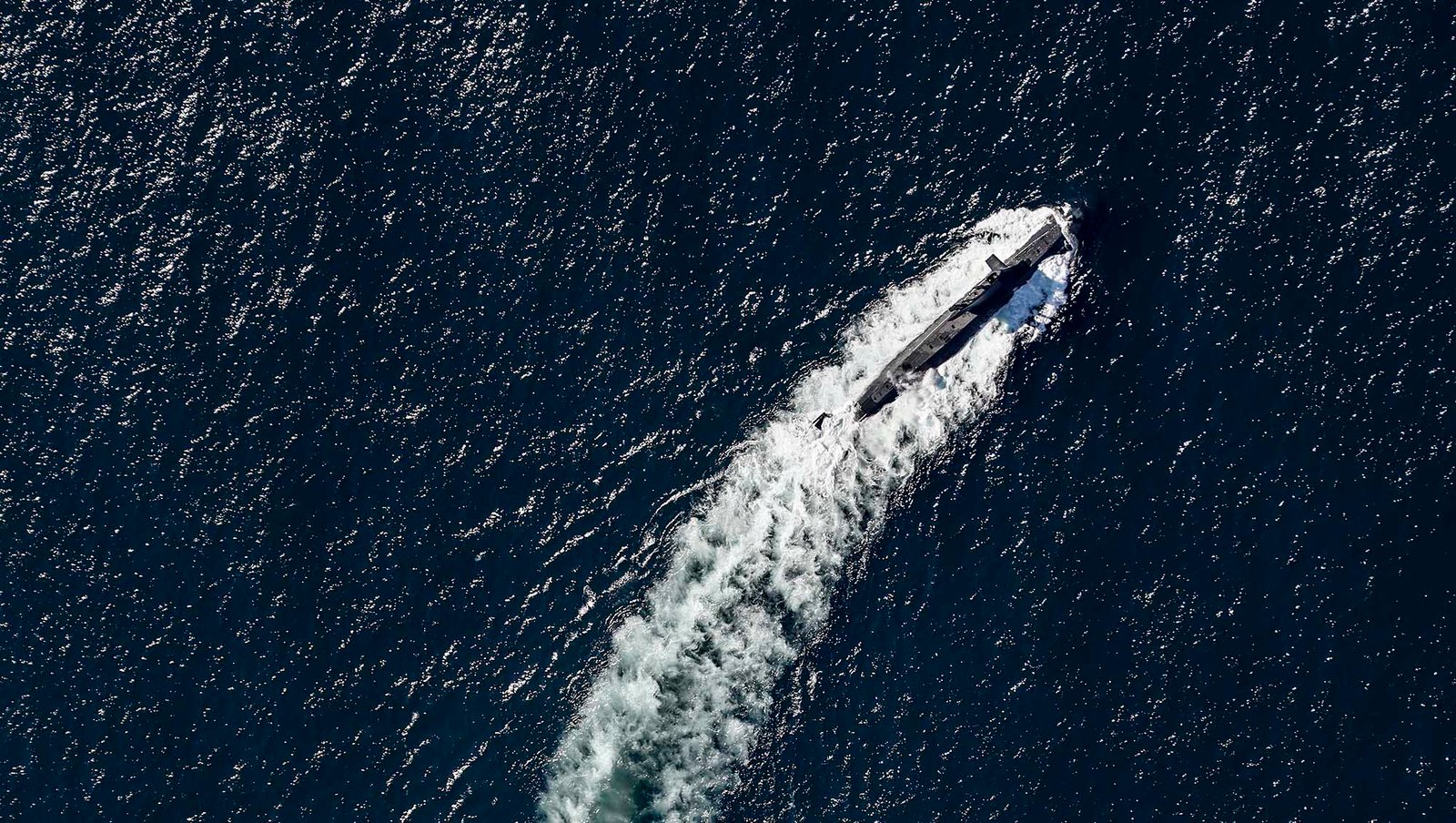
As a major North Atlantic NATO navy, the UK Royal Navy (RN) operates at the forefront of Alliance efforts to deter and defend against Russia’s resurgent underwater threat. Today, the RN is integrating traditional crewed anti-submarine warfare (ASW) platforms with emerging maritime uncrewed system (MUS) capabilities into a ‘hybrid navy’ force structure that will deliver – in North Atlantic terms – the ‘Atlantic fleet’ operational outputs series. In one of these ‘fleet’ areas – the underwater-focused ‘Atlantic Bastion’ – ‘real-world’ Russian activities are illustrating the multi-faceted nature of both the threat and required response.
For NATO, Russia’s underwater threat has traditionally been an ASW problem. During the Cold War, Soviet submarines would seek to push out from the Barents Sea, across the Norwegian Sea, through the Greenland-Iceland-UK (GIUK) Gap, and out into the western Atlantic, where they could roam more freely and threaten US eastern seaboard targets. Today, with state-based competition and conventional conflict having returned to the Euro-Atlantic theatre, the ASW threat persists, albeit with Russian boats – carrying long-range Kalibr conventional cruise missiles – now using the GIUK Gap more as a barrier to keep US Navy (USN) submarines and other ‘heavy metal’ out of the Norwegian Sea, so they can close on and threaten NATO targets at sea and ashore across central Europe.
However, Russia’s underwater threat now comprises a new element – the risk to seabed critical underwater infrastructure (CUI). The CUI threat element has been present across the Euro- Atlantic but particularly evident in the Baltic Sea, in a small series of incidents involving damage to seabed cables and pipelines between September 2022 and January 2026. Alongside the returning prevalence of naval mine warfare (NMW), with sea mines now a threat not only to ports, chokepoints, and littoral areas but to deep-water sea lines of communication (SLOCs) these three elements – ASW, CUI, and NMW – now form what many NATO navies call underwater warfare (UWW).
The RN Type 23 ASW frigates HMS Somerset (foreground) and HMS St Albans track a Russian destroyer in the English Channel in April 2026. The two ‘TAPS 23s’ have been actively involved in addressing Russian surface and sub-surface threats around UK waters this year. (Image: Crown copyright/UK Ministry of Defence)
These elements can present an integrated threat, too – and one that is not just theoretical. In April, the UK Ministry of Defence (MoD) announced that UK and NATO Allies had combined to defend against, and ultimately deter, a Russian underwater incursion into NATO waters. The incident involved at least two Russian underwater platforms, and illustrated the integration of ASW and CUI activities as a combined UWW threat.
The incident reflected a step-up in Russian naval activity in and around UK waters. According to the UK government, Russian activity levels there have increased by 30% since 2024. In revealing a rare level of detail about underwater operations, the MoD demonstrated the need to publicise such information to help build deterrence against what is clearly a significant current threat.
An MoD statement released following the incident said a Russian Akula-class nuclear-powered attack submarine (SSN) had deployed into international waters in the High North and had conducted a diversionary operation while multiple other Russian underwater vessels – platforms from Russia’s Main Directorate of Deep-Sea Research (GUGI), and bringing capability specific to CUI targeting – advanced towards NATO allies’ CUI. GUGI develops capabilities to (in peacetime) surveil and (in wartime) destroy CUI, the MoD statement said.
In an operation lasting several weeks, UK joint forces combined with allies to track the vessels’ activities as they sailed to an area northeast of the UK’s exclusive economic zone (EEZ) border. NATO generated round-the-clock, multi-domain surveillance of the target platforms. The MoD said “The UK and its allies began a campaign of overt action to ensure the Russian units knew they were being monitored and were no longer covert.” The Russian units returned home. In the statement, then UK Secretary of State for Defence John Healey said: “To [Russian president Vladimir] Putin, I say this: we see you, we see your activity over our underwater infrastructure. You should know that any attempt to damage it will not be tolerated and would have serious consequences.” The statement added that the UK would not be diverted from maintaining its resolve, even while the US/Israel versus Iran war in the Gulf may have been a high-level politico-strategic distraction.
UK assets deployed on the operation included the RN’s Type 23 ASW-specialist frigate HMS St Albans (known as a ‘TAPS 23’, namely being a towed-array sonar patrol ship), fleet tanker RFA Tidespring, and multiple embarked Merlin helicopters; and Royal Air Force (RAF) P-8 Poseidon maritime patrol aircraft (MPAs). RN and RAF platforms combined to deploy sonobuoys to support the tracking effort.
Around the same time, other RN assets spent a 10-day period surveilling various Russian vessels transiting the English Channel/ Dover Strait/North Sea corridor. Russian platforms here included a destroyer, frigate, and landing ship, plus a Kilo-class diesel-electric submarine travelling on the surface. RN assets involved included another TAPS 23 HMS Somerset, the Batch 1 River-class offshore patrol vessel HMS Mersey, fleet tanker RFA Tideforce, and embarked Wildcat helicopters.
Summarising the operation in the statement (and in a media briefing), Healey said it demonstrated UK military capability to detect, deter, and respond to this type of threat, and that the UK is continuing both to monitor the threat and invest in the required response capability.
Reinforced Bastion
The operation also reinforced the urgent requirement for the UK to deliver its ‘Atlantic Bastion’ underwater presence, surveillance, and deterrence programme. In the MoD statement, Healey said ‘Bastion’ is already using initial investments to develop and test innovative technologies, within the context of combining autonomous vehicles and advanced sensors with crewed platforms in a ‘hybrid’ transformation of the RN’s submarine-hunting capabilities, as recommended by the UK’s most recent Strategic Defence Review (SDR), published in June 2025.
The RN’s contribution to UK defence and security, including covering the ASW and CUI tasks, is reflected in the three cores roles SDR identified for the UK armed forces: defending and building national resilience; enhancing North Atlantic deterrence and defence; and shaping global security. Specifically for the RN, SDR launched its overarching ‘hybrid navy’ concept. This new force structure, SDR said, will include deploying cutting-edge crewed submarines and frigates, transforming the navy’s in-service carrier capability, and introducing autonomous new vessels to patrol the North Atlantic and beyond.

Integrating the autonomous vessels and crewed platforms, particularly SSNs and the incoming Type 26 ASW frigates, will form the spine of ‘Atlantic Bastion’. SDR flagged ‘Bastion’ as a central element of the UK armed forces’ accelerating transition to a ‘high-low’ equipment mix. Here, whether for surveillance or strike operations to deliver deterrence or defence, crewed platforms are widely recognised as providing the ‘exquisite’ high-end capability, with MUS providing the ‘lower-end’ mass and rapid, affordable scalability.
Underscoring the central role the UK’s ASW capabilities bring in meeting NATO’s evolving needs, SDR said “‘Atlantic Bastion’ is the RN’s plan to secure the North Atlantic for the UK and NATO against the persistent and growing underwater threat from a modernising Russian submarine force.”
SDR described ‘Bastion’ as a layered, multi-domain, joint and combined services construct, within which the RN will use crewed platforms like Type 26 frigates to deploy MUS – especially in the surface and underwater domains – via multi-purpose mission bays. The MUS, it noted, will harness artificial intelligence (AI)-enhanced acoustic detection systems and will be integrated into the UK’s digital targeting web, to help accelerate UK and allied underwater targeting decision making.
In this 2017 file photograph, Somerset is shown shadowing a Russian Kilo-class submarine through the English Channel. The UK government has reported a 30% increase in Russian naval activity in UK waters since 2024. (Image: Crown copyright/ UK Ministry of Defence)
The RN itself first revealed details of ‘Bastion’ at the DSEI exposition in London in September 2025. There, General Sir Gwyn Jenkins, the navy’s First Sea Lord and Chief of Naval Staff, described ‘Bastion’ as a ground-breaking concept revolutionising underwater defence and security for the UK and allies, and delivering robust posture and presence from the Mid-Atlantic Ridge to the Norwegian Sea. In particular, he said, “A blend of crewed and uncrewed host platforms will be networked together, but capable of independent operations, creating a ‘system of systems’ that will enable us to find, track, and, if required, act against our opponents, adding both mass and lethality to our already-capable submarines, ships, and aircraft in the North Atlantic.”
In December, when opening the RN’s annual Sea Power Conference, again in London, Gen Jenkins detailed the role and requirements of the three integrated layers of the ‘Atlantic Fleet’ construct, including ‘Bastion’. “It’s about three overlapping concepts,” he said. “‘Atlantic Bastion’, which is the protection of our sensitive waters and the [SLOCs] for NATO; ‘Atlantic Shield’, which is our contribution to air defence from our vulnerable north; and ‘Atlantic Strike’, which is about creating the advantage that if an aggressor is foolish enough to strike us, they will know we can strike back.”
Such a multi-domain construct is core to ‘hybrid navy’ warfighting output.
In one of his most recent public discussions of ‘Bastion’ – at the Combined Naval Event 2026 (CNE 26) conference in Farnborough, UK in May – Gen Jenkins set ‘Bastion’ in the wider context of both the ‘Atlantic Fleet’ series and the ‘hybrid navy’. “Bastion’ is a defensive net to protect the at-sea deterrent and our critical national infrastructure through the deployment of new ASW capabilities, autonomous sub-surface systems, and a layered sensor network,” Gen Jenkins said.
The UK’s national nuclear deterrent consists of nuclear-armed ballistic missiles deployed in nuclear-powered ballistic missile submarines, with one of the four boats in that particular fleet always deployed at sea in what is called the continuous at-sea deterrent.
“Shield’ is our contribution to integrated air and missile defence [IAMD] to protect the homeland, our interests, and our ships against the increasingly sophisticated threats we face,” Gen Jenkins continued “Strike is about enhancing our conventional deterrence, our reach, and ensuring that if an adversary attacks us, we have the capabilities to hit back decisively.”
Regarding the MUS contribution across the ‘Atlantic Fleet’ series, in brief summary, ‘Bastion’ covers the underwater domain, with the deployment of uncrewed underwater vehicles (UUVs); ‘Shield’ is about building IAMD capability across the air domain, with uncrewed surface vessels (USVs) providing escort capability, particularly surface force protection against incoming threats; and ‘Strike’ will see a range of MUS systems deliver air, surface, and sub-surface conventional power projection to build deterrence through assuring an adversary the UK can strike back.
The RN has also outlined plans for delivering initial capability into the water for each ‘Fleet’ component, to support operational development: for ‘Bastion’, the aim is to have the first sensors in the water in 2026; for ‘Shield’, the RN wants its first large USVs in the water in 2027; for ‘Strike’, the plan is to launch an uncrewed system technology demonstrator from a UK aircraft carrier in 2026.
Setting these developments in a wider operational context, Gen Jenkins told the CNE audience that the UK’s ‘hybrid navy’ concept is based around the capability and operational principle of building a force structure that is “crewed where necessary, uncrewed wherever possible, and integrated always”.

Building the Bastion
Beyond the strategic direction set out by the First Sea Lord from the top down, ‘Bastion’ has been progressing in technology and capability development from the bottom up.
Under an overarching procurement programme called Project ‘Cabot’, ‘Bastion’ in fact consists of two separate phases, each with a distinct technology, capability, and operational focus.
The first phase is called ‘Atlantic Net’. This involves deploying massed UUV-based sensors to augment intelligence, surveillance, and reconnaissance (ISR) sensing and detection capacity across wide areas, particularly around critical regions like the GIUK Gap, and doing so more affordably. The second phase, actually called ‘Atlantic Bastion’, will see the initial ‘ink spot’ of ‘Atlantic Net’ spread more widely in capability and geographic terms, with the UUVs and more uncrewed platforms like extra-large UUVs (XLUUVs) being connected up with crewed platforms (like Type 26s, P-8s, and Astute-class SSNs) and generating expeditionary reach across the Norwegian Sea and other areas east of the GIUK Gap.
Holistically, ‘Bastion’ is all about pushing UWW sensing capability – especially, although not just, ASW – further ‘up threat’. Alongside sanitising the GIUK Gap and Norwegian Sea of Russian activity, building UK and wider NATO sensing capability across that region will provide a base from which NATO ASW assets can push Russian submarines back into the Barents Sea through the Bear Gap (which runs from Svalbard, south past Bear Island, to Norway’s north coast).
There is NATO interest in ‘Bastion’ outputs, too. For example, the Canadian and Norwegian navies have expressed interest in participating. Moreover, NATO is already developing an underwater command, control, and communications (C3) architecture – the Allied Under Water Battlespace – Mission Network (AUWB-MN) – that could provide the digital backbone around which ‘Bastion’ could be built. AUWB-MN offers a single, interoperable, integrated C3 construct for connecting sensors and communications, and enhancing alliance data-based underwater operations. It could also help link ‘Bastion’ to other NATO underwater operational architectures.
Another multinational programme – AUKUS – may support ‘Bastion’, too. The Australia/United Kingdom/United States strategic accord is developing two pillars that will help build North Atlantic underwater sensing mass. First, under Pillar I, a new SSN – SSN-AUKUS – is being built for the RN and the Royal Australian Navy; the RN’s force requirement for up to 12 SSN-AUKUS boats (compared to the current seven-boat Astute inventory) will see more SSN presence generated in the North Atlantic. Second, under Pillar II, which is focused on exploiting new collaborative technologies including MUS, in May the three partners announced the first Signature Project, covering UUV developments relating to (among other things) ASW, CUI, and ISR requirements
Data Hub
Critical across both ‘Bastion’ phases is data – with the gathering, assessing, and disseminating elements of data use all enhanced by AI and machine learning.
In this context, the assembled MUS provide a sensing ‘tripwire’, and will generate enhanced levels of information for the maritime operational commander; in turn, the commander will direct the ‘exquisite’ crewed assets to employ their sharper sensing capability to prosecute particular targets.

The entire process is designed to generate and demonstrate enhanced warfighting readiness.
Reflecting the strategic significance of the ASW issue and the First Sea Lord’s emphasis on time-urgency, the broad timelines for casting an integrated ‘Atlantic Net’ are: (as noted, above) deploying an initial sensing capability in 2026; developing this into a minimum deployable capability by the end of the year; and, across 2027, further enhancing functionality to enable ‘Atlantic Net’ to go fully live by the end of 2027.
Delivery at speed will be enabled by a novel procurement approach, using a contractor-owned, contractor-operated, navy-oversight (COCONO)-based mission partner model for acquisition, delivery, and operation. In sum, under RN watch, industry will supply and operate the UUV-based sensing capability for ‘Atlantic Net’, effectively as a ‘sensing service’. A tender process for this mission partner role commenced in October 2025, and seems set to conclude in the first half of 2026.
For the ‘Bastion’ phase, no dates have yet been set – but with good reason. The RN and MoD will develop the requirements and approaches, including the acquisition model (which they will continue to refine), in parallel to delivering ‘Net’, and learning from it what is achievable and capable in technology and output terms. These lessons will be taken forward not only into a broader capability and operational context for the second phase, but also using a government-owned/ government-operated (GOGO) operational construct. This military- delivered approach will provide the required support for the enhanced ASW sensing capability and flexibility that will be needed as the concept develops from ‘Net’ into ‘Bastion’.
While developing the mission management approach, the RN and MoD have also been assessing sensing technology options. Here, industry has been directly involved for some time, including (early in 2025) in workshops defining the mission requirements.
Alongside the tender launch in October, a technology demonstrator process commenced, to help understand the technological ‘art of the possible’ for ‘Bastion’, particularly for ‘Net’. In December, the MoD noted that £14 million of seedcorn investment had been supplied for the technology demonstrator process, with 20 companies invited to showcase their system capabilities.
In technology and capability terms, the ‘Bastion’ programme is again using a novel approach. Industry is proposing solutions against a broad operational problem set, rather than against tightly-specified requirements. Technologies demonstrated also must be quicker and easier to refine and scale. In turn, the RN is providing a ‘live’ operational experimentation testbed for industry to enhance and exploit development of its technology.
Outcomes on both the mission partner and technology demonstrator elements may be awaiting funding approval under the forthcoming, much-anticipated Defence Investment Plan (DIP) – the MoD’s detailed procurement programme designed to fill out SDR’s strategic framework.
Author: Dr Lee Willett
Author: Dr Lee Willett is an independent writer and analyst on naval, maritime, and wider defence and security matters. Previously, he was editor of Janes Navy International, senior research fellow in maritime studies at the Royal United Services Institute, London, and Leverhulme research fellow at the Centre for Security Studies, University of Hull.
Click here to read the latest issue of ESD.
