

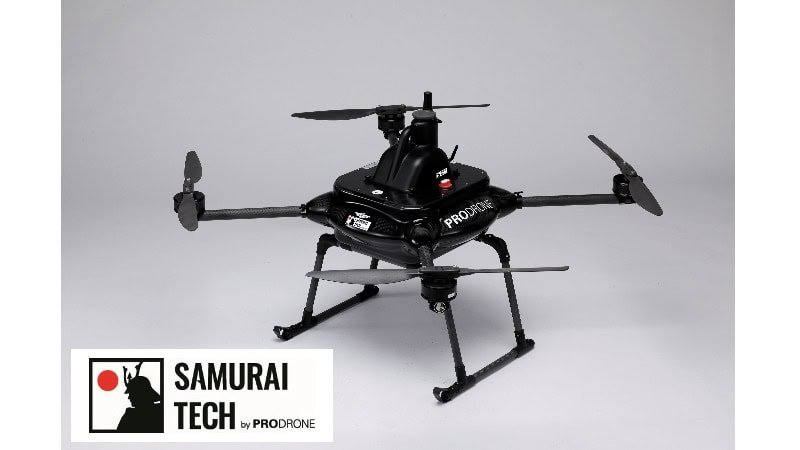
On September 2, Prodrone Co., Ltd., a Nagoya-based developer of “Made in Japan” unmanned aerial vehicles (UAVs), announced that its proposed plan to promote a stable domestic supply system for drones had been certified by Japan’s Ministry of Economy, Trade and Industry (METI).
In a press release,[1] the Japanese drone producer explained that under the certified plan it is targeting an annual production and supply capacity of 58,000 drone units by March 2029 in order to meet growing demand in Japan for drones capable of inspections, logistics, disaster prevention, and other applications.
Prodrone – which also develops drones for defense – is eligible for up to 1.5 billion yen (approximately USD 9.7 million) in subsidies from METI, which has designated UAVs as one of Japan’s “specified critical materials” eligible for government support.
Under the plan, the company will look to advance technologies required for mass production of UAVs, develop new production lines and a new factory, and establish a domestic procurement system and supply chain for key drone components.
On September 7, Prodrone also revealed that it would be setting up its first mass production plant on the premises of Howa Machinery, Ltd., a manufacturer of machine tools, firearms and other equipment based in Nagoya. Prodrone is also co-developing with Howa Machinery “countermeasure drones” in a collaboration first revealed during a May visit to Prodrone headquarters by Japanese Defense Minister Shinjiro Koizumi.[2]

The move by Prodrone reflects the growing awareness in the Japanese government of the need to strengthen the country’s domestic production capacity for drone systems and secure a resilient supply chain.
In March, METI released its policy on UAVs, which sets a target of establishing a domestic mass-production base capable of producing approximately 80,000 units per year by 2030. This is to be coupled with efforts to secure a stable supply chain for critical drone components, such as batteries, motors and flight controllers.[3]
The backdrop to this target is Japan’s overwhelming dependence on international supply chains. METI notes that overseas-produced drones account for around 90% of Japan’s industrial UAV market and how cases have been identified of Japanese drone producers sourcing components from suppliers based in a “specific country.”[4]
Although the country is not identified, this likely refers to China, which controls around 80-90% of the global drone market and dominates component production.[5]
In the area of defense, this dependence is particularly problematic as the Japanese Ministry of Defense (JMOD) seeks to prepare for “new ways of warfare” and offset manpower shortages in the Japan Self-Defense Forces (JSDF) by urgently building up drone capabilities.[6]

The Japanese effort to set up a domestic mass-production base, however, should not be read as meaning that Japan is not looking to work with other countries. Rather, the aim appears to be for Japan to build up a domestic mass-production base while also strengthening supply-chain cooperation with like-minded partners, with the latter principally to expand overseas demand for Japan-made drones and components.[7]
This approach was put into action this summer in the ministry’s interceptor drone acquisition program. While this program designated a Japan-made interceptor drone supported by the domestic production base as one of its required variants, JMOD also selected for testing drone systems from U.S., German and Portuguese developers who were supported by local Japanese partners.

To meet JMOD’s domestic drone and critical component production requirements, Japanese UAV developers active in the defense sector appear to be responding in different ways.
Prodrone appears to be focused on an all-Japan approach. In addition to handling its own drone development – including airframe design and software[8] – the company is also beginning to develop in recent months UAV systems that source key components only from Japanese manufacturers.[9]
Meanwhile, Tokyo-based Terra Drone Corporation appears to be taking a more international approach involving the direct acquisition of overseas companies that possess substantial know-how in drone development. In order to establish its lineup of interceptor drones, Terra Drone is actively working with three Ukrainian companies, two of which the Japanese firm has consolidated as subsidiaries.
Nevertheless, similar to Prodrone, Terra Drone has in recent months signalled that it is looking to reduce its reliance on imported drone components.[10] In response to the government’s call for a resilient supply chain, the firm announced in July the establishment of a Japan-based mass production system for high-output drone battery packs.[11]

Another approach being pursued by Japanese firms is to represent overseas drone developers to explore the import of drone systems for JMOD. A subsequent long-term option would then be to set up a local Japanese production base at a later stage.
One such example here is the Japanese e-commerce giant Rakuten Group, which has partnered with Germany’s Helsing in a bid to introduce the Munich-based company’s HX-2 strike drone to the Japanese Ground Self-Defense Forces (JGSDF).[12]
If the drone is selected, the Rakuten-Helsing partnership would likely initially involve the direct import of HX-2 units from abroad to meet JGSDF demand. This could potentially be followed by domestic production in Japan, an option that the two companies are reportedly considering.[13]
Whatever the approach taken by Prodrone and other Japanese drone makers in shoring up the domestic UAV production base, a key consideration for these companies will be how to balance JMOD’s defense requirements with demands for commercial applications such as infrastructure inspections and transport.
This is because going forward, both JMOD and METI expect that the vast majority of demand underpinning Japan’s target of producing 80,000 drones per year by 2030 will come from the commercial sector, rather than defense.[14]
Thus, Japanese drone companies and representatives of overseas companies may wish to consider this JMOD-METI expectation when investing in Japan-based production through modularisation or other scalability options.
Notes:
**1 USD = 154.45 JPY
[1] Prodrone Co., Ltd., “METI Certifies “Supply Security Plan”, September 2, 2026, https://www.prodrone.com/en/news/10446.
[2] Prodrone Co., Ltd., “Establishment of Prodrone’s First Mass Production Plant within Howa Machinery – Notice Regarding Third-Party Allotment of Shares with the Company as the Subscriber -”, September 7, 2026, https://www.prodrone.com/en/news/10461.
[3] METI, “無人航空機に係る安定供給確保を図るための取組方針” [Policy on Initiatives to Ensure a Stable Supply of UAVs], March 13, 2026, p8-11, https://www.meti.go.jp/policy/economy/economic_security/drone/drone_policy.pdf.
[4] Ibid, p.5.
[5] Federico Borsari, “Reality Check: Breaking Free From China’s Drone Ecosystem is Harder Than You Think”. Bandwidth, May 28, 2026, https://cepa.org/article/reality-check-breaking-free-from-chinas-drone-ecosystem-is-harder-than-you-think/.
[6] JMOD, “Direction of Defense Capability Transformation (2)” pp.1-4, March 2026, https://www.mod.go.jp/en/d_policy/defense-capability-transformation/images/6th_19-mar-2026a.pdf.
[7] METI and JMOD, “日本成長戦略会議 第2回 防衛産業WG 事務局説明資料” [Secretariat Explanatory Materials Prepared for the 2nd Meeting of the Defense Industry Working Group of the Japan Growth Strategy Council], April, 2026, p.22, https://www.meti.go.jp/shingikai/mono_info_service/defense_industry_wg/pdf/002_01_00.pdf.
[8] Prodrone, Co., Ltd., “Careers”, https://www.prodrone.com/en/careers.
[9] Prodrone Co., Ltd., “Completed domestic drone prototype, SAMURAI Tech”, April 17, 2026, https://www.prodrone.com/en/news/10328.
[10] JIJI, “Japan’s Terra Drone to mass-produce defense drones domestically”. Japan Times, July 9, 2026, https://www.japantimes.co.jp/business/2026/07/09/terra-drone-domestic-production/.
[11] Terra Drone Corporation, “Terra Drone Enters Japan-Made Battery Business for Drones”, July 27, 2026, https://terra-drone.net/global/2026/07/27/27927/.
[12] John Geddie, “German drone maker Helsing enlists Rakuten to broker Japan military deal”. Reuters, August 17, 2026, https://www.reuters.com/business/retail-consumer/german-drone-maker-helsing-enlists-rakuten-broker-japan-military-deal-2026-08-17/.
[13] Kenichiro Shino, “楽天、ドイツの新興企業と攻撃用ドローンで提携 防衛省への納入目指す” [Rakuten partners with German startup on strike drones; aims to supply Ministry of Defense]. Asahi Shimbun, August 17, 2026, https://www.asahi.com/articles/ASV8K2VFYV8KULFA016M.html.
[14] METI and JMOD, “日本成長戦略会議 第2回 防衛産業WG 事務局説明資料” [Secretariat Explanatory Materials Prepared for the 2nd Meeting of the Defense Industry Working Group of the Japan Growth Strategy Council], April, 2026, p.22, https://www.meti.go.jp/shingikai/mono_info_service/defense_industry_wg/pdf/002_01_00.pdf.
This article was originally posted on NSBT Japan, the first defense and security industry network in Japan. The publication provides the latest information on security business trends both within Japan and overseas. Asian Military Review began exchanging articles with NSBT Japan in April 2024.
Read the original article here.
