

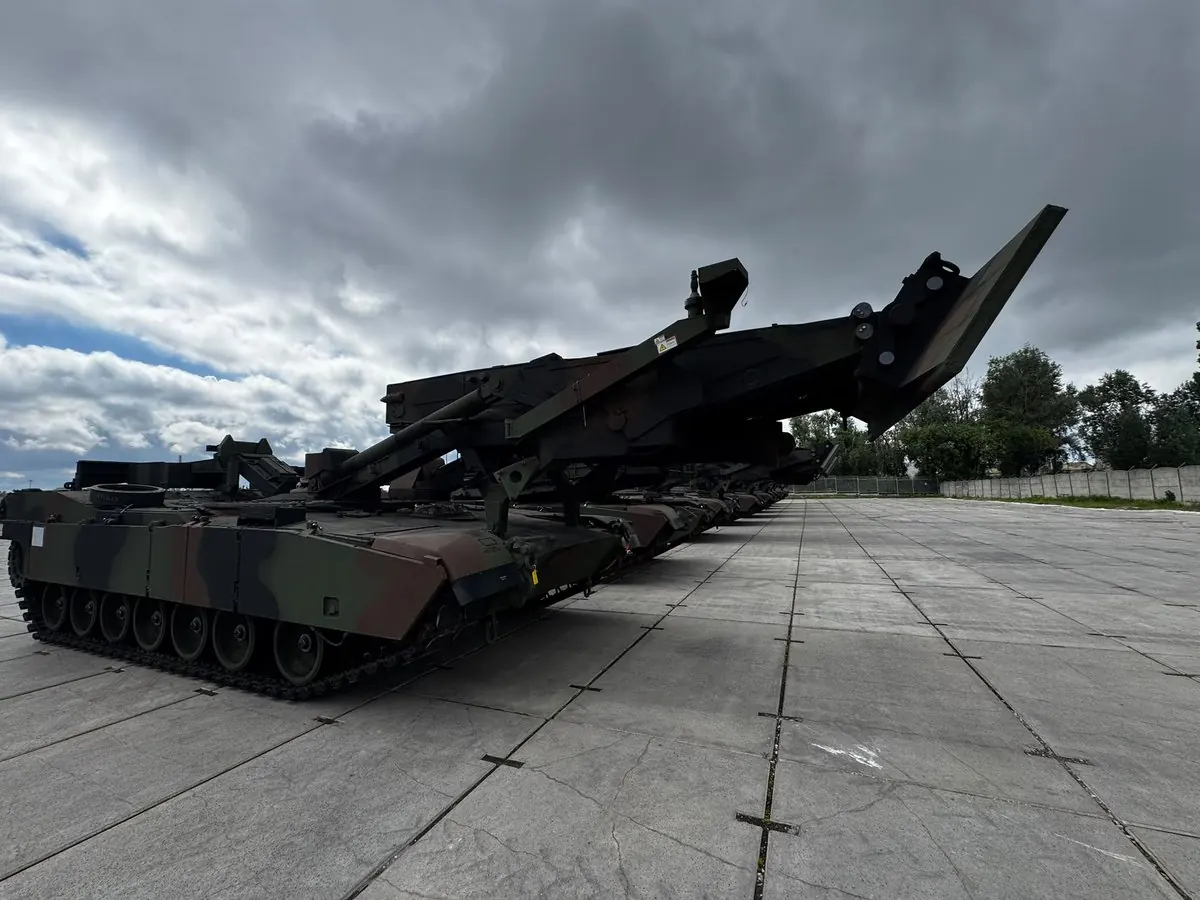
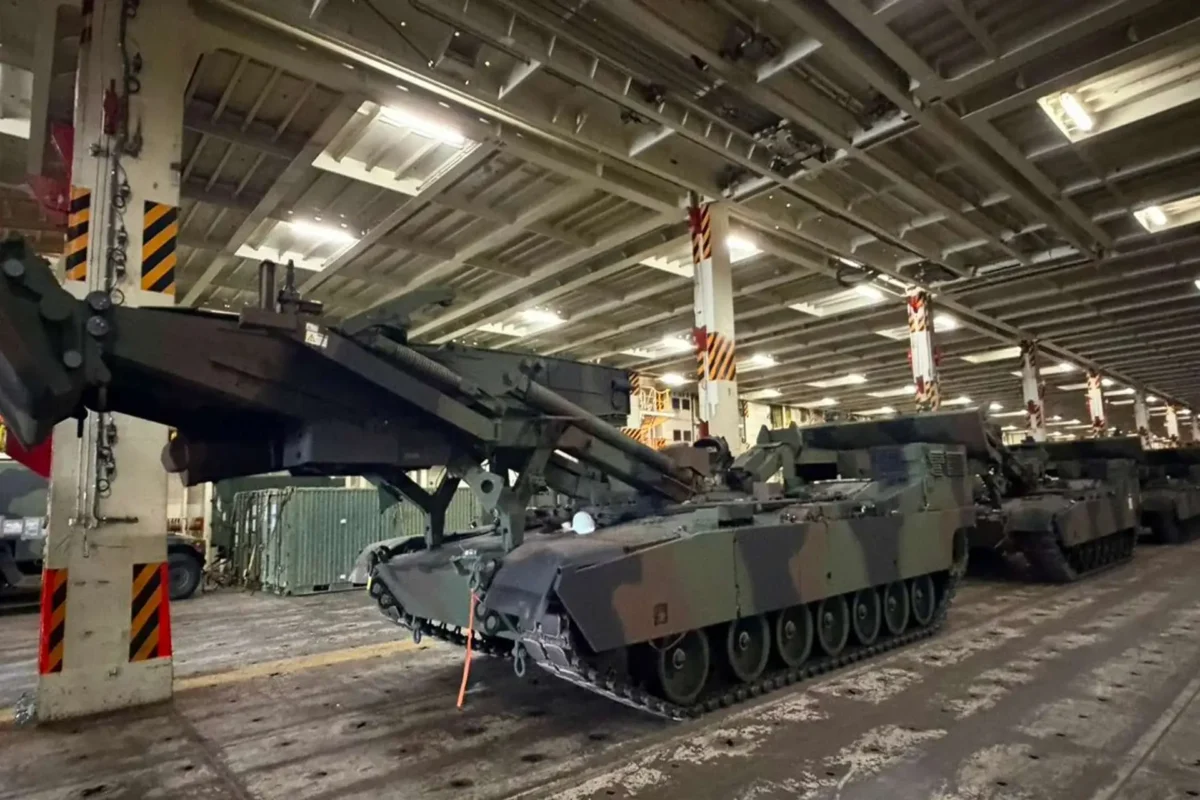
Defense Feeds, Warsaw – Poland has received its first M1110 assault bridge, adding a capability that often receives far less attention than tanks or artillery but is indispensable during high-intensity ground operations.
The new bridge-laying vehicle will support the country’s expanding fleet of 366 M1 Abrams tanks, ensuring armored formations can continue advancing when confronted with rivers, anti-tank ditches and other battlefield obstacles.
The arrival of the system reflects a simple military reality: an armored force is only as effective as its ability to keep moving. Even the most advanced main battle tank can quickly lose its operational advantage if engineers cannot open routes through damaged infrastructure or enemy defensive barriers.
M1110 Assault Bridge Gives Abrams Units Greater Freedom of Maneuver
The M1110 assault bridge is built on the same chassis as the M1 Abrams, allowing it to operate alongside frontline armored units without sacrificing mobility or protection. Equipped with a rapidly deployable bridge, the vehicle enables combat engineers to create temporary crossings in minutes, allowing tanks and other heavy vehicles to maintain momentum during offensive operations.
Unlike civilian bridging equipment, the M1110 is designed to work under combat conditions. Its armored platform allows crews to move close to the forward line, deploy the bridge quickly and withdraw once the crossing has been established.
That capability is particularly relevant for Poland as it expands one of Europe’s largest Abrams fleets. Purchasing modern tanks alone would not guarantee battlefield effectiveness if supporting engineering assets failed to keep pace. The introduction of dedicated bridge-laying vehicles ensures the army is investing in the enabling capabilities that armored warfare depends upon.
The procurement also demonstrates that Warsaw’s modernization effort extends beyond headline platforms, focusing instead on building complete combat formations capable of sustained operations.
Combat Mobility Is Often the Decisive Advantage
Although tanks usually dominate public attention, the M1110 assault bridge addresses one of the oldest challenges in land warfare: overcoming terrain without losing operational tempo.
Natural obstacles such as rivers, canals and steep embankments, as well as artificial defenses including anti-tank trenches, can slow an advancing force and create opportunities for defenders to reorganize or launch counterattacks. Combat engineers play a crucial role in preventing those delays.
From an operational perspective, rapidly deploying a bridge can preserve the momentum of an offensive while reducing the time armored units remain exposed in vulnerable crossing areas.
Recent conflicts have reinforced the importance of mobility. Military planners have observed that success often depends not only on firepower but also on the ability to maneuver faster than an opponent expects. Engineering vehicles capable of restoring mobility therefore contribute directly to the effectiveness of tanks, infantry fighting vehicles and logistics convoys alike.
The M1110 also benefits from sharing its automotive components with the Abrams, simplifying maintenance and reducing the logistical burden for units already operating the American-built main battle tank.
Poland Builds a Complete Armored Force
The delivery of the M1110 assault bridge fits into Poland’s wider effort to develop one of NATO’s most capable land forces on the alliance’s eastern flank. Alongside large-scale investments in Abrams tanks, K2 main battle tanks, self-propelled artillery, air defense systems and long-range precision fires, Warsaw has steadily expanded the engineering and support assets needed to sustain modern mechanized operations.
That approach reflects an increasingly comprehensive understanding of military modernization. Advanced combat platforms generate the greatest battlefield advantage only when supported by engineers, logistics units, recovery vehicles and command systems capable of keeping formations operational under demanding conditions.
For NATO, Poland’s growing engineering capability also strengthens the alliance’s collective readiness. Bridge-laying systems can support multinational armored formations during joint exercises or contingency operations, improving interoperability while reducing potential mobility bottlenecks.
Looking ahead, combat mobility is expected to become even more important as European militaries prepare for operations involving dispersed formations, damaged infrastructure and rapidly changing front lines.
The arrival of the M1110 assault bridge may not attract the same attention as a new tank or missile system, but its battlefield contribution could prove just as significant. By ensuring heavy armored units can maintain their advance across difficult terrain, the vehicle reinforces one of the fundamental principles of mechanized warfare: momentum is often as decisive as firepower.
