

Aaron Brandt
Between January and June 2025, more than $16 billion in government funds have been invested in modernizing U.S. naval fleets. The Department of Defense and Department of Homeland Security are driving this push with programs focused on submarine production, combat system upgrades, and industrial base expansion.
The increased investment carries a deep responsibility for shipbuilders. The industry faces mounting pressure to increase throughput, reduce costs, and comply with strict safety and environmental standards. Advanced cutting technologies, especially plasma and waterjet, play a vital role in helping shipbuilders meet production, material, and labor challenges.
Strategic Pressures Demand Versatile Cutting Solutions
Modern shipbuilding involves the construction, repair, and maintenance of diverse vessels from military submarines and surface combatants to tankers and smaller transport boats. While thick mild steel remains a foundational material, increasing use of aluminum and stainless steel is driven by:
- Fuel efficiency
- Demand for corrosion resistance
- Tactical needs for lighter, faster, and less detectable defense vessels


Able to handle a wide range of materials, hull shapes and performance needs, plasma is a process that helps shipbuilders meet tightening timelines and stringent quality standards while improving worker safety and operational efficiency.
Meeting varying demands requires flexible, high-performance systems that can be productive when cutting multiple materials and thicknesses with accuracy, safety, and repeatability.
Plasma Cutting: Versatile, Safer, and Future-Ready
While traditional oxyfuel and carbon-arc cutting methods are still common, neither can be used to cut aluminum or stainless steel. The shipbuilding sector can benefit by shifting operator awareness toward the productivity, safety, and cost savings plasma offers.
Plasma cutting provides a more versatile and safer alternative to legacy cutting technologies. Applicable across a wide range of materials, including thick mild steel, aluminum, and stainless steel, plasma systems can be used for gouging, beveling, temporary attachment removal, and general handheld or mechanized cutting.
Unlike oxyacetylene, plasma cutting systems operate with no-touch arc initiation, reducing injury risk and enabling faster, more controlled beveling with fewer secondary operations such as grinding. Plasma also streamlines material handling by combining multiple steps into a single operation.
Smart Plasma Cutting for Today’s Shipyards
With plasma technology, shipbuilders can select a system that best meets the needs in their shipyard. Portable systems with a built-in compressor and dual-voltage input are ideal for remote or mobile applications. On the other end of the spectrum, fixed plasma systems deliver high-speed metal removal and versatile torch configurations for robotic, handheld, and table-mounted systems.
For high-volume and heavy-duty operations, shipyards can use high-definition, mechanized plasma cutting. Even at this intensity, many systems are engineered for operator simplicity while also optimized for performance. Shipyards can still get superior cut quality, improved tolerances, and clean edges on steel, aluminum, and stainless with minimal operator intervention.
Benefits of plasma cutting extend beyond the machine itself. Torches and consumable cartridges include user-centric technologies, too. For example, manufacturers can replace five-piece consumable stack-ups with a single color-coded cartridge for simplified changeovers. The color-coding helps operators work more quickly because it eliminates part mix-ups for different applications. In addition, that one cartridge can auto-set amperage and operating mode to prevent setup errors. It also notifies operators when cartridges need replacement.
These advanced features translate into significant reductions in consumable costs. For shipyards facing skilled labor shortages, they also reduce training time and make systems easier to operate.
Waterjet Cutting: Cold Cutting for High Precision and Safety
Abrasive waterjet machines are exceptionally well-suited for today’s shipbuilding needs, especially in shops using Near Net Shape (NNS) production for enhanced efficiency and sustainability. Capable of cutting virtually any material, waterjets support a wide array of shipbuilding functions including:
- Beam cutting
- Armor plating
- Deck plating and deck grates
- Superstructure and aluminum components
- Portholes, doors, and structural openings
- Submarine and pressurized vessel parts where structural integrity is critical

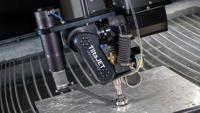
Manufacturers in the shipbuilding industry, as well as others, often turn to abrasive waterjet cutting to handle ever-changing part materials.
Waterjet machining is a cold-cutting process, meaning it produces no Heat Affected Zone (HAZ), which preserves the structural integrity of materials and eliminates cracking or delamination. It is ideal for processing high-value metals and composites because it avoids thermal distortion. People working in shipbuilding benefit from waterjet cutting because it does not generate fumes nor combustible gases. Much like plasma, risk of worker injury is reduced compared to oxyfuel and grinding methods.
Software suites designed specifically for waterjet cutting include CAD functionality, machine control, and cut optimization. Combined with automation features like motion control and self-monitoring systems, abrasive waterjet machines can reduce reliance on skilled operators and shorten the learning curve for new employees.
Designed for the Next Generation of Shipbuilders
Plasma and waterjet technologies align with broader shipyard modernization goals, especially the need to attract and retain skilled labor. Features like plasma-cobot integration and intelligent waterjet automation relieve operators of repetitive tasks, for instance. Robotic and software innovations make fabrication roles more appealing, less physically demanding, and easier to learn, helping shipyards build a more sustainable and adaptable workforce.
With the U.S. government investing more than $16 billion to strengthen naval shipbuilding and defense readiness, the ability to scale production, control costs, and adapt to evolving requirements is more urgent than ever. Plasma and waterjet cutting technologies offer the precision, safety, and operational flexibility required to meet these expectations by supporting faster build cycles, multi-material processing, and a cleaner, smarter shop environment.
As shipbuilders rise to meet both strategic and commercial challenges, the adoption of next-generation cutting systems will be a key differentiator that ensures the U.S. industrial base is equipped to deliver on today’s national defense priorities and tomorrow’s maritime innovations.