

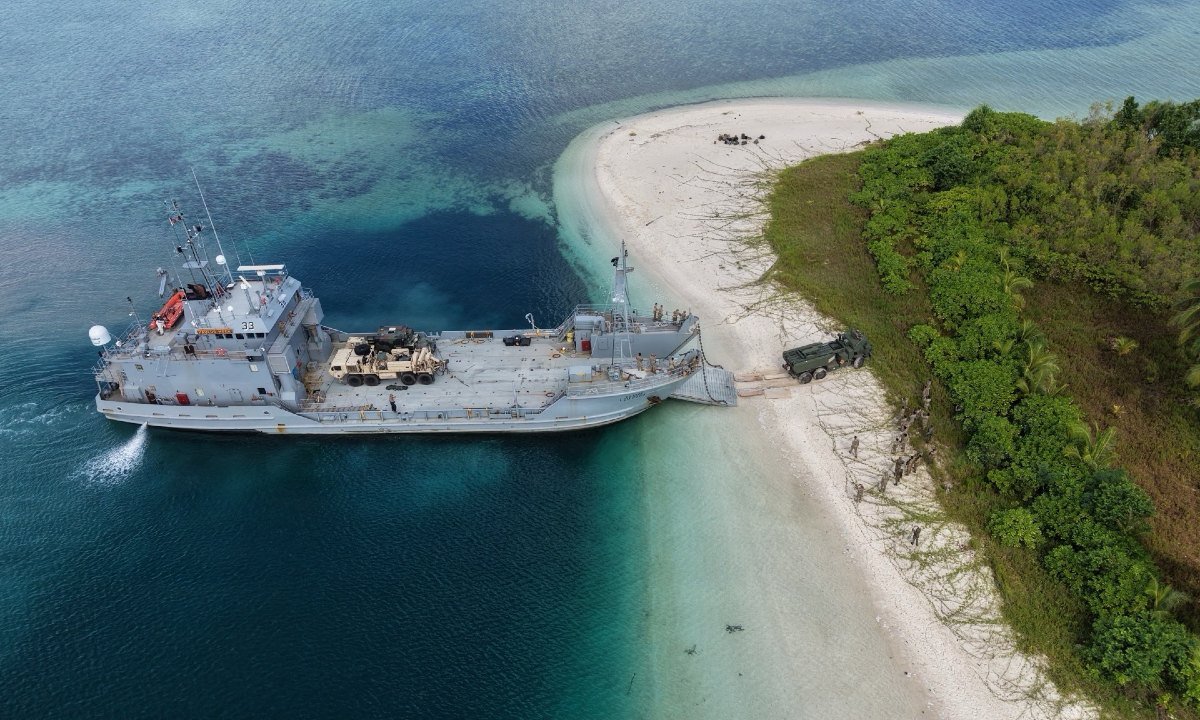
It is 2027. China has spent three years repositioning forces under cover of maritime exercises and coast guard operations. In October, Beijing declares an expanded air defense identification zone covering the Luzon Strait, the Senkakus, and the waters between Taiwan and the Philippine archipelago. Chinese forces occupy three undefended features within seventy-two hours, positioning air defense and antiship missile systems on each. Electronic warfare nodes begin jamming GPS and communications across the contested zone. The positioning is not an invasion. It is a new status quo, enforced by systems already in place before the United States can respond.
The US response is fundamentally a combined effort. Japan maintains forces in the Senkaku area and expects US support. The Philippines operates in the Luzon Strait region and depends on US capability. Taiwan faces the immediate threat in the central sector and requires assurance of US commitment. The Army commits three divisions to support the operation across separated sectors to provide ground-based long-range fires, forward intelligence, surveillance, and reconnaissance positioning, and base defense for the airfields and ports the joint campaign requires.
Sector distances exceed real-time coordination. Enemy cyber and electronic warfare force coordination into periodic windows of two to six hours. Division commanders make decisions on reconnaissance, fires, and sustainment independently.
The 2026 National Defense Strategy prioritizes deterring China in the Indo-Pacific and directs a strong denial defense along the first island chain. Assuming the Army has a role in that effort, what does it mean for Army divisions, the service’s newly designated chief warfighting formations? The question of how Army divisions should execute battle management across the dispersed maritime geography of the first island chain is an unresolved one.
The vignette above is imagined. But it is based on current Chinese activities—military exercises, coast guard operations, maritime coercion, and pressure against Taiwan and the Philippines. And it highlights the consequences of letting the question remain unresolved.
Division commanders in separated sectors execute battle management independently. They synchronize reconnaissance, fires, maneuver, and sustainment within their own sectors. They make decisions when brigades commit to contact and enemy tempo compresses decision windows. This is the operational reality. Army doctrine accounts for decentralized execution and degraded communications, but provides limited detail for division battle management across widely separated littoral sectors. Geography and enemy capability forbid it.
Army Divisions in the World War II Pacific Theater
Pacific island campaigns in World War II provide historical examples of dispersed operations, restrictive terrain, contested sustainment, and Army dependence on joint air and naval support. US planners repeatedly underestimated resistance in the western Pacific. On Peleliu, Major General William Rupertus expected a four-day fight, but decisive control took sixteen days and Japanese resistance continued for months. Aerial photography identified large enemy positions but missed small, lethal infantry embedded in terrain. In New Guinea, jungle terrain fragmented the deployment of large formations and made company- and platoon-sized actions the norm. Jungle obscures enemy activity: Close vegetation, deep jungle, and broken terrain limited visibility and made enemy locations difficult to determine. These visibility constraints persist today. Terrain fragments formations, and small positions defeat formation-level firepower.
On Guadalcanal, ground success required naval movement, naval fire, air support, and supply-line interdiction. Ground forces depended heavily on air and naval support to maintain essential logistical support and interdict Japanese reinforcement. Airpower helped protect the lodgment, interdict Japanese reinforcement, and support ground forces. Ground forces risked culmination when essential logistical support could not be maintained. These lessons were discovered under fire.
Basing determined what divisions could accomplish. Henderson Field became the center of an Allied lodgment whose survival depended on sustained air, naval, and logistical support. A division’s operational reach extended only as far as logistics could sustain. Japanese attacks on Allied sea lines repeatedly threatened the ability to sustain the Guadalcanal lodgment. The campaign demonstrates how loss of logistical endurance can drive a land force toward culmination. Continued air and naval support preserved essential logistical support while interdicting Japanese efforts to reinforce and sustain their forces. During the Pacific campaigns, commanders also learned to understand their sectors independently and sustain operations.
Much has changed since World War II. Enemy fires capabilities have advanced at a pace that has accelerated dramatically and Chinese positioning operations have grown much more sophisticated than what the US Army faced more than eighty years ago. But operational art has remained constant. A division commander in 2027 operating in the Senkaku area will face a much more capable adversary but also the same constraints that divisions faced on Guadalcanal: Basing determines where operations can be sustained, operational reach determines what joint forces can accomplish, and culmination arrives when a critical system fails. Divisions cannot hold terrain without naval forces protecting supply. Divisions cannot sustain operations without air support. A division will reach culmination when logistics break or when protection architecture collapses.
Why Independent Divisions are Necessary
The division is the Army’s primary battle-management formation in large-scale combat operations. When these operations are conducted across connected terrain, the division synchronizes reconnaissance, fires, maneuver, and sustainment spanning multiple brigades fighting simultaneously over extended depth and duration. The division integrates these functions through continuous planning, fires allocation, protection priorities, and operational sequencing while brigade commanders retain initiative within division-directed bounds. By managing commitment, support, transition, and reconstitution across subordinate formations, the division prevents brigade culmination. This does not change when the terrain is noncontiguous or when communications are degraded. Rather, it becomes harder and more critical.
The Pacific requires the same battle-management functions across noncontiguous sectors. Distance and enemy electronic warfare can disrupt continuous coordination between widely separated division sectors. Division commanders should establish their operational limits—how far they can reach, how long they can sustain operations, when they will reach culmination—before deployment. Adjusting these limits under fire means discovering them when brigades have already committed.
In the imagined vignette that opened this article, each division receives delegated authority over reconnaissance, fires, and sustainment within its assigned sector. Geographic dispersion and degraded communications increase the need for delegated authority and decentralized execution within commander’s intent. But Pacific operations require divisions to master intradivisional battle management across their sectors. Brigades sustain combat through division-level integration of reconnaissance, fires, and sustainment. Divisions should establish delegated authorities, decision protocols, and commander’s intent before communications degrade. Those unprepared will lose operational coherence.
Operational Art in the Pacific
A division operating in a Pacific island sector is constrained by three elements of operational art: basing, operational reach, and culmination. Each element determines what a division can and cannot do. Division commanders who understand these constraints before deployment will sustain operations long enough for joint forces to act.
First, basing shapes where a division can position forces, generate combat power, and extend operational reach in support of the maritime campaign. A division sustains operations from positions that are protected and defensible. It supplies forward brigades through logistics bases, maintenance areas, casualty collection points, and protected command posts. In the Pacific, distance, access, austere infrastructure, and contested distribution constrain basing and sustainment options. Scarce and austere infrastructure constrains where sustainment nodes can operate and how much combat power they can support. A division that positions sensors near secure supply lines sustains them through enemy pressure. A division that extends sensors forward accepts reduced visibility in exchange for better sensor positioning. Weighing sensor positioning against basing capacity is important because the sensors’ ability to enable joint operations depends on sustaining those positions under fire.
Next, operational reach is the distance and duration across which a force can successfully employ military capabilities. Maritime sustainment introduces distance, access, distribution, protection, and infrastructure constraints that affect operational endurance and reach. Restrictive island and jungle terrain can limit terrestrial observation and complicate reconnaissance. Fires from land positions have limited range across water. A brigade positioned three days of water movement away from supply bases reaches culmination faster than a brigade two hours away by road. Operational reach establishes the distance and duration across which a division can employ capabilities in support of joint operations. Forward Army sensors can extend joint sensing and targeting networks in support of air and maritime operations. Army land-based fires can support maritime operations by extending joint force depth and imposing additional threats on enemy maritime forces. If division operational reach is limited by basing constraints, a division cannot feed joint forces with the intelligence and fires support they need to shape maritime operations.
Finally, a division approaches culmination as declining endurance and operational reach reduce its ability to continue operations. A division may plan for thirty days of supply, but indicators of declining endurance can appear well before stocks reach zero. Casualty evacuation capacity fills over time, not instantly. Air defense and communications degrade under pressure but retain function until they fail completely. A division commander and his staff should identify indicators of declining endurance before the force reaches culmination and loses freedom of action. Waiting until culmination arrives leaves limited options.
Dispersed Battle Management
A division executing battle management in separated island sectors should organize around the three elements: basing, operational reach, and culmination. Task organization decisions ripple across basing options. Moving an engineer company from one brigade to another changes logistics demand, maintenance coverage, and protection requirements. A division staff should calculate basing implications before approving task organization. A brigade positioned on an island with limited basing can absorb fewer attachments than a brigade positioned near established logistics infrastructure. Division commanders and their staffs should understand which task organization options basing can support.
Division staffs should synchronize reconnaissance, fires, maneuver, and sustainment across positions separated by water. Under these conditions, reconnaissance reaches less distance and fires have limited range. Maneuver takes days, not hours. In the vignette that opened this article, planners assume that some inter-island reinforcement requires five to seven days. Maritime sustainment faces long distances, contested distribution, limited infrastructure, and vulnerable nodes and routes. Divisions must communicate these constraints to brigade commanders so they understand that commitment to contact is commitment to sustained operations without quick relief or resupply.
Protection architecture should be independent by sector. Command posts, air defense systems, supply nodes, and casualty collection points cannot assume mutual support from sister divisions. Each division sector protects its own critical systems. Command posts require dispersion, redundancy, mobility, and reduced signatures to survive sustained large-scale combat operations. Each division sector requires an air defense plan that protects prioritized critical assets and accounts for the support available from Army and joint air defense forces. Sustainment routes and nodes should be incorporated into a division’s protection plan based on threat, vulnerability, and operational priority. A division that establishes independent protection architecture before crisis onset will sustain operations. A division that assumes mutual support will discover that assumption was wrong under enemy pressure.
Recommendations
Divisions preparing for Pacific operations should produce three specific planning outputs before deployment. Each output shapes how division and brigade commanders make commitment decisions. Divisions with these outputs will understand their operational constraints, while those without them will discover their limits under enemy fire.
First, divisions need to produce a basing matrix before deployment. Map suitable locations within the sector. Calculate logistics capacity at each location. Calculate brigade sustainability per location. Determine what happens when primary basing is damaged. Show brigade commanders where their operations can be sustained and for how long. Divisions arriving with this matrix should be able to decide faster on positioning.
Second, divisions need to understand their operational reach before committing brigades. Planners should calculate how far reconnaissance can see, how many days resupply takes, how long casualty evacuation requires, and how far fires can reach from division positions. Equally importantly, these limits should be communicated to brigade commanders so they understand what support is and is not available. A brigade commander who knows resupply takes five days will plan differently than one who assumes one day. Division commanders who communicate operational reach constraints to brigades prevent commitments that lead to early culmination.
Third, divisions need to identify the critical system that will fail first and communicate that timeline to brigade commanders. Staffs should calculate how many days of supply forward brigades carry, casualty evacuation capacity compared to expected casualty rates, air defense capacity against expected air threat, and command post redundancy under electromagnetic attack. They should identify which system reaches its limit first. And they should communicate this culmination timeline to brigades so they understand how long they can sustain contact. If leaders know a division will reach culmination on day thirty unless resupply arrives, they can plan the entire operation around that constraint. Ignoring this timeline leaves the division to discover it has no options left when culmination arrives.

In the Pacific Theater of World War II, divisions learned the hard operational truths that constrained their operations. In a Pacific theater in a 2027 war, divisions would face an adversary with entirely more sophisticated capabilities than those fielded by the Japanese eight decades ago. The 2027 war would be characterized by technologies barely imaginable during World War II, and the character of the two wars would be radically different. But the hard operational truths and their consequent constraints will remain. Divisions cannot wait for those truths to impose themselves and their constraints to be revealed. The work must start now.
Michael Carvelli is a US Army lieutenant colonel and engineer officer who writes from an operational planning, protection, and engineering perspective. He serves as an assistant division operations officer in First Army.
The views expressed are those of the author and do not reflect the official position of the United States Military Academy, Department of the Army, or Department of Defense.
Image credit: Staff Sgt. Vadim Bolfun, US Army
