

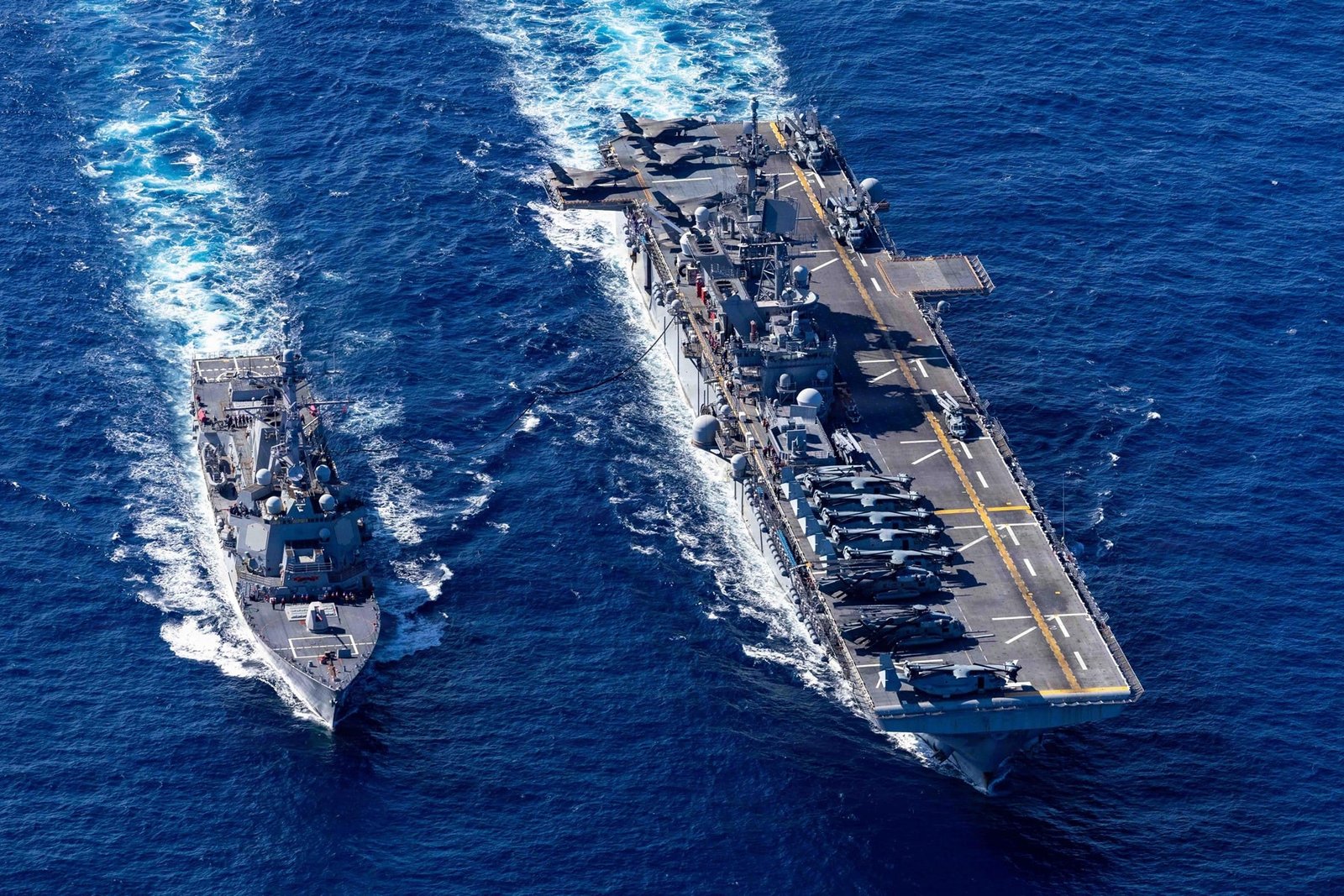

Having failed to secure the Strait of Hormuz at the start of Operation Epic Fury, it remains a key focus for United States operations against Iran.
According to US CENTCOM on 28 March, the Tripoli Amphibious Ready Group (ARG) and the 31st Marine Expeditionary Unit (MEU) consist of roughly 3,500 Sailors and Marines, supported by a combined aviation element including F-35B Lightning II fighters, MV-22B Osprey tiltrotors, CH-53 heavy-lift helicopters, and AH-1Z attack helicopters. The force includes the Arleigh Burke-class Aegis guided-missile destroyer USS Rafael Peralta and the amphibious transport dock USS New Orleans.
After US President Donald Trump’s attempt to shift responsibility for unblocking the Strait of Hormuz to allies in Europe, Japan, Australia, and Canada failed, preparations for missions to unblock the strait continued. The allies started planning without US involvement, and the UK and France will lead negotiations involving around 30 countries on reopening the Strait of Hormuz, followed by a meeting of defence chiefs of staff. Canada, which had previously declined a similar request from the US, will join the expanded group.
Meanwhile, European countries are gradually deploying ships to two assembly points, near Cyprus and in the southwestern Indian Ocean.
The French carrier Charles de Gaulle Strike Group operating in the eastern Mediterranean includes the frigate FS Chevalier Paul, a FREMM-class frigate, a fleet oiler, and a nuclear-powered attack submarine, alongside the Spanish Navy frigate ESPS Cristóbal Colón and the Royal Netherlands Navy frigate HNLMS Evertsen. The United Kingdom is preparing the Bay-class auxiliary landing ship RFA Lyme Bay for deployment to the strait to counter naval mines. The ship will be fitted with autonomous underwater drones powered by artificial intelligence, designed to detect and neutralise threats on the seafloor.


Similarly, Ukraine is ready to share its unique experience in overcoming a naval blockade to assist in restoring maritime navigation in the Strait of Hormuz, which is currently under attack by Iran. Ukraine has reached an agreement with countries in the Persian Gulf to supply naval drones.
President Zelensky signed defence partnership agreements with both Saudi Arabia and Qatar, under which Ukraine and its partners will collaborate on co-production, establishing factories and production lines in both Ukraine and the Gulf countries.
After singling out Britain, President Trump stated that the British navy is inadequate for the task. The UKDI and the US Defense Innovation Unit (DIU) recently signed a Memorandum of Understanding (MoU), solidifying their commitment to collaborate on developing technology to counter unmanned underwater vehicle (UUV) threats. The programme, called REEF (Robotic Exclusion and Engagement Framework), aims to develop technology to counter UUVs, serving as an early example of that partnership in action. It also demonstrates how UKDI is working with allied innovation teams to identify advanced capabilities that could bolster UK defence. Despite interest across the US, within all Combatant Commands, and the UK Ministry of Defence in countering these threats, current solutions remain fragmented, expensive, and limited in number.
by David Oliver
