

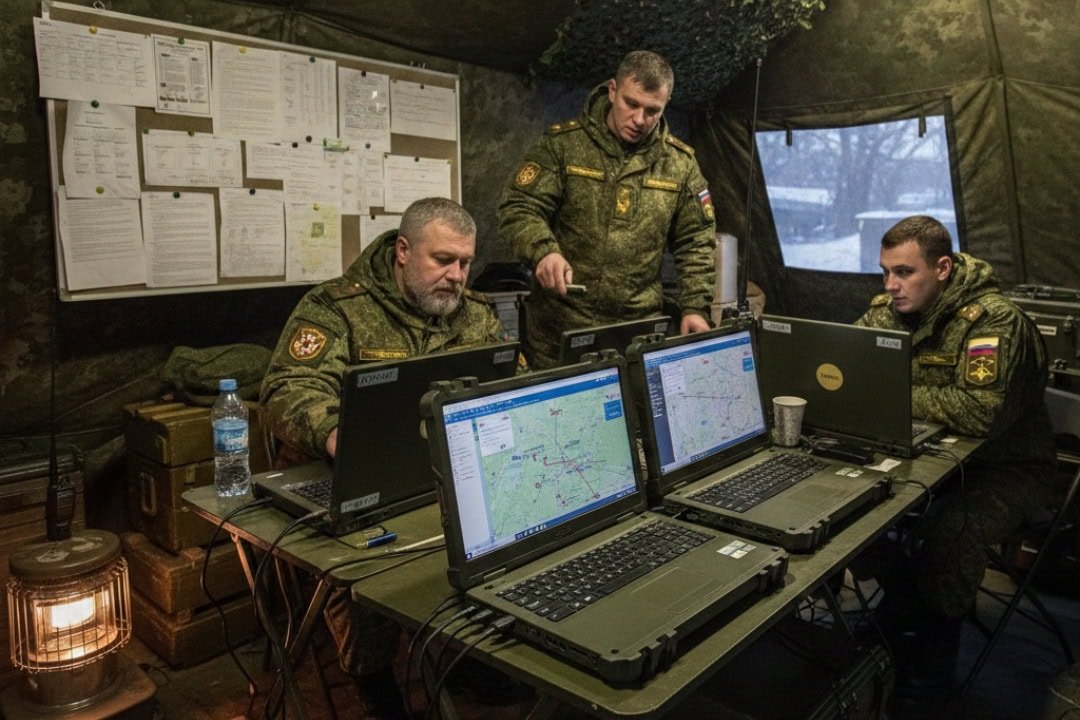

A new command and control system is entering service with Russian land forces which is thought to use artificial intelligence to aid tactical decision-making.
In late January, the United24 Ukrainian media organisation and Forbes magazine revealed details of a new Russian Command and Control (C2) system called Svod (Vault). Unlike other existing Russian tactical and operational C2 systems, Svod reportedly includes Artificial Intelligence (AI) algorithms to aid commander decision-making. Much like Ukraine’s Delta C2 system, Svod federates and merges intelligence arriving from disparate sources to enrich a commander’s tactical picture. AI is used to not only help analyse incoming intelligence, but to present the user with possible outcomes based on the intelligence and potential courses of action.
The intention behind Svod, as the reports articulated, is to accelerate commander tactical decision-making. Elements of Russian military doctrine, particularly in the land domain, are thought to be excessively top heavy. Local commanders, and their subordinates, have been discouraged from showing excessive initiative. It is possible that Svod aims to devolve decision-making downwards to accelerate battle rhythm via the use of AI to help users anticipate potential consequences. The war in Ukraine is now largely characterised by small units of dismounted troops performing limited actions. This has made the devolution of decision-making to the lowest tactical level increasingly important.
Existing C2 systems
Reports stated that Svod completed operational testing in December 2025 with its rollout expected to begin in April 2026. According to official Russian official documents seen by Armada, Svod’s implementation across all land forces formations deployed in, or deploying to, Ukraine will be completed by the end of 2026. Tactical formations in the 2nd and 41st Combined Arms Armies (CAAs) are the first recipients. Both these CAAs are deployed in Ukraine’s Donetsk oblast in the southeast of the country, Armada understands.
The Russian military already deploys the YESU-TZ Unified C2 System for Troops and Weapons. YESU-TZ is deployed from the strategic level downwards to operational and high tactical echelons. The system receives and processes data sent by subordinate echelons, and disseminates information, orders and situation reports. It appears YESU-TZ also equips the National Defence Command Centre in Moscow. At the tactical level, the Akatsiya-M C2 architecture is employed for logistics, general force organisation and battle management. Russian airborne troops, which constitute a separate service, have the Andromeda-D system with dismounted infantry using the Strelets command and control architecture. Other C2 systems include Akatsiya-E for tactical and operational ground-based air defence, and Asuno-S which furnishes artillery units. Bylina is the command and control system used by Russian land forces Electronic Warfare (EW) troops.
Svod functionality
As a software-driven system, Svod can be hosted on standard, militarised personal computers and laptops. This marks a break from YESU-TZ which was thought to need dedicated computing hardware, particularly when deployed onboard armoured vehicles. To understand how Svod could work, consider this scenario: A local, tactical commander has identified through a combination of intelligence derived from dismounted EW units, Uninhabited Aerial Vehicle (UAV) sorties and visual reconnaissance, a local building that is being used by the enemy. All this relevant intelligence is accessible from a map which depicts the building. The commander can see the location, and the dispositions and capabilities of local, subordinate units. These units could include artillery, mounted and/or dismounted infantry, EW, armour and UAV detachments. AI-based decision-making tools provide the commander with information regarding each units’ capabilities noting which might be best placed to support their intent. Svod also provides a combat cloud. Intelligence collected across the tactical and operational area can be uploaded to, and downloaded from, this cloud. Nonetheless, access to the cloud is not required for the user to employ Svod to support local, tactical decision-making.

This new C2 system looks likely to replace elements of YESU-TZ. The former may still provide C2 functionality from the strategic to the operational level. Nonetheless, Svod will likely be the C2 system used at the high tactical level, typically in motorised rifle/tank division/brigade command down to the dismounted tactical level where systems like Strelets will be employed as before. Speciality branches like those listed above will probably continue using their own C2 systems. These latter architectures will feed into Svod and associated data will be carried across standard Russian land forces tactical communications which are explained in more detail here.
Potential
Will Svod help Russian land forces accelerate tactical battle rhythm and shorten sensor-to-shooter times? Potentially yes, although Svod only appears to have a capacity that, at the very least, matches Ukraine’s Delta system. Ukraine has a headstart on its Russian adversary as Delta’s implementation on the battlefield commenced from mid-2022 and has been in a near constant state of evolution ever since. In the C2 technology arms race, Ukraine is clearly winning. Will Svod work sufficiently well to win commanders’ trust? YESU-TZ has been plagued by technical problems. If Svod suffers the same fate, users will simply abandon it in favour of alternatives or fall back on existing systems like YESU-TZ despite its shortcomings.
From an electromagnetic manoeuvre perspective, introducing another digital C2 system onto the battlefield introduces another potential set of targets for Ukrainian cyberwarriors. Likewise, any digital command and control system depends on communications links like radio which can be prone to jamming. Russian battlefield communications are under pressure with the country’s recent eviction from the Starlink satellite communications network. The Russian government is also reviewing military access to the Telegram messaging application. Telegram has been vital for data communications at the tactical level. Closing off these channels inevitably means more data using fewer links creating a greater vulnerability to jamming. Svod’s success, or otherwise, will likely become apparent early next year once its roll-out is complete. Any subsequent Russian success on the battlefield could be a consequence of its introduction. Until then, Ukraine and her allies must ensure that any, and all, of Svod’s vulnerabilities are identified and ready to target.
by Dr. Thomas Withington
