

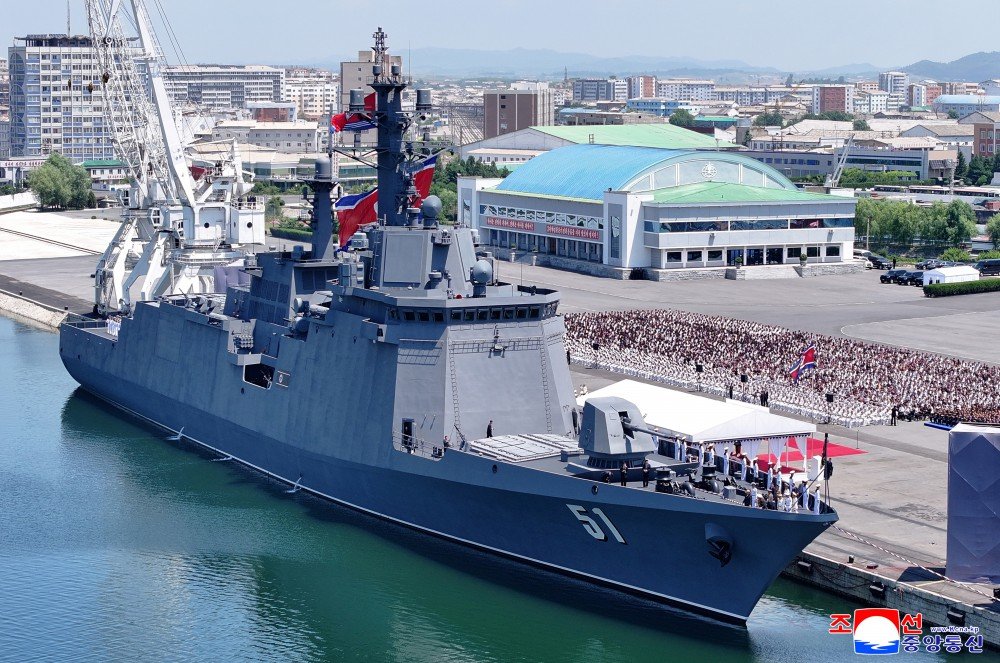
North Korean paramount leader Kim Jong-un has unveiled plans to build at least two major warships annually over the next five years. This includes a new class of 10,000-tonne cruiser, as Pyongyang seeks to rapidly modernise what Kim describes as a long-neglected navy.
His vision was outlined during the commissioning ceremony of the lead ship of the Choe Hyon-class destroyer at Nampo Port on 23 June.
“In the new five-year-plan period, we should correctly implement all the plans for building up our naval capability. We should build every year two surface ships whose class is higher than the Choe Hyon, including a 10,000-tonne cruiser. And we should build escort ships and ships for special purposes, and develop and produce underwater weapon systems,” Kim said.
The North Korean dictator also announced plans to construct new naval bases to support the expansion and operation of a larger fleet.
The 5,000-tonne Choe Hyon had been launched in April 2025, and it is by far the largest and most capable surface combatant ever operated by the Korean People’s Navy.
Although Pyongyang has released few official specifications, imagery of the vessel reveals a substantial weapon fit such as a 127mm main gun, a close-in weapon system (CIWS) resembling Russia’s Pantsir-ME, two additional side-mounted CIWS installations, and an estimated 88 vertical-launch cells of varying sizes. The latter are capable of accommodating both conventional and ballistic missiles.
A second ship in the class, Kang Kon, was launched in May 2025, although it capsized during the ceremony. The vessel was refloated and righted approximately one month later, with Kim stating that it would be commissioned in the near future.
The Choe Hyon class represents a significant leap in capability for North Korea’s navy, which has traditionally relied on ageing Soviet-era vessels, coastal patrol craft and an outdated submarine force.
While North Korean state media continues to portray the ships as entirely indigenous designs, analysts have pointed to numerous design similarities with contemporary Russian naval vessels, thus fuelling speculation that Moscow has provided technical assistance.
North Korea’s military modernisation has accelerated markedly since the outbreak of the Ukraine war in 2022. In exchange for supplying ammunition, missiles and military personnel to support Russian operations against Ukraine, Pyongyang is widely believed to have gained access to advanced technologies across multiple defence sectors, including missile, rocket and naval programmes.
by Chen Chuanren
