

Updated: 7:50 p.m. ET.
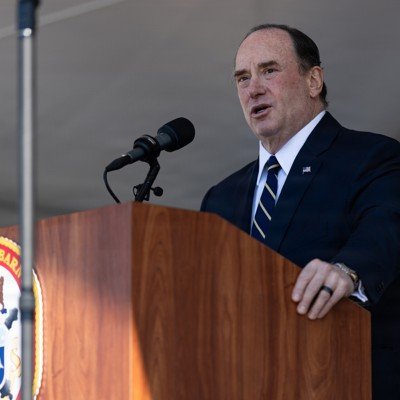
Navy Secretary John Phelan, the service’s top civilian leader, is leaving his role, the Pentagon announced Wednesday. His departure was announced as the Navy takes part in an unprecedented blockade of Iranian ports, and the day after Phelan spoke at the nation’s largest naval-themed conference.
“Secretary of the Navy John C. Phelan is departing the administration, effective immediately,” Sean Parnell, the chief Pentagon spokesman, said in a post on X. “On behalf of the Secretary of War and Deputy Secretary of War, we are grateful to Secretary Phelan for his service to the Department and the United States Navy. We wish him well in his future endeavors.”
Undersecretary Hung Cao, a former Navy diver and prior Republican congressional candidate, will serve as the acting Navy Secretary, Parnell said.
Phelan, a businessman with no prior naval experience, was in the role for just over a year. He spoke to reporters on Tuesday during the Navy League’s Sea-Air-Space conference as the service unveiled its $378 billion budget proposal. The request focuses on buying 18 battle force ships and 16 auxiliary ships as part of the administration’s “Golden Fleet” initiative.
“This is a strategy-driven budget,” Phelan said in a Tuesday press release. “It’s not about business as usual—it’s about making generational investments in real, usable capability for our warfighters.”
The then-secretary also suggested that foreign shipyards might build U.S. warships—an idea that might have led to his unexpected departure, said Hunter Stires, who served as maritime strategist to Phelan’s predecessor.
“Secretary Phelan committed a grave strategic as well as political error yesterday in signaling his openness to outsourcing production of U.S. Navy warships abroad,” Stires said in a statement. “Phelan’s statements directly undercut a bipartisan strategy championed by the Trump Administration to incentivize world class allied shipbuilders to invest in modernizing and expanding shipyards here in the United States. Phelan’s firing within hours of his blunder should be read as a stark and welcome signal that outsourcing U.S. Naval construction abroad is and must remain a non-starter.”
The White House and a Pentagon spokesman did not immediately return a request for comment asking for more details about Phelan’s departure.
It comes weeks after Defense Secretary Pete Hegseth pushed Army Chief of Staff Gen. Randy George to retire. One defense insider told Defense One the Navy secretary’s vision for the service and personality clashed with other Pentagon officials.
“Long-rumored but still, wow,” the source said. “Insiders did not see him a minute past July 4 and even this late was borrowed time.”
Mark Montgomery, a retired Navy rear admiral and a senior fellow at the Foundation for Defense of Democracies, said Phelan did not leave a strong legacy as a service secretary and specifically criticized his battleship and frigate initiatives.
“Not knowing why he left, I’m careful to not be too critical. But I would just tell you he was not a successful service secretary,” Montgomery said. “Way too many of his good ideas haven’t developed enough and his bad ideas are hurting the force.”
In early February, CNN first reported that Phelan had flown on a plane from London to New York with convicted sex offender Jeffery Epstein in 2006. A copy of the flight manifest, which shows six redacted names of other passengers, was reviewed by Defense One.
Bradley Peniston contributed to this report.
