

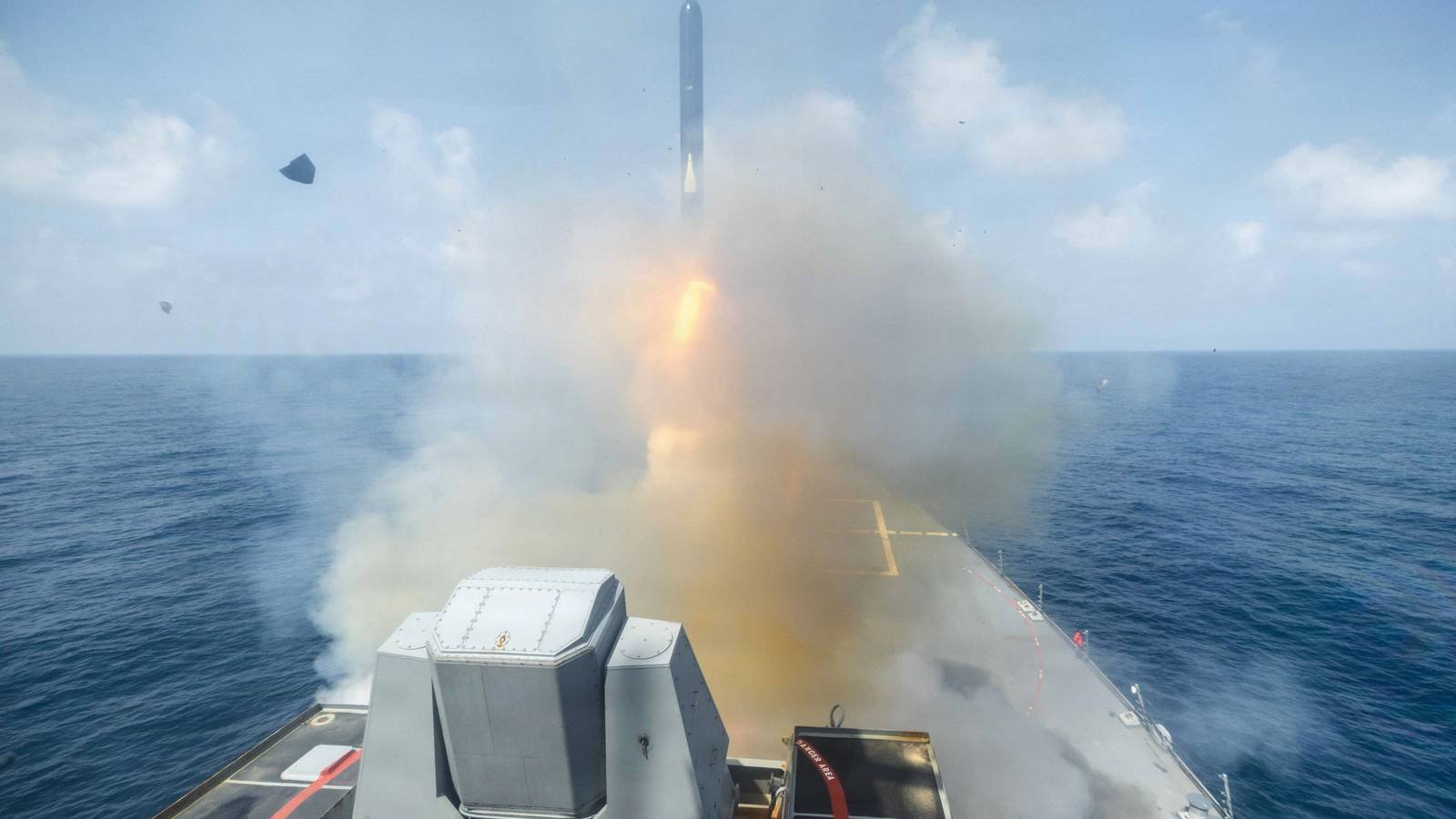
The Navy has awarded a $22.9 billion contract to Raytheon to develop Tomahawk missiles.
The U.S. has used missiles like these, which are capable of flying low to the ground to evade detection and can carry 1,000-pound conventional warheads to accurately strike targets up to 1,000 to 1,500 miles away, since 1991. The contracts come amid reports of potential weapons shortages in the U.S.
Hung Cao, the acting secretary of the Navy, said in prepared remarks that the “landmark investment” with the company will accelerate the development of the missiles “at unprecedented speed.” Exact specifics regarding the details of the contract were not released.
“By working closely with industry to expand the capacity of our munitions industrial base, the department is utilizing every available tool to meet the demands of current operations—guaranteeing our naval and joint forces have the lethal firepower they need to deter aggression and protect the homeland,” Cao said in a statement.
Military.com reached out to Raytheon for comment but received no response by publication.
It comes amid reported concerns that the U.S. is suffering from a munitions’ shortage as its war with Iran continues. A defiant President Donald Trump said earlier this month that the U.S. “has massive amounts” of weapons and that “large amounts are being manufactured and shipped to the U.S. as needed.”
The award was made by the Portfolio Acquisition Executive (PAE) Munitions, a Navy organization that is responsible for developing and procuring naval munitions.
“The Department has challenged industry to answer the call to expand munitions production and capacity, and RTX has answered,” Michael P. Duffey, Under Secretary of War for Acquisition and Sustainment, said in a statement. “This contract accelerates our ability to get warfighters what they need, ensuring they never have to face a fair fight.”
More Defense Spending
The contract announcement comes as the Trump administration has called for more defense spending.
The administration has requested a $1.5 trillion defense budget from Congress. In July, Defense Secretary Pete Hegseth told Senate Appropriations Committee lawmakers that not fully funding the Department of Defense (DOD) to the tune of $1.5 trillion is the “greatest threat” the United States faces at home and abroad.
He made the statement while publicly requesting an additional $87.6 billion for “urgent needs” for military operations in Iran.
Hegseth also said that the cost of the Iran War to U.S. taxpayers amounted to roughly $37.5 billion as of late July.
Other Recent Missile Contracts
Government departments have also initiated other contracts to increase weapons production.
In July, the DOD announced two framework agreements with defense companies Northrop Grumman and Lockheed Martin to triple the production of Patriot Advanced Capability-3 (PAC-3) components, and quadruple the production of Terminal High Altitude Area Defense (THAAD) components.

The PAC-3 component framework will provide a second source for Solid Rocket Motors (SRMs). It will also increase the production of ignition safety devices for PAC-3.
Under the THAAD framework, the production of THAAD interceptor structural components including mid-body shells, muzzle covers and rail car assemblies will be quadrupled.
The Pentagon did not disclose the terms of these new agreements, including costs and production timelines.
In July, the DOD awarded two companies to develop laser weapons. The Joint Laser Weapon Systems (JLWS) agreements, which have an initial award value of $86 million and a total program ceiling of $847 million, were awarded to nLIGHT Defense and Lockheed Martin Aculight to advance the United States’ cruise missile and unmanned aerial system (UAS) defense architecture.
The government also awarded contracts worth $1.75 billion to build missile-tracking satellites for the U.S. Space Force.
These contracts, awarded by the U.S. Space Force’s Space Development Agency (SDA) to Sierra Space, a technology company based in Louisville, Colo., and to L3 Harris Technologies, are for 36 total satellites to track missiles and other threats.
