


A recent contract amendment is helping to advance work on the European Secure Software Defined Radio narrowband waveform.
On 7th July OCCAR (Organisation Conjointe de Coopération en matière d’Armement/Joint Organisation for Armament Cooperation) announced the signature of a contract amendment with a4ESSOR. The amendment concerns the ESSOR (European Secure Software Defined Radio) waveform programme. OCCAR is a pan-European governmental organisation which manages European collaborative military procurements.
The ESSOR programme involves Finland, France, Germany, Italy, Poland and Spain. The a4ESSOR consortium is the programme’s industrial element comprising Bittium, Indra, Leonardo, Radmor, Rohde and Schwarz, and Thales. All six countries will be introducing ESSOR waveforms into their tactical, operational and strategic communications over the coming years. Two of the ESSOR nations, Finland and France, have already introduced the HDRWF into service with their tactical radios. Two nations outside the ESSOR membership, Croatia and the Republic of Ireland, are also adopting the HDRWF.
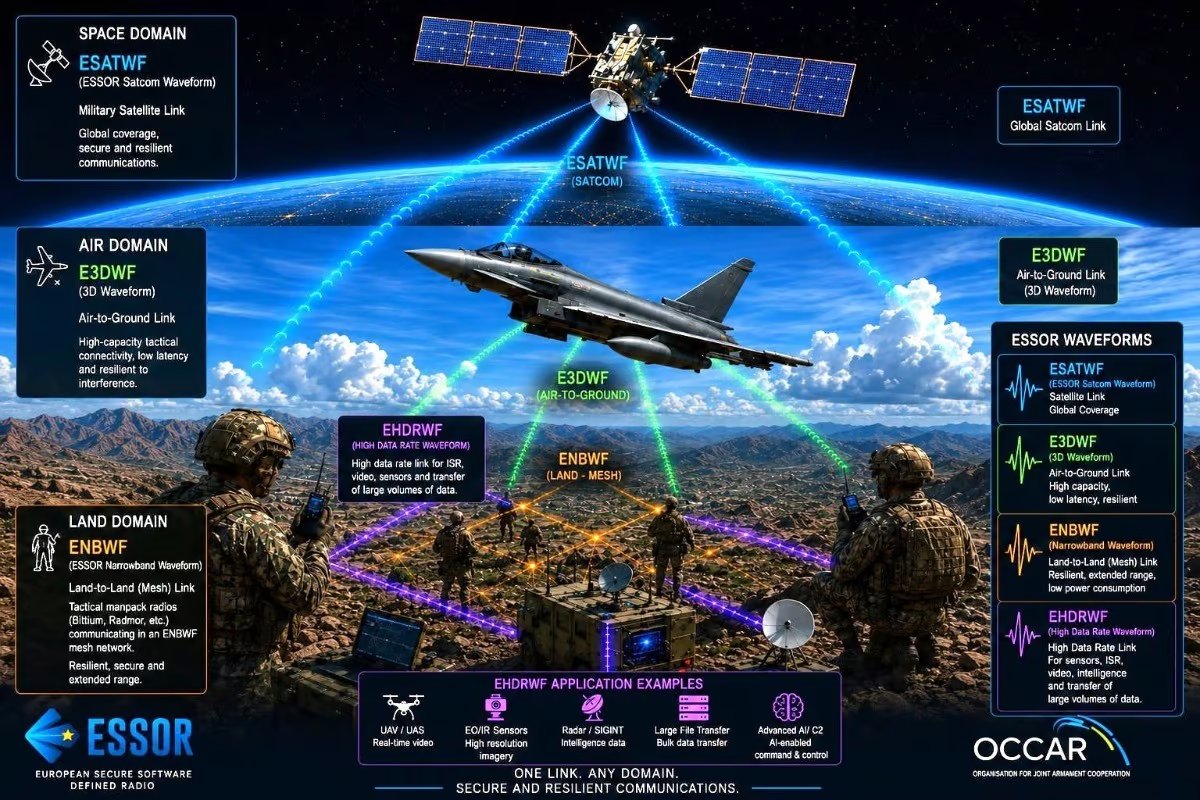
Four radio communications waveforms are expected to be developed, delivered and implemented via the ESSOR initiative. The suite of communications protocols includes the ESSOR High Data Rate Waveform (HDRWF). The HDRWF is an Ultra-High Frequency (UHF) waveform using a waveband of 225 megahertz/MHz to 400MHz. True to its name, the waveform can handle data rates of up to one megabit-per-second. The HDRWF can work in environments where global navigation satellite system position, navigation and timing signals are badly degraded or denied.
The HDRWF is joined by ESSOR’s Narrowband Waveform (NBWF). The NBWF is optimised to support communications in urban, rural, littoral, undulating and mountainous terrain using a mobile ad-hoc networking architecture. The waveform employs frequency hopping across wavebands of 30MHz to 88MHz, or 225MHz to 400MHz. Beyond the HDRWF and NBWF plans are afoot to develop the ESSOR Tactical UHF Satellite Communications Waveform (ESATWF). ESTATWF is likely to join the ESSOR Three-Dimensional Waveform (E3DWF) which is earmarked for air-ground-air communications. More details on the specifics of these latter waveforms, and the ESSOR programme in general, can be found here.
STANAGs
The July contract amendment “expands the (p)rogramme with the development of the ESSOR Narrow Band Waveform” according to a press release. The specifications for the NBWF are enshrined in the North Atlantic Treaty Organisation’s (NATO’s) Standardisation Agreement 5630 Edition-2 (STANAG 5630 Edition-2). Lino Laganà, a4ESSOR’s president and general manager, told Armada that STANAG 5630 Edition-2 has already been agreed by NATO’s Line-of-Sight Communication Capability Team. Known as LOS CAT, this team supports the alliance on technical aspects of line-of-sight communications. STANAG 5630 Edition-2 is expected to commence its ratification process in the last quarter of 2026, he continued. STANAG ratification involves NATO members evaluating a proposed standardisation agreement and reporting back on whether that country can achieve full, partial or no ratification. These responses are communicated back to NATO’s Standardisation Office and are taken into account. Once member nations have approved the proposed STANAG it is formally published and thus available for implementation across the alliance.
The press release continues that the contract amendment signature increases the overall value of the ESSOR programme to $240 million. Mr. Laganà says that the current contract amendment will run until 2030 and conclude with “interoperability laboratory tests and an external vehicle demonstration”. Following this date, “it will be up to nations to conduct their operational tests and training as required for field deployment”. Over the longer term, in addition to ESATWF and E3DWF work, Mr. Laganà says “(a)dditional activities are being considered (including the) start of common logistic support (provision for the) upgrade and maintenance of the waveforms”. Other activities are expected to facilitate “development and interoperability tests of newly-ported waveforms by NATO nations”.
by Dr. Thomas Withington
