

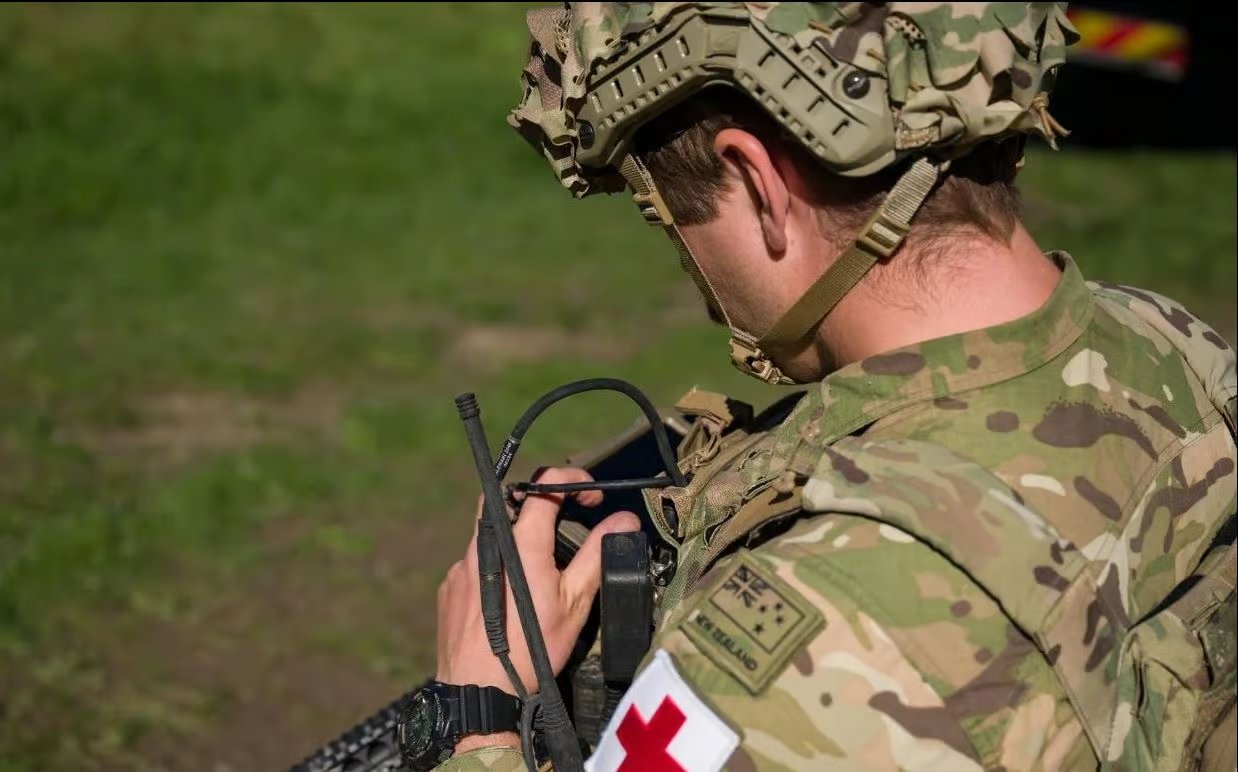

New Zealand’s new Mobile Tactical Communications System shows its worth during a recent exercise involving the country’s High Readiness Task Unit.
New Zealand’s modernisation of her armed forces’ communications systems is continuing. In early October, the country’s Ministry of Defence (MOD) announced that the New Zealand Army’s High Readiness Task Unit (HRTU) had used its Mobile Tactical Communications System (MTCS) in a recent exercise. The HRTU is, according to open sources, a rapid response force comprising troops from the 2nd Company/1 Battalion of the Royal New Zealand Infantry Regiment. As its name suggests, the HRTU can rapidly mobilise and deploy either at home, or internationally, to provide a short notice response to crises, conflict and humanitarian needs. The HRTU works closely, and regularly trains with, the Royal New Zealand Air Force’s NH Industries NH-90 series medium-lift utility helicopters.
The MTCS is an ensemble of communications and Command and Control (C2) systems providing tactical C2, battle management and situational awareness. According to a New Zealand MOD press release, a contract was awarded to L3Harris’ Australian subsidiary in 2019 for the MTCS under a contract worth circa $26.3 million. The MTCS forms one part of the larger Network Enabled Army (NEA) initiative that is being delivered in four tranches. According to the MOD’s Major Projects Report 2025, $72.5 million was allocated to NEA tranche one in 2015, followed by $70.2 million for tranche two in 2019. It appears that tranches three and four are awaiting funding.
Tranche one deliverables
As Armada reported in 2022, NEA tranche one focuses on army C2 systems while tranche two concentrates on intelligence, surveillance and reconnaissance. In late 2018, L3Harris was chosen to provide the tactical radio hardware and software for the MTCS. Alongside the radios, tranche one includes materiel for the command post environment, chiefly physical infrastructure and accompanying computer systems, according to the MOD. The radios will work with a Battle Management System (BMS) and a universal bearer network, both of which are being supplied via tranche one. The BMS is built around Systematic’s SitaWare software.
Tranche one radios include L3Harris’ RF-5800S High Frequency (HF: three megahertz/MHz to 30MHz) and Very High Frequency (VHF: 30MHz to 300MHz) backpack radios. The RF-5800S is augmented by the AN/PRC-117F VHF and Ultra High Frequency (UHF: 300MHz to three gigahertz) backpack transceiver. Joining the AN/PRC-117F is L3Harris’ AN/PRC-163 and AN/PRC-158 V/UHF multi-channel handheld and backpack radios.
Alpha Dracula
The Mobile Tactical Communications System was put through its paces by the HRTU during a recent exercise named Alpha Dracula. The exercise scenario was built around a deployment to counter gunrunning occurring in and around a Pacific nation. HRTU units were deployed at sea using inflatable boats before continuing to their objective, a weapons-smuggling camp in the nation’s hills. The MOD press release stated that the MTCS allowed “commanders on the water and ashore to track the location of their teams, and share orders and information remotely and securely”.
The deployment of the MTCS represents a wider deployment of the system across New Zealand’s army. Sarah Minson, the MOD’s deputy secretary for capability delivery, told Armada that the system is being “incorporated into ongoing training and operational activities” during its force-wide introduction. “Further enhancements and improvements will continue to be delivered as part of the army’s broader modernisation programme,” she added. Ms. Minson continued that, compared to legacy land forces communications and C2 systems, MTCS “supports more timely decision-making, improves coordination during operations, and helps personnel maintain an understanding of friendly force locations and operational activities”. Interoperability has been built into the MTCS from the outset, as the system “has been designed to support cooperation with other New Zealand Defence Force units, government agencies and international partners, where appropriate”.
Additional exercises involving the MTCS are expected in the coming year, as the MOD says the system may be deployed to support New Zealand Army units participating in Exercise Talisman Sabre in 2027. According to the Australian Department of Defence, Talisman Sabre will be jointly hosted by Australia and the United States and will involve an additional 24 nations from within and beyond the Asia-Pacific region. The exercise will involve sea, land, air, space and cyberspace units. The multinational nature of the initiative will be an invaluable opportunity to test the MTCS’ multilateral/coalition mettle.
by Dr. Thomas Withington
