

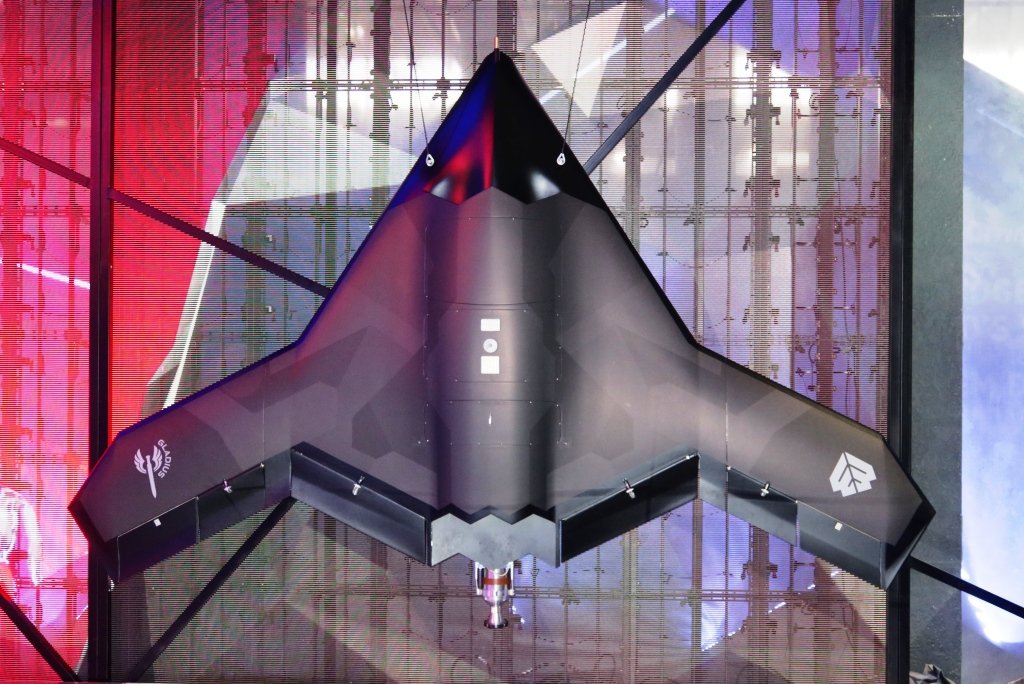
With four Gladius reconnaissance-strike battery fire modules already delivered, the Polish WB Group unveiled at MSPO a series of new effectors, among which the Warmate 30, which in Polish service will be named Gladius 2, a loitering munition system designed to detect and engage high-value targets
In 2022 Poland ordered four Gladius reconnaissance-strike systems which are now fully operational. These were mostly based on the FT-5 ISR UAV and on the BSP-U U(Bezzałogowe Statki Powietrzne-Uderzeniowe, for strike UAV) Gladius 1/Warmate 5 effector.
EDR On-Line understood that in fact the Gladius 1 attack effector is something more than the Warmate 5, as it can exchange information with the other elements of the system, both ground-based and flying ones, leveraging the WB experience in crypto communications.
Both the ISR and the loitering munition have an operational range of over 100 km, the surveillance airframe having an over six hours endurance, while the loitering munition can carry a 5-10 kg warhead at around 100 km range.
Different warheads can be installed depending on mission, such as high-explosive fragmentation, thermobaric, and anti-tank. Both systems are propeller-powered and take off from a ramp, usually installed on a light vehicle.
Warmate 30/Gladius 2: longer range, lower visibility, greater payload

The new Warmate 30/Gladius 2 will allow artillery units to engage targets at over 150 km distance, with a greater terminal effect thanks to the 30 kg warhead of the new effector. The development of the new weapon started in 2022, when the Ministry of National Defence’s Agencja Uzbrojenia, the Polish Armament Agency, asked WB to provide a longer-range arrow to add to the Gladius system. The development work should have finished officially in 2026, but the work is mostly finished therefore WB could unveil it at MSPO.
The Warmate30/Gladius 2 has a wholly different architecture compared to its predecessor; it comes in the form of a flying wing featuring a low-visibility shape, one of the design priorities was clearly the reduction of the radar cross section and is powered by a turbojet engine located at the rear, also produced by the WB group.
Fully made of composites, the group WB Composites Centre (WBCK) providing the knowledge and materiel, the Warmate 30 has a maximum take of mass of around 100 kg.

No details were provided on the engine thrust; considering that take-off is carried out from a rectangular-section canister using a booster, the system is readied for use in less than five minutes, for horizontal flight a 100-200 N should be sufficient.
Of course, the choice of a jet engine will increase the airframe thermal signature, although part of the cold air captured by the wide air intake visible on the upper side of the airframe may well be used to dilute the plume generated by the turbojet engine, to lower its temperature hence reduce signature.
No details were given on dimensions, however a length of around 1.6-1.8 metres and a wingspan of 2-2.3 metres should be credible figures; EDR On-Line understood that the airframes visible at MSPO might not be exactly the same of production ones, while a folding wing version is in development, which will probably allow to adopt smaller. WB Group is currently producing a low-rate initial-production batch of over 20 airframes, which will probably used not only for company tests but also for evaluation tests by the military, three Warmate 30/Gladius 2 being exhibited at the Kielce exhibition.
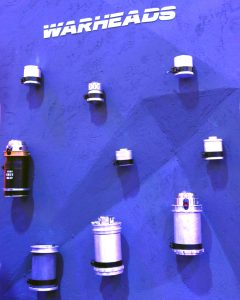
As said the warhead can have a mass up to 30 kg, here too the effector being able to accept different types of warheads, also produced by WB. The base warhead is a multirole one, based on an HEAT warhead with a fragmentation sleeve, providing an antitank capability together with a fragmentation one to be used against lightly protected or unprotected targets. It is to remember that the new effector was designed to detect and engage high-value targets, such as command posts and armoured vehicles.
A thermobaric warhead will also be available. Its cruising speed is of far over 150 km/h while its endurance is of more than one hour, which means its range should be of at least 200 km, a data confirmed by the declared radio line-of-sight range of around 250 km. Operational ceiling is 5,000 metres above sea level, while operational altitude is between 500 and 1,500 metres.
The configuration of the Warmate 30/Gladius 2 is now frozen, and soon WB will start production of the 12 battery-level fire units on order by Poland, a contract worth 10 billion Zloty, over 3 billion Euro, part of the European Union SAFE (Security Action for Europe) programme, signed on 28 May 2026 [1] and which requires the systems to be delivered by December 2029.
The contract also includes the development of a long-range, long-endurance, low-visibility ISR UAV, which will operate in team with the Warmate 30/Gladius 2 and other new effectors; no information on this new product were provided during MSPO.
The in-service Gladius system

The four Gladius fire modules currently in service are each a battery-level unit, with one BSP (Bezzałogowe Statki Powietrzne, for UAV) platoon, and two BSP-U strike UAV platoons.
The BSP platoon is made of three FT-5 ISR UAV sections, each one including a Command Vehicle, a Launch Vehicle with ramp, and an Ammunition Vehicle. The Command and Launch vehicles are based on a 4×4 chassis, while the Ammunition Vehicle is an 8×8 truck, the number of systems remaining classified.
FT-5s are available in three different versions, IMINT (Image Intelligence), SAR (Synthetic Aperture Radar) and ELINT (Electronic Intelligence). These reconnaissance sections can be deployed forward, possibly attached to operational units.
Each BSP-U platoon is made of one Command Vehicle, four Launch Vehicles, and two Ammunition Vehicles, these carrying mostly Warmate 5, ISR UAVs being eventually available ensuring autonomous ISR as well as battle damage assessment capabilities.
At battery level we find one Battery Command Post, one Technical Support and Maintenance Truck, and one Mobile Analysis Station. The latter is the key element at this level, as its AI-based algorithms allow to perform data fusion of all incoming information, from day cameras, thermal cameras, synthetic aperture radars and, which is even more important, Electronic Intelligence, AI being used as a decision-support element to reduce commander’s workload and decision-making time, however human control is maintained.
Potentially Gladius can be used in fully autonomous mode, however it is used in a man-in-the-loop configuration considering the limitations self-imposed by the western world on hard-kill effectors.
The Gladius is part of the artillery; hence it falls under the Topaz, the battle management system of the Polish Land Forces artillery up to Corps level. WB underlines the importance that all sensors and effectors can exchange information between and considers this a key factor of the reconnaissance-strike Gladius system.
Looking into the future

The aforementioned organisation refers to the four Gladius units already delivered by WB to the Polska Wojska Lądowe, the Polish Land Forces, EDR On-Line understanding that the table of organisation of the 12 units on order may differ.
According to information gathered at MSPO, the launch system for the Gladius 2 will be palletised, and therefore it will be easily installable on different platforms, the new loitering munition being however able to exploit also legacy Gladius launch ramps for take-off, the Gladius being the only self-propelled reconnaissance-strike system within NATO, WB representatives underline.
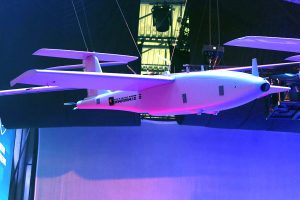
At MSPO the Warmate 30/Gladius 2 was not the only novelty at the WB stand. Another member of the Warmate family was unveiled, the Warmate 8X, where the number indicates as usual the mass of the warhead while the letter indicates it is fitted with a cruciform wing, a solution adopted by several loitering munitions producers as it ensures maximum manoeuvrability in the terminal phase, allowing high angle of attack profiles.

The Warmate 8X has a take-off mass of around 40 kg, is powered by an electric motor fitted at the rear driving a two-blade pushing propeller that allows a maximum speed in excess of 150 km/h, endurance being over one hour.
This gives an operational range of over 150 km, operational altitude being 100-1,000 metres over ground level, ceiling being 3,500 metres above sea level. Three types of warheads are available, HEAT based on a shaped charge, HEF (high-explosive fragmentation) and thermobaric.
Different autonomous flight modes are available, such as waypoint flight, flight to a point and loitering over the target to select the optimal target and attack profile, before switching to attack mode; a 1.5 metres circular error probable is declared by the company.
It is unclear if the Warmate 8X will become part of the Gladius system; the latter being an open architecture system, and the Warmate 8X being part of the WB loitering munitions ecosystem, this will be definitely possible.
The new Warmates unveiled at the Kielce exhibition are definitely not the last members of the family; more and being developed, some are already in the portfolio, and will be shown to the public in the coming years.
[1] On that same day two more SAFE contracts were assigned to WB, one for hundreds of Warmate loitering munition systems sets, and another one for nearly 200 FlyEye unmanned reconnaissance systems sets
Photos courtesy WB and P. Valpolini
