

This is the second part (I, IIa) of our honestly-who-knows-how-many part series laying out some general guidelines for how pre-modern armies are recruited, raised, equipped and paid. While I hope this will be of great interest to the history nerds out there, I’ve opted to structure this specifically as a service for the worldbuilders out there, making useful rules of thumb for imagining fantastical societies.
Last week, we laid out some basic groundwork questions for our underlying society and then discussed what I’ve called recruitment principles – the social justifications for military service. And as we saw, some of those principles are going to fit some societies a lot better than others: a society’s recruitment principles (remember, they may use different principles for different groups!) are generally going to map fairly directly onto the society’s own peacetime organization.
That said while those principles provide the justification to get and keep fighters under arms, what they do not do is actually organize the process – what we might call the mobilization process. Mobilization processes are often a step in the road to war that are glided over in relative silence in both historical treatments of real events and speculative fiction about made up wars, but it turns out that the process of getting thousands of men from their homes to a muster point, organized and ready to fight is a very complex one. And, as we’ll see the recruitment principle often heavily impacts the mobilization method and both are tied deeply into underlying social structures.
So that’s what we’re going to look at today: how do you get these men from their homes to the army, sort them into units and make sure they have the equipment they need to fight. As we’ll see, the primary problem pre-modern polities (states and non-states alike) face in doing this is managing such a complex process with such a limited administrative apparatus.
Now for both length and time (this post alone is swiftly approaching 6,000 words) I’ve had to split this up, so this week we’re going to look at the shape of the problem and the two most minimalistic approaches to the problem: ‘self-recruitment’ (entitlement-based recruitment where most of the burden is shifted to the men serving) and retinue-of-retinue systems (where recruit is done by Big Men in a non-state system). The next week we’ll look at the three other models I have in mind: brigading households together to provide recruits, shifting the adminsitrative burden onto military contractors and finally professional soldiers of both the volunteer and compelled varieties.
But first, as always, recruiting and maintaining large pre-modern armies is expensive! Much like many of those pre-modern armies, this project is supported by devolving the costs of my ruinous book-buying habit on to recruits readers. You can help by spreading the word to new readers and by supporting this project over at Patreon. If you want updates whenever a new post appears or want to hear my more bite-sized musings on history, security affairs and current events, you can follow me on Bluesky (@bretdevereaux.bsky.social). I am also active on Threads (bretdevereaux) and maintain a de minimis presence on Twitter (@bretdevereaux).
(Bibliography Note: What I am presenting here is a series of models, which is to say simplified classifications of more complex systems. For each model then, I do generally have one or two specific core systems (that is, specific historical mobilization systems) in mind, with the idea that the model in turn encompasses more systems than just those. Nevertheless, I want the reader to recognize the generalization going on here! The ‘core’ systems for each model and some further reading on them are as follows. For the ‘self-recruitment’ model, my core systems here are the Middle Roman Republic and classical Greek poleis armies ; I also reference the late medieval town militias of the low countries and their Schuttersgilde, on which see L. Crombie, Archery and Crossbow Guilds in Medieval Flanders, 1300-1500 (2016). For Big-Men based recruitment, my core models are pre-Roman Gaul and post-Carolingian France (on the latter, see J.F. Verbruggen, The Art of Warfare in Western Europe During the Middle Ages (1954) and C. Rogers, Soldiers’ Lives Through History: The Middle Ages (2007); note also for England D. Simpkin, The English Aristocracy at War: From the Welsh Wars of Edward I to the Battle of Bannockburn (2008). For the brigaded-households-and-local-officials model, I was thinking especially in terms of the Anglo-Saxon fyrd and the Carolingian levy system; on the latter see B. Bachrach, Early Carolingian Warfare: Prelude to Empire (2001) and G. Halsall, Warfare and Society in the Barbarian West 450-900 (2003). For the ‘contractors’ model, I was thinking very much of early modern European armies, on which see inter alia G. Parker, The Army of Flanders and the Spanish Road, 1567-1659: The Logistics of Spanish Victory and Defeat in the Low Countries’ Wars (1972, 2nd ed. 2004) and L. Staiano-Daniels’ The War People: A Social History of Common Soldiers during the Era of the Thirty Years War (2024). For ‘professionals and prisoners’ as a model I was thinking in terms of the Roman army of the early and high imperial period and (especially for the prisoners bit) the army of the Song Dynasty; on the latter see E. Alyagon, Inked: Tattooed Soldiers and the Song Empire’s Penal Military Complex (2023).
I encourage worldbuilders using this series, once they’ve figured out what sort of system their fictional society is likely to have, to read one or more books focused on the details of specific systems in that category to get a sense of how they function at more detail than the generalizations here.)
The Shape of the Problem
I want to start by getting a sense of the shape and scale of the coordination problem here. Pre-modern field armies vary in size but they typically start in the high single-digit thousands (e.g. ~8,000 English at Agincourt) and quickly move into the low tens of thousands. At least in the broader Mediterranean world, logistical limits tend to cause armies to ‘cap out’ between 80,000 and 100,000, though such large armies cannot be maintained in once place for very long without riverine or sea-based logistics. And that’s the number of combat effectives; we ought to assume at least something like 1 non-combatant per every 4 combatants (often more). A standard Roman field army in the Middle Republic was right around 20,000 soldiers, with probably 5,000 (or more) non-combatants) and something like 10,000 animals split more-or-less evenly between mules and horses.
Now in a history textbook, the process of gathering such an army is often just glossed over with, ‘so and so raised an army.’ And fair enough – our sources generally treat the raising of an army like that too. Livy, for instance, writing about the years from 218 to 167, generally glosses over the annual raising of Rome’s armies in just a few sentences, noting the total Roman dispositions for that year (though interestingly, Polybius, writing for a non-Roman audience, describes the process in depth). Our sources do this because they assume their readers largely know what the process of raising an army looks like because these societies do that regularly.
Fictional works often do the same: the war begins and the king dramatically declares, “raise the army!” or “call the banners!” and then it mostly just happens. Maybe there is something in there about sending messages.
But consider the complexity of the operation here: you need tens of thousands of men who are currently living in their homes (without access to any kind of modern rapid or mass communication) to find out they have been selected (remember, many of them may not be able to read and you do not have a postal system anyway), then to transit to a muster point, acquire their arms, armor and other equipment (which they may not already have!), divide into workable units for command and organization, have leaders selected and then pitch the army’s first camp.
If you have ever organized so much as a small sports club, MMO guild or RPG group, I imagine you are right now breaking into a cold sweat at the idea of trying to coordinate tens of thousands of people for something like that. Crucially many of whom probably do not want to be there and will thus look for any excuse to be absent or late.
As noted, a lot of speculative fiction just sort of lets this process work ‘off screen’ so to speak. After that, the next most common assumption is to have the process work the way a modern administrative state would do mobilization: either by mass hiring volunteer professionals (we’ll get to how a pre-modern state does that below) or with mass conscription. So you have figures that resemble recruiting officers walking into villages with lists of names of fellows that are to be conscripted, implying – among other things – that the kingdom is keeping a full and accurate name-by-name census of the entire male population. Very few pre-modern states were capable of this – the fact that Rome did this for much of Italy during the Republic was legitimately impressive to later rulers! – and obviously non-state polities (including vassalage based ones) aren’t going to be able to do this. The parish registers that represent the very beginnings of modern European census systems mostly date to the early modern period (though there were older systems, as we’ll see below, that replicated parts of this approach).
That scenario also assumes the state is maintaining conscription officers. As we’ll see, there might be people in that role (though sometimes not!), but large numbers of full-time recruiters distributed evenly across a large kingdom was typically a bureaucratic demand most pre-modern societies simply could not meet. Remember, in societies where upwards of 90% of the population is engaged in subsistence, the supply of highly literate bureaucrats is very limited. Instead pre-modern societies have to use the social structures and officials they have to facilitate mobilization – unlike a modern state, they generally cannot afford to create a parallel bureaucracy for the purpose.
Finally and crucially centralized conscription assumes the state is supplying the weapons. I think many modern readers finds this surprising, but it is worth stressing: it is quite unusual for pre-modern states to directly supply arms and armor for most of their armies. We’ll loop back around to this problem from another direction next week when we talk about paying for all of this, but the financial and more importantly administrative demands of full state supply of equipment exceeds the capability of most pre-modern states (and functionally all pre-modern non-state polities).
Consider, for instance, what it would mean to manage state issue for an army of 40,000 men: 40,000 shields, spears, and swords, along with cuirasses and helmets, the latter two complicated by the fact that they have to fit the fellows in question. Taking something like the Macedonian phalangite’s kit (on the low-end of labor intensity for a heavy infantryman), that’s probably a couple thousand hours of labor time per man (so c. 80 million labor-hours total), which then needs to be stored. The sarisae (or if you prefer a smaller weapon, spears) if lined up standing upright in racks might run in a single row some 2000 meters, side to side. In short you’d need enormous centralized storage and production facilities which would need to be built, maintained and guarded. Someone would need to regularly inventory all of that.
It’s clear that some pre-modern states did some of that! During the Imperial period, some Roman equipment was state issued and it seems like Carthage’s North African and citizen troops may have been equipped out of state-run armories. Wealthy European medieval rulers might likewise display their wealth by equipping their retinue in their own livery out of a personal armory, though most soldiers were not so equipped. But such centralized systems tend to be both rare and relatively limited. By and large the only way most pre-modern polities could handle the administrative and financial strain of equipping their armies was to devolve the costs, either to individual soldiers or local communities or smaller aristocrats. They simply lacked either the revenues of the administration to do this centrally.
In short, the kind of full bureaucratic centralization of this process is rarely possible, especially for large states covering a lot of territory. Instead, as we’ll see, the key to effective recruitment is almost always some kind of devolution or fragmentation, pushing the demands of organization and bureaucracy downward away from the central government, where the scope of the problem is more manageable.
So let’s look at some ‘model’ versions of historical systems and see how they work. I should stress these are models, which is to say idealized and simplified. Any kind of ‘general history’ of the sort I am doing here incurs that cost and so I want to note that up front. Now these models are based on something – in each case I typically have a system I know at least reasonably well in mind as the ‘core’ of the conceptual model with a mind towards other systems that also fit. Nevertheless, each of those systems would demand a monograph treatment to fully discuss and the model covers multiple systems. So please keep in mind if you want to understand these systems in full detail, you need to read on them (bibliography above).
At the same time, also note how different models seem to fit more easily into different recruitment principles which in turn fit differently into different kinds of societies and you start to get a sense of how the structure of the underlying society in a lot of cases is going to dictate – or at least heavily influence – what systems are used to raise armies.
In practice, each of these systems is providing an answer to who handles the administrative demands of assembling and equipping large numbers of men: do you have the recruits do it themselves? Do you have local aristocrats do it? Do you have local officials do it? Or do you employ private contractors?
Self-Mobilization
We can start with perhaps the easiest model: what if our soldiers recruited themselves?
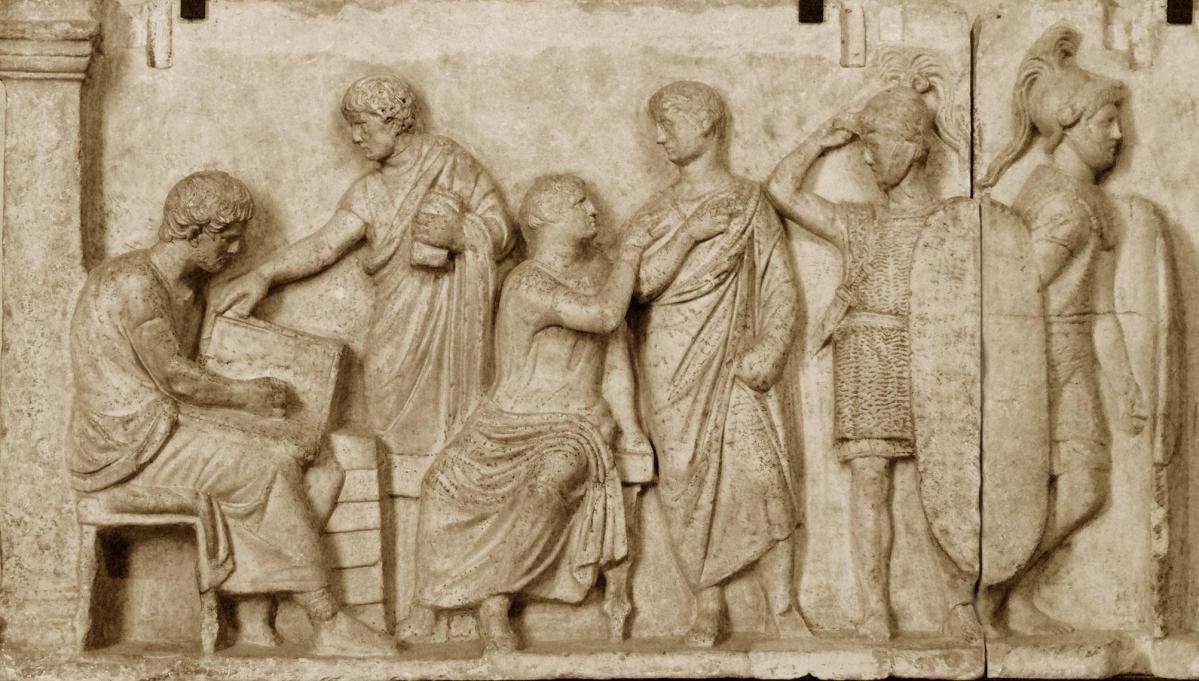
We’ve actually discussed one of these sorts of systems in depth: the Roman dilectus. On the one hand, military conscription in the Roman Republic was legally mandatory, with severe punishments for draft dodging. On the other hand, there was very little enforcement capacity and Roman citizens were expected to navigate the system themselves. Readers are invited to read the linked post above for the details, but in short the process went thusly: near the start of every year the Republic raised new armies and refilled old ones (this could also be done mid-year on an emergency basis). Citizens of military age were required to present themselves in Rome for the selection process (called the dilectus), where officials (the military tribunes) would call up each of Rome’s voting tribes one by one and then call out the names of the recruits who would then take the military oath.
Then recruits were told to assemble on another day to be split into units before being sent home to get the weapons their assignment demanded, before finally being expected to present themselves one last time on the appointed muster date when the army pitches its first camp and fully organizes as an army. And that process is based on the Roman census (which lists, by tribe, everyone eligible for service and their age and property (which determines how they serve)), which is self-reported.
So the system largely relies on individual Romans doing most of the world: self-reporting for the census, then proactively showing up to the dilectus, then attending the division into units, then getting their own equipment, then showing up at the final muster.

The Roman census worked functionally on the honor system. What encouraged Romans not to under-report their wealth was the strong social status tied to wealth holding and property: to under-report your property to try to dodge military service meant accepting the shame of being poor in front of friends and neighbors and it also meant diminished political voice.
The Roman system is hardly the only one to work like this: the impression we get, for instance, of polis hoplite armies is that they are relatively similar: when the assembly votes for war, the citizenry (who are both the assembly and the hoplites) are expected to arm themselves, gather by census unit (sometimes tribe (phyle) or neighborhood (deme)) and join the muster largely on their own initiative. In both cases there are draconian penalties for failure to join the muster, but often with very limited enforcement mechanisms: the system can enforce penalties against one or two shirkers, but not against a coordinated wave of draft resistance among the citizenry. That’s what makes the vote in the assembly so important: by having a majority of the citizenry decide for war in the first place, it ensures ample public support for the self-recruitment that needs to follow.
Now naturally, this is a great system if you can use it: minimal bureaucratic overhead, easy to administer (because it administers itself) and you have a lot of flexibility in how to structure the units you recruit, being able to either split them up by neighborhoods to put neighbors next to each other for greater cohesion (the typical Greek approach) or splitting them into units of regular size for tactical convenience (the Roman, but also Macedonian and Spartan approach).
What I want to note of course is that most societies cannot raise armies this way. I focus here of course on Greek and Roman armies raised in this manner, but you also see this sort of self-recruitment in the armies of medieval town and Italian communes. You may immediately notice some commonalities: these are urban societies, generally structured around a single major city center. They’re also relatively small (except for the Roman Republic, which is exceptional in pulling off this kind of system at scale).
That small size matters because this system relies – because it lacks lots of enforcement officers – on social peer pressure to get recruits to show up. Men show up to the muster because they would be ashamed not to, which only works if they know their friends, family and neighbors will notice their absence and that only works in a fairly small community. The larger the community, the less those ties work.
Finally, these fellows can arm themselves, which means they have a certain amount of personal property, wealth and income. Now it isn’t surprising that aristocrats might be able to do that, but we’re talking about recruitment below the level of the aristocracy – aristocrats alone are generally not enough to build an army around. So these societies also need to have a large propertied class below the aristocracy who nevertheless can defend their wealth (defend in the sense that they can keep from having it all taxed away, extracted with rents and so on – they have enough political power to resist the encroachment by the elite). That can mean a large body of freeholding farmers (the bulk of the citizens of the Roman Republic, or Greek poleis), or it can mean an urban population of skilled workers and artisans (the burghers of many medieval towns and communes) or some mix of the two.
But perhaps most importantly these are all entitlement principle recruitment systems. Systems of self-recruitment like this work because military service is tightly bound to membership in the community which comes with political rights one of which is some kind of right to decide on if the community goes to war or not (that may be a counted vote, but it may also be a collective affirmation, the sort of thing where the sources will say, “and then the men of [town] said with one voice, “Yes!”). As you may imagine in many political systems, the authorities (like a king) are not going to be willing to devolve that kind of political power, even if it lets them raise armies really efficiently.
Notice how political power plays two roles here: it provides the entitlement principle incentive to get these guys into the army but it is also how they ‘defend’ their wealth from the aristocrats which gives them the spare surplus income to afford weapons and armor. In short, in these entitlement system regimes, the ‘middle’ of society (it isn’t quite right to call them a middle class) has enough political power to limit extraction which both enables them to serve (because they can afford the gear, typically heavy infantry gear) but also incentivizes service because military service is bound up with that political power: they fight because they vote and they vote because they fight.
It’s worth noting, societies with these forms of militaries generally have few ‘full time’ soldiers hanging around. MMORPGs and fantasy worlds alike love their ‘local village guards,’ but these societies are calling up the citizen-militia to deal with specific problems on an ad hoc basis. There may be some sort of permanent order-keeping force (Classical Athens had its enslaved Scythian bowmen) or part-time volunteer city watch (one of the roles of the Schuttersgilde in the towns of the Low Countries), but for the most part a lot of the ‘law and order’ functions we’d expect police to perform here are going to be performed by the citizens, who after all can become the army at pretty short notice.
So when we’re thinking self-recruitment, we’re thinking generally entitlement based systems which are typically city-states (or the Roman Republic) which can rely on peer pressure to get men to show up to the muster because of their small, tight-knit citizen bodies (or small tight-knit sub-units, like those demes or – for the Romans – the tribes (tribus)) and which devolve a fair amount of political power to the infantry class that makes up the bulk of their armies (which is to say, to the freeholding farmer class below the aristocracy) who are thus able to preserve enough personal wealth to arm themselves. The small community element also makes the necessary record keeping – keeping track of who is a full member of the community and required to serve – more manageable.
Needless to say, these sorts of citizen communities are not the most common type and tend to remain small. The Roman Republic is astoundingly unusual in being a super-duper-jumbo version of this kind of community and there is a whole chapter in Of Arms and Men (forthcoming) on how exactly they managed that. For the most part, this sort of self-organizing system tends to be limited to small, fairly tight-knit urban communities that either have states or are fairly close to developing them.
Aristocrats, Clients and Retinues
Another option, particularly for non-state societies – we may include here ‘tribal’ agrarian polities, vassalage-based polities and nomadic pastoralists, inter alia – is to channel recruitment through local aristocrats via their clients and retinues. We’ve discussed forms of this recruitment, both ancient and medieval, in more depth before as well.
The key structure here are the big men. For pastoral societies, someone (or at least, some family) generally owns the largest herds of animals and thus wields outsized wealth and influence in the community. For agrarian societies, the Big Man is a ubiquitous fixture of the countryside – the large landowner with the big farms upon whom the smaller farmers rely for access to farming capital and for assistance in bad years (and who in turn often exploits those small farmers). These big men can organize local production (through taxes and rents), they can enforce laws and social order, they can provide a buffer for local subsistence and – crucially for us – they can wield armed force. In short the Big Man can more or less do many of the things a state would do, on a smaller scale (albeit they’re going to do these things in their own interest, which may not be the outcome you want!).
Put another way: these polities are defined by the fragmentation of force – by the existence of Big Men who can wield substantial legitimate military force on their own – and so are both encouraged and often compelled to raise force through those Big Men. However for a ruler or ruling institution (like an aristocratic council) that lacks a bureaucracy or much administrative capacity, these Big Men offer a substantial advantage in that they are few enough for that central institution to have personal relationships with all of them. In essence, it is possible (and indeed important) for the king or tribal war chief to personally know all of the biggest Big Men in the kingdom and so to be able to call upon them personally in the event that he needs an army. For large polities, that system can nest: the king has his vassals, who have their own vassals, who have their own vassals – essentially the Biggest Man knows all of the Bigger Men who each know their own troupe of Big Men.

In these sorts of societies, the Big Man’s status as a Big Man is in part predicated on his independent ability to wield force – note that Big Men in state societies are generally shorn of this and are often more political-economic figures than military ones – and so he maintains his personal supply of force on his own initiative, making it available to that central ruling institution at minimal cost (which is good, because not being a state, they also have minimal centralized resources).
In practice that personal supply of force likely comes in two parts: retainers and clients (of some form). The Big Man himself is generally a vocational principle warrior, a member of a warrior aristocracy for whom being a warrior is a core part of his identity. In order to function as a Big Man in this kind of society, he often needs to maintain some more-or-less permanent supply of force, his regular retinue. These retainers represent a smaller ‘full time’ force, often a mix of other smaller aristocrats and blue-collar military professionals. Thus in peacetime a Big Man might keep younger members of his family – who will have trained as warrior aristocrats too, since that was the class they were born into – in his household to serve as retainers. Equally, he might take in young men from other aristocratic households in the same capacity (pages, squires, etc), often as means of maintaining horizontal bonds between aristocratic families.
Often alongside these warrior aristocrats of varying levels of ‘bigness,’ there are non-aristocratic warriors maintained on an employment principle – though because non-state societies generally aren’t heavily monetized, these fellows are typically ‘paid’ in status (including valuable prestige goods) and maintenance (food, board, equipment, etc) rather than strictly in money. Because they are non-noble, these fellows tend to be ‘left out’ or rendered somewhat invisible in many sources – for instance, they clearly exist in the retinues of Iberian, Celtiberian and Gallic Big Men but only rarely do our Greek and Roman sources note their presence explicitly, preferring to focus on the aristocrats. In a medieval European aristocrats retinue, these fellows are variously termed sergeants, men-at-arms (though this phrase can includes nobles or knights), coutiliers and so on. Because they’re not aristocrats, in addition to being trained combatants, they can also be made to do non-aristocratic things: breaking down the camp, tending animals, handling food, standing guard and so on (although in some cases these fellows can get fancy enough to have their own servants to do some of that).
The retinue of a Big Man is often enough for small-scale warfare, but military pressures tend over time to push beyond the ability of the Big Man to match simply with retainers. I’d argue that the 6th through the 4th centuries in much of the western and central Mediterranean, for instance, we can see these pressures rippling through, forcing societies to reach beyond a small warrior aristocrat class and find ways to mobilize broader populations. For the early part of the Middle Ages in much of Europe the process went the other way, moving from mass conscription systems (see below) towards more Big Man oriented systems, yet large-scale warfare still demanded more men than a retinue could supply and so nobles had to reach outside of their households for troops.
We thus shift principle to assemble the rest of the Big Man’s army: no longer recruiting other aristocrats or work-a-day warriors, he now levies his clients, via the clientage principle. For a pastoralist society, these many be the poorer members of the Big Man’s tribe or clan, while for agrarian societies, these are the peasants. In both cases, these decidedly ‘little’ men rely in peacetime on the Big Man for protection (often military, economic and legal protection), in exchange for some kinds of service to the Big Man. That relationship is sometimes formalized (as with serfdom or debt peonage) and sometimes simply a structure of strong social expectations (as with clientage, narrowly construed) but it often includes an expectation that the Big Man can call upon his clients (/serfs/clansmen/tenants, etc) for military service, not as a ‘full time’ occupation (these folks need to be farming and herding, after all), but either on a rolling, time-limited basis or more often for specific ‘big campaigns.’
In terms of the process for all of this, it can generally work quite directly through personal relationships: the king decides to raise an army and so calls up his Big Man vassals (who, as clients to the king (as Biggest Man), owe him a duty of service). Those Big Men in turn set out with their household retinue (who are in pretty much daily contact with them anyway) and if necessary raise up a levy of their clients or peasants from the local villages which they administer and extract from. The system thus ripples through a series of personal peacetime relationships: the king to his Big Man friends to their slightly-smaller Big Man friends to the members of their household and the Big Man’s tenants, serfs and clients (who all interact with the Big Man in socially subordinate ways – perhaps through a steward or other member of the Big Man’s household – on the regular anyway).
In terms of supply equipment, because the prestige and power of the Big Man is often dependent on the effectively of his retinue, he might opt to pay himself for the equipment of his permanent retainers, if he has the resources, though equally having the gear may the ‘price of entry’ for being a retainer in the first place. What the Big Man almost certainly is not doing is maintaining an armory large enough to fully equip his clients: they’re expected to bring their own gear. However, these tend to be the kinds of societies where those ‘little men’ clients do not have the kind of political heft to protect their production and wealth from the Big Man’s extraction – that’s why they’re so subordinate in the first place – and so the gear they’re likely to be able to afford is going to be cheap. This can produce kind of a feedback loop where client levies are badly equipped and perform poorly, so the Big Men magnates focus on their more aristocratic retinues by extracting more heavily from the peasants, which further reduces the quality of their client levies.
The army form that results from all of this is what I’ve termed repeatedly a retinue of retinues (a term I did not invent). The advantage of this kind of a system is that it involved very low administrative overhead or direct cost for the king, chieftain or other ruling institution (though equally it does require having a lot of resources soaked up by the Big Man class).

But the disadvantages are numerous: armies recruited this way tend to be of very disparate quality, with enormous gaps between the best-equipped aristocrats and very poorly equipped client-peasant-levymen. Without much in the way of state institutions, it’s quite hard to enforce a meaningful ‘floor’ on levy quality and in some cases the levy gets so poor that it becomes basically useless, leading rulers scrambling to find other (generally more expensive) ways to ‘bulk out’ their armies. Equally, because the army arrives as a series of units structures around a Big Man, his retinue and his client-levy, it is structured as a series of irregular units which cannot be easily recombined or restructured. After all, these peasant spearmen here and those knightly cavalry there are both in this army because of their personal relationship to this specific Big Man, Baron Owns-Some-Land. You cannot simply flip them into the unit of Count Owns-Some-Different-Land, they don’t owe that guy anything. Equally, both Baron Owns-Some-Land and Count Owns-Some-Different-Land are arriving with their private armies and so they expect to lead those units in battle and to exercise some real discretion over how they are used. All of that makes central command by the king, chieftain or whomever an excercise in herding cats: charismatic leaders (William of Normandy, Chinggis Khan, etc) can wield these sorts of armies very adroitly, managing the personalities as they go but less forceful individuals (King Edward II, for instance) struggle fiercely to control their chiefs, counts, earls, barons and so on.

Note the contrast between the riders at the top – those are the aristocrats and their retinues – who have fine metal helmets with large metal decorations and wear what seem to be mail shirts, riding their horses and on the other hand the infantrymen at the bottom, who carry shields and spears but appear to have only textile coverings for their heads and little, if any body armor (possibly just some kind of textile armor or perhaps just clothing).
The aristocrats above are some of the best equipped men on their iron age battlefield; their clients below are some of the worst equipped.
Likewise, militaries formed on this basis tend to have fairly limited peacetime force and what they have is gathered around the household of the Big Man, not scattered like local police through the villages. MMORPGs and fantasy worlds alike love their ‘local village guards,’ but these societies cannot afford many full-time soldiers and the ones they can afford tend to be guarding things like castles and towns (or just, you know, hanging around the Big Man’s person), not villages. The people who will arrest you for robbing the village are the villagers (who, remember, make up the levy in an emergency anyway).
Naturally, as noted, this tends to be the system for non-state polities where power is wielded not centrally, but by the Big Man. It is a substantial and frequent mistake to give such polities more state-based army forms, which they can rarely sustain. By contrast, the process of state formation by definition diminishes these sorts of household armies, merging them into a single military system under the authority of the state.
Now we’ll pause there for now. Next week we’ll start looking at some more adminstratively and overhead intensive approaches (although as we’ll see in some cases the trick is still getting someone else to supply that administrative overhead).
