

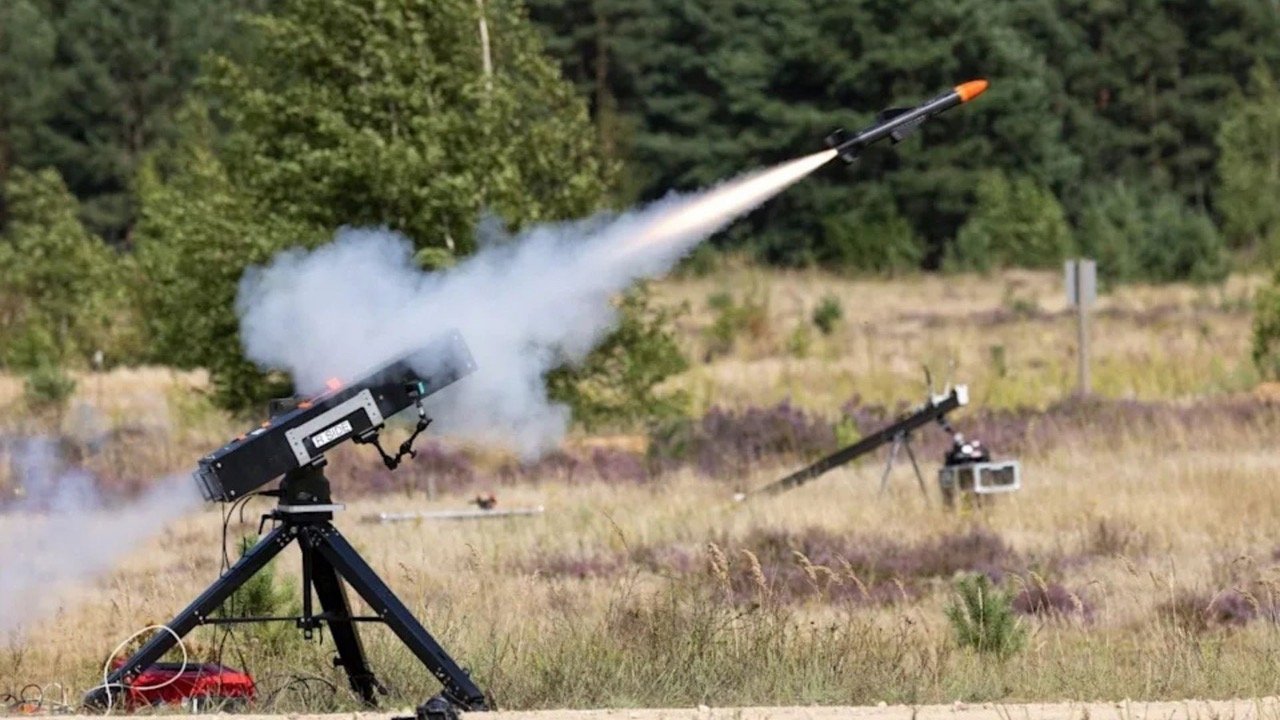

Frankenburg Technologies has been working since 2024 on a solution that will address the proliferation of unmanned aerial vehicles that have come to dominate the battlefields.
The firms Chief Executive Kusti Salm emphasizes that to be effective any solution must not only engage and destroy the targets but consider “the economics of air defence.” This means it must be producible in large numbers at an affordable price! The company’s Mark I close range counter drone missile development that aims to achieve these objectives advanced a crucial step forward with the March 2026 announcement that it and the Poland’s PGZ (Polska Grupa Zbrojeniowa) have signed a long-term agreement for cooperative development and production. The goal, according to Salm, will be to achieve an initial production rate of one hundred missiles per day and 10,000 annually.
The Mark I went from concept to initial proto-type testing in only thirteen months. To date over fifty test firing of the missile have been performed. The missile itself is a solid-fuelled, high-speed system with a 0.5 kg high explosive proximity fuzzed warhead. The missile is “fire-and-forget” with initially an electro-optic seeker. It will detonate within two meters of its target disbursing a glass fragment cloud that will down up to Group 3 drones. The 60mm diameter missile is 660mm long has an effective range of 2000 meters and can reach 1500 meters altitude.
The Mark I benchmark is the reliable destruction of the Shahed type attack drones and Orlan, Zala, and Supercam reconnaissance drones while also being capable of addressing FPV (first person view) and loitering munitions.

The Mark I can be ground mounted on a tripod, on a vehicle, or vessel. It, therefore, can be employed for fixed site defence or on a mobile platform offering CUAS coverage for ground manoeuvre forces or ship defence. Development of a longer 5-to-8-kilometre range 5 to 8 km Mark II and the possibility of an air-to-air are also being pursued. The modular design of the missile and maximum use of commercial components both allows for capability upgrades and provides for a significantly lower the per unit price. In fact, Salm suggests the Mark I should be one tenth the unit price of equivalent capable missiles.
Frankenburg Technologies, based in Estonia, is pursuing collaborations in multiple international companies and potential production in several different countries. These include Latvia, Germany, Lithuania, the United Kingdom, and others. The British defence company Babcock International announced it plans to co-develop a containerized missile launch system for the Mark I intended for to defending ships and coastal sites against low-cost, one-way attack drones. The Mark I could be an ideal candidate for inclusion in the proposed critical national infrastructure (CNI) project along Nato’s eastern flank. CNI will require thousands of CUAS systems to protect each of these sites from just one large-scale attack. Mark I and its successors are intended to provide a cost-effective solution in the numbers required while also offering a tactical battlefield system. The company anticipates its first production Mark I’s will be coming off the production line in 2026.
by Stephen W. Miller
