

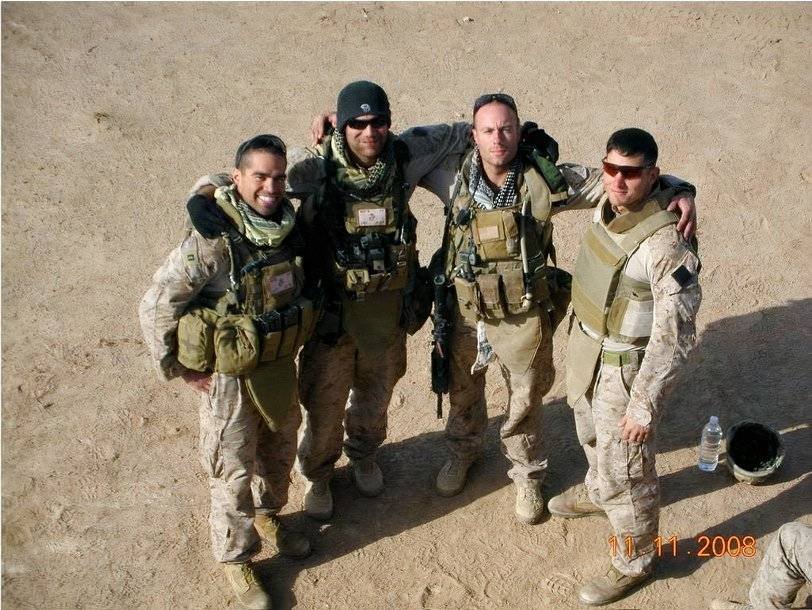
The idea for Clearspeed did not begin in Silicon Valley. It emerged from Lt. Col. Alex Martin’s deployments during the Global War on Terror, where insider attacks and the challenge of vetting partner forces exposed dangerous gaps in battlefield security.
Alex Martin, the CEO and co-founder of voice analytics company Clearspeed, traces the origins of the company to a deadly insider attack during a deployment with the U.S. Marine Corps.
Martin served on active duty from 2004 to 2011 in infantry, reconnaissance, and Force Reconnaissance units, deploying multiple times during the height of the wars in Iraq and Afghanistan. He currently serves in the reserve forces.
During one deployment, Martin unexpectedly reunited with one of his closest friends, a Marine officer he had known since The Basic School. The two crossed paths while operating alongside local partner forces during the war.
The reunion lasted only minutes. The next day, one of the local partner forces working alongside American troops killed Martin’s friend and another U.S. service member in what military officials classify as a “green-on-blue” insider attack.
The attack left Martin questioning how coalition forces screened and trusted local partner personnel during wartime operations. Martin said the event permanently changed the way he thought about trust, security, and battlefield risk.
What happened here? Martin recalled asking himself repeatedly after the attack. No one had vetted any of those people.
That question eventually became the foundation for Clearspeed, a San Diego-based company using AI-enabled voice analytics to assess risk and initiate follow-up reviews.
Martin later worked with Stanford University mentors and engineers already experimenting with voice-based credibility assessment technology before formally launching the company in 2016.
Martin said the original goal was straightforward: find a way to identify trustworthy people faster without slowing operations to a halt. “In combat, there’s always tension between speed and security,” he said. “What if speed became your security?”
From Battlefield Screening to Commercial Risk Assessment
Clearspeed’s earliest deployments focused on military vetting operations. Martin said U.S. Special Operations Command provided early funding that allowed the company to test the technology in Afghanistan, where coalition forces routinely screened local workers and partner forces.
The company’s concept differs from traditional lie detection tools. Rather than attempting to definitively determine whether somebody was lying, Clearspeed is designed to be used as a triage system intended to rapidly identify lower-risk individuals while flagging others for additional scrutiny.
That distinction remains central to how the company markets itself today. The company describes itself as a “voice-based risk assessment” platform rather than a lie detector. “We’re not actually first trying to find the Al Qaeda operative,” Martin said. “We’re actually trying to find the people that aren’t working for Al Qaeda.”
Martin compares the system to an airport metal detector. The value, he said, is not necessarily catching every threat. The value is rapidly clearing most people so human investigators can focus their time and expertise on a much smaller pool.
That operational philosophy helped Clearspeed expand beyond defense work into commercial sectors. The company now works with insurers, financial institutions, and government agencies seeking to accelerate fraud screening and claims processing.
Clearspeed’s technology can conduct automated yes-or-no interviews over phones or tablets in multiple languages before assigning a risk score that falls along a spectrum rather than a binary “truth” or “deception” determination.
How the Technology Works
Martin is careful not to describe Clearspeed as a lie detector, conventional voice stress analysis tool, or polygraph. Instead, he presents it as a neuroscience-based voice triage system that analyzes vocal characteristics rather than spoken words to assess the presence or absence of risk, not truth or intent.
When a person hears a question, Martin explained, the brain processes the information before producing a verbal response. According to Clearspeed’s model, that cognitive activity creates measurable changes in speech patterns almost immediately.
“What we’re measuring is the question as stimuli, the brain activity that fires in, hits the vocal cord, and in 300 milliseconds you either have that drop or you don’t,” Martin said during the interview.
Martin emphasized that the company does not claim it can directly detect deception. Instead, the system flags what he describes as “anomalies” or elevated risk indicators that may justify further questioning.
The distinction matters legally and ethically. Martin said Clearspeed’s technology is never supposed to serve as the sole basis for a negative action against a person. “If the system alerts to elevated risk, that should initiate human review, not automatic negative action,” Martin said.
The company also does not establish individualized baselines in the same way many polygraph systems do. Instead, Martin said Clearspeed relies on proprietary models developed through years of operational testing with military and commercial partners.
The quality of the questions themselves is equally important. Martin stressed that the design of the question across different languages and cultural contexts is equally important. “We found that the language really matters,” he said. “The questions are everything.”
That challenge becomes especially complicated in global environments involving multiple Arabic dialects, interpreters, or differing cultural understandings of words like “terrorist,” “fraud,” or “association.”
Martin said Clearspeed works closely with customers and data scientists to ensure interview questions are legally vetted, culturally understandable, and standardized across populations.

AI, Synthetic Voices, and the Future of Trust
The rise of generative AI has created new opportunities for Clearspeed, but also new threats.
Martin said synthetic voices and AI-generated fraud attempts have rapidly changed the landscape for insurers, banks, and security agencies. Claims documents, receipts, and even audio interactions can now be artificially generated with increasing sophistication. Clearspeed continues to evolve its synthetic voice detection capabilities as a component of its voice-based risk assessment platform. “We can detect synthetic voices within the system,” Martin said.
The company argues its technology may also reduce bias in automated decision-making systems by focusing narrowly on vocal responses rather than demographic information. “We have no gender, no race, no credit, no PII,” Martin said. “We’re just standing in front of this process blind.”
That argument arrives as both government agencies and private industry increasingly adopt AI-driven fraud detection and claims systems. Critics of those systems have raised concerns that algorithmic decision-making can unintentionally reinforce racial, economic, or geographic biases.
Martin insists Clearspeed’s role should remain limited. From the beginning, he said, the company established several hard ethical boundaries. Clearspeed will not sell its technology to U.S. adversaries such as China, Russia, Iran, or North Korea.
It also prohibits customers from using Clearspeed scores alone to deny claims, employment, or access. “This is a tool for processing people forward, trusting faster,” Martin said.
Nearly two decades after losing his friend in a green-on-blue attack, Martin still frames Clearspeed less as a conventional startup than as an attempt to solve a battlefield problem that never sat right with him.
The company’s commercial growth may now place it inside insurance claims departments and financial fraud teams as well as combat outposts. Even so, Martin says the original mission has not changed.
He still sees the company as an effort to answer the same question that emerged during those deployments years ago: How do you determine who can be trusted before it is too late?
