

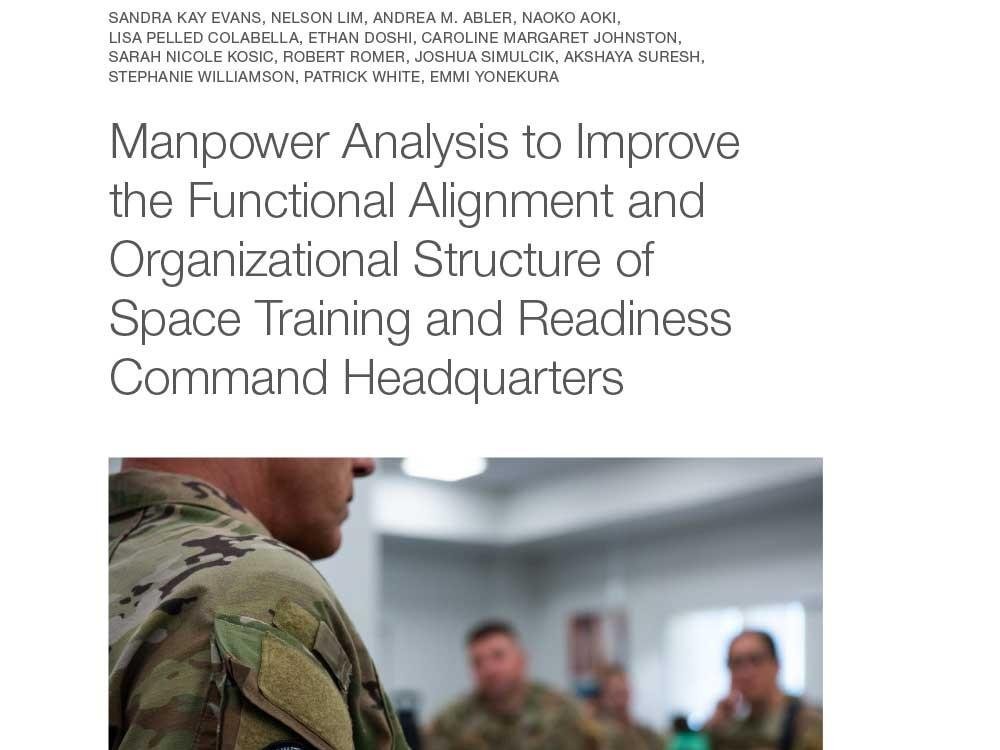
The mission of the U.S. Space Force (USSF) shapes all USSF activities, from doctrine and organization to training and policy. The Space Training and Readiness Command (STARCOM) plays a central role in this mission by preparing the force through training, education, doctrine development, exercises, wargames, and capability testing. However, its headquarters (HQ) has been concerned that it does not have the manpower needed to meet its evolving set of requirements. To examine this issue, HQ STARCOM sought to understand the manpower requirements and optimal workforce composition needed to address its missions and how it can organize to achieve improved alignment between its functions and missions.
To assess and improve its functional alignment and human resource allocation, RAND researchers determined HQ STARCOM’s manpower needs as it prepares its guardians—military and civilian personnel in the USSF—for space combat operations. In this report, the researchers present the findings and recommendations from their work, including an estimation of HQ STARCOM’s current and projected staffing levels and workload, an optimization model for staffing decisions, and an assessment of HQ STARCOM’s mission alignment and organizational structure.
This publication is part of the RAND research report series. Research reports present research findings and objective analysis that address the challenges facing the public and private sectors. All RAND research reports undergo rigorous peer review to ensure high standards for research quality and objectivity.
This document and trademark(s) contained herein are protected by law. This representation of RAND intellectual property is provided for noncommercial use only. Unauthorized posting of this publication online is prohibited; linking directly to this product page is encouraged. Permission is required from RAND to reproduce, or reuse in another form, any of its research documents for commercial purposes. For information on reprint and reuse permissions, please visit www.rand.org/pubs/permissions.
RAND is a nonprofit institution that helps improve policy and decisionmaking through research and analysis. RAND’s publications do not necessarily reflect the opinions of its research clients and sponsors.
