

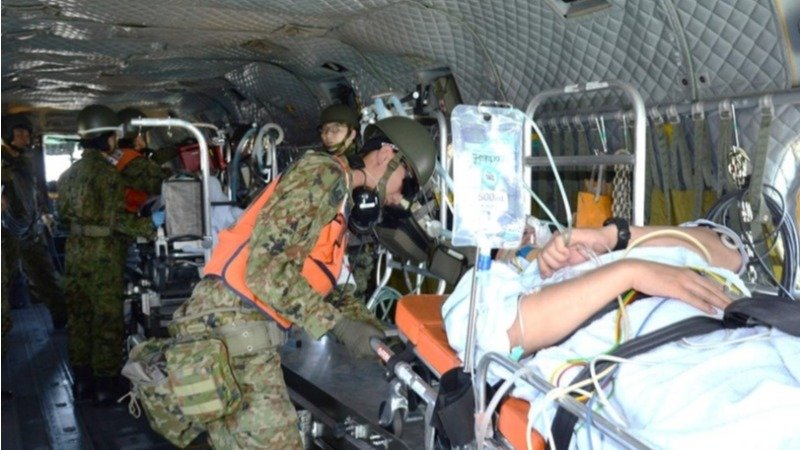
The Japan Self-Defense Forces (JSDF) is reportedly planning to introduce a new medical information system in fiscal 2028 to enable the timely sharing of information on injured personnel’s condition and treatment details from frontline medics to rear-area JSDF hospitals.
According to local Japanese reports,[1] this prospective rapid information-sharing system is designed for emergency scenarios on remote islands in Japan’s southwestern Nansei region, and assumes a contingency resulting in a large number of wounded JSDF personnel.
Although not explicitly stated in press coverage, it is likely that JSDF’s new medical data-sharing system will be a digital solution. It aims to improve the efficiency of evacuation and treatment by replacing the current paper-based approach, in which treatment details are recorded manually and then passed on to the next medical facility.
Under this new information-sharing system, the condition of the wounded and the care administered by specialized frontline medics will be shared swiftly with hospitals in the rear-area, enabling hospital staff to confirm what treatment has been provided and to effectively assess patient conditions.

In a combat situation, trauma care for JSDF personnel is expected to be provided on the front while emergency surgery is to be performed in mobile field operating units. More comprehensive treatment would see transport of the patient to one of the JSDF’s main hospitals, which are located at 10 sites across Japan.

In the event of a contingency in Japan’s southwestern Nansei island chain, the JSDF’s Amphibious Rapid Deployment Brigade and other units would be mobilized to defend or recapture key remote islands in the littoral region.
Personnel wounded in the Nansei region are most likely to be transported to Okinawa’s JSDF Naha Hospital, which Japan’s Ministry of Defense (JMOD) has highlighted as being “essential” for JSDF operations and is now undergoing substantial infrastructure improvement works.[2]

The medical information-sharing system for emergency scenarios scheduled to be introduced in fiscal 2028, if connected with Naha Hospital, would enable swift and effective communication of medical needs of patients being airlifted from the southwestern remote islands.
In line with Japan’s 2022 National Defense Strategy, JMOD has in recent years sought to overhaul the JSDF’s combat trauma care capabilities and to transform its medical force into an organization that can provide life-saving care for personnel operating in hostile environments.[3]
Due to a lack of historical involvement in kinetic operations and the absence of combat casualties, the JSDF has not traditionally prioritized specialized infrastructure and equipment for the treatment of complex trauma injuries.[4]
However, in light of Japan’s rapidly changing security environment and in response to the complexity of injuries being observed in Ukraine, JMOD is now seeking to address these capability gaps.
Japan’s latest defense budget commits JMOD to procuring in fiscal 2026 equipment and technology required for a “seamless flow of medical and evacuation posture from the frontline to hospitals”[5].
Notably, within this framework, a subsidiary initiative to secure and stockpile blood products earmarks 10 million yen (approx. USD 64,400) for equipment related to “a joint medical information system”.

Such JMOD commitments for fiscal 2026 in transforming the JSDF’s “medical functions” form an important building block for the emergency scenario medical information system scheduled to be in place by FY2028.
Also relevant to the aim of the FY2028 medical information system of providing immediate information sharing is the ministry’s “Next-Generation Information and Communications Strategy”[6] This is a broader initiative announced last October that envisions the development of high-bandwidth, low-latency systems for the JSDF and integration of ICT infrastructure.
This ICT strategy aims to establish a new network being tentatively dubbed the “New Defense Information Infrastructure”. Designed to serve as a foundational ICT platform for all JMOD/JSDF initiatives and to integrate data collected through a variety of assets, this multilayered network is set to include medical care as one of eight components within the system’s “Service Layer”.

The JMOD’s service layer, to which medical care belongs, highlights a need to build “an environment that enables flexible development, modification, addition, and deletion”.[7] This indicates a strong JMOD preference for a modular, open approach to medical information systems.
JMOD will therefore need to procure systems to support the implementation of this medical care service layer as well as ensure its close connection horizontally with the other services identified, most notably logistics and information sharing systems.
Vertically too, equipment will be needed to integrate such medical care systems with both the Network Infrastructure Layer’s multi-network architecture in addition to the Data Layer, which aims to provide timely and reliable access to information required across the Information Structure.
JMOD’s prospective medical information system slated for FY2028, designed for emergency contingencies in the southwestern Nansei region in support of JSDF operations, will need to be fully integrated to ensure seamless and timely information sharing.
Notes:
** 1 USD = 155 JPY
[1] Nikkei Shimbun, “自衛隊、有事にらみ医療システム 前線の負傷者情報を即時共有” [JSDF prepares medical system for emergencies that instantly shares information on personnel injured at the front lines], February 11, 2026, https://www.nikkei.com/article/DGXZQOUA19C2Q0Z11C25A2000000/.
[2] JMOD, “Progress and Budget in Fundamental Reinforcement of Defense Capabilities – Overview of FY2026 Budget Request -”, p.44, https://www.mod.go.jp/en/d_act/d_budget/pdf/fy2026_20251210a.pdf.
[3] JMOD, “National Defense Strategy” p.37, https://www.mod.go.jp/j/policy/agenda/guideline/strategy/pdf/strategy_en.pdf.
[4] Nobuhiko Tajima, “Defense Ministry to set up medical center for SDF combat injuries”. Asahi Shimbun, August 10, 2023, https://www.asahi.com/ajw/articles/14959400.
[5] JMOD, “Progress and Budget in Fundamental Reinforcement of Defense Capabilities – Overview of FY2026 Budget Request -”, p.44, https://www.mod.go.jp/en/d_act/d_budget/pdf/fy2026_20251210a.pdf.
[6] JMOD, “Next-Generation Information and Communication Strategy of the Ministry of Defense”, October 2025, https://www.mod.go.jp/en/images/Next-Generation_Information_and_Communication_Strategy.pdf.
[7] Ibid.
This article was originally posted on NSBT Japan, the first defense and security industry network in Japan. The publication provides the latest information on security business trends both within Japan and overseas. Asian Military Review began exchanging articles with NSBT Japan in April 2024.
Read the original article here.
