

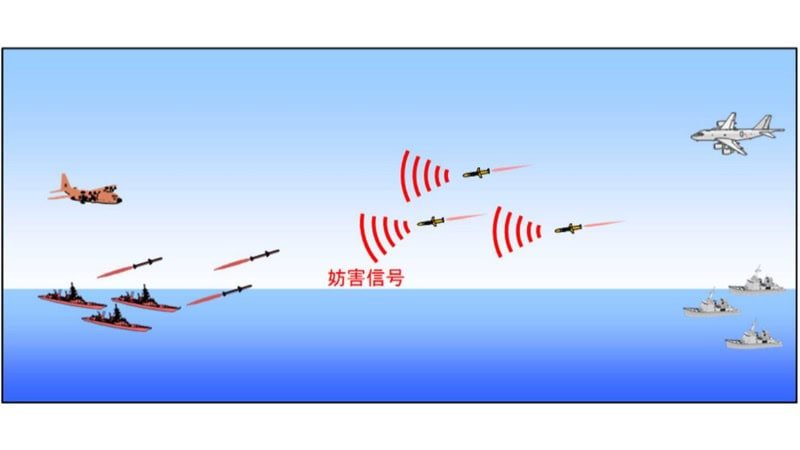
Earlier this month, it was reported that Japan’s Ministry of Defense (JMOD) is considering introducing unmanned aerial vehicles (UAVs) equipped with stand-in jammers capable of operating within hostile airspace and tasked with disrupting enemy radar, air defense and communication networks.[1]
The UAV-mounted stand-in jammer payloads are expected to enable the Japan Self-Defense Forces (JSDF) to conduct electronic warfare (EW) within threat zones, disabling radar and communications systems that support adversary missile and weapons operations.
The stand-in jammers are expected to be mounted on relatively inexpensive drones to enable large-scale deployment with air launch from manned aircraft emerging as the leading option. Other methods being considered are ground-based launchers and deployment from escort vessels.
The introduction of the UAV-mounted jamming systems is expected to be included in a revision of Japan’s Defense Buildup Program, due to be published by the end of the year.
Development of stand-in jammers – alongside electronic warfare aircraft that can deliver stand-off jamming effects from outside hostile airspace – was also included in the 2022 Defense Buildup Program, which stipulated the need to strengthen capabilities in the electromagnetic domain to support cross-domain operations across land, maritime and air domains.[2]
Efforts by Japan’s Acquisition, Technology & Logistics Agency (ATLA) to research and prototype a stand-in jamming payload designed for installation on UAVs began in FY2024, with the project scheduled for completion by the end of FY2028.
ATLA’s Project to Realize Stand-in Jammer Payloads
An August 2023 project evaluation[3] reveals how ATLA is carrying out a project titled “Research on Smart Radio-Wave Decoy Technology” to develop the underlying technology for a stand-in jamming device.
ATLA describes its prospective stand-in jammer as an electronic-warfare payload that could be carried on board a UAV or other platform and operate within an adversary’s threat zone, where it would generate radio-frequency signals to both jam and deceive hostile radar.
The prototype phase for the radio-frequency deception-jamming technology is scheduled to run from FY2024 through mid-FY2027 and is to be supported by a budget of around 5 billion yen (approximately USD 30.6 million).
In March 2025, ATLA also signed a contract with Fujitsu Limited worth approximately 1 billion yen (USD 6.1 million) to support this prototyping phase,[4] to be followed by in-house testing conducted by ATLA from mid-FY2027 through to FY2028.
RF decoy technology, which is intended to be included in the UAV-mounted stand-in jammer, is expected to feed false information to enemy radar systems so that the adversary misidentifies the tactical situation as involving multiple threats.
Other requirements include the adoption of an open-architecture approach to maintain versatility and the ability to mount the device on multiple types of platforms.
Although ATLA does not specify a launch system, a conceptual image provided in the 2023 evaluation report appears to support reports that the UAV carrying the stand-in jammer is primarily intended to be air-launched from a manned aircraft.

Overall, the stand-in jammer is expected to make it difficult for an adversary to correctly select targets for engagement, thereby improving the survivability of the JSDF.
ATLA’s Stand-In Jammer and the JSDF’s Wider EW Architecture
ATLA expects its stand-in jammer to reduce an adversary’s response capabilities by working in combination with stand-off jammers, among various other EW systems.
JMOD is planning to use stand-in jammers onboard UAVs within the threat zone as a means to reduce JSDF casualty risks. These drone systems are expected to operate in conjunction with manned EW aircraft that deliver stand-off jamming effects from outside of the threat zone.
For long-range stand-off jamming, ATLA announced this month that a new manned electronic warfare aircraft had entered operational testing and evaluation. Named EC-2, the new stand-off jammer plane is set to replace the EC-1, an electronic warfare training aircraft which has been in service since 1986.[5]

Turning back to the stand-in jammer, ATLA has been given a deadline of FY2028 for finishing its research so that JMOD can then move toward integrating the device onto UAVs and fielding it for operations as soon as possible.
International Developments of Stand-in Jammer Technologies
Japan’s sense of urgency in acquiring stand-in jammers is a response to the fact that EW and jamming systems are now widely used in modern conflicts such as the war in Ukraine.
Like Japan, NATO is also responding by actively developing stand-in capabilities as a key component of a multilayered toolkit designed to support the suppression of enemy air defenses (SEAD) .[6]
For NATO, stand-in systems are expected to serve as force enablers by jamming or deceiving enemy acquisition, tracking, and fire-control radars, with the payloads delivered by low-cost UAVs that penetrate deep into missile engagement zones.
To keep up with the rapid innovation cycle observed in Ukraine, NATO allies are looking to quickly procure stand-in capabilities.
In this regard, ATLA’s FY2028 deadline for completing research into the underlying RF decoy technology for stand-in jammers risks being behind the curve.
The U.S. Air Force first received for operational testing in 2012 its air-launchable stand-in jammer: Raytheon’s Miniature Air-Launched Decoy – Jammer (MALD-J), a jamming variant of the MALD expendable decoy UAV that has reportedly been used by Ukrainian aircraft in combat operations since 2023.[7]

The MALD-J combines a stand-in jammer to degrade the ability of enemy radar systems to track friendly strike aircraft with decoy functions for mimicking U.S. or allied aircraft in order to confuse enemy air defense systems.
The United Kingdom, while lagging behind the United States, is further along than Japan in developing its own stand-in jammer for the Royal Air Force (RAF): the SPEAR-EW, a variant of MBDA’s SPEAR mini cruise missile. The EW payload is being developed by Leonardo and as of 2023 has advanced to the trial phase.[8]
While the SPEAR-EW variant remains in development, the SPEAR surface attack version entered initial production this year, with the first missile deliveries planned for early 2027 and work underway on integration with the RAF-operated F-35B.[9]
Japan’s program, by contrast, remains focused on developing and testing the underlying radio-frequency deception-jamming technology for a future UAV-mounted stand-in jammer.
Conclusions
Japan increasingly recognizes the need to acquire UAV-mounted stand-in jammers alongside stand-off systems and other EW capabilities in order to adapt to modern warfare.
ATLA should accelerate its research into the underlying technology in order to be able to more rapidly field the required stand-in jammers aboard UAVs.
This urgency is reflected in recent proposals for transforming Japan’s defense capabilities issued by Japan’s ruling Liberal Democratic Party (LDP) ahead of the government’s strategic review, which is due by the end of the year. The party’s recommendations highlighted the need to expand the use of electromagnetic-spectrum capabilities and accelerate their development for early deployment.
JMOD’s Promotion Headquarters for the Transformation of Defense Capabilities has assigned similar priority to EW, emphasizing in March the need to diversify JSDF jamming capabilities through the development of stand-off and stand-in jammers, as well as high-power microwave systems for countering UAVs.
Notes:
** 1 USD = 163.16 JPY
[1] The Japan News, “Japan Mulls Introduction of Jammer UAVs to be Ready for Electronic Warfare, Aim for Combined Use with Stand-off Jammers”. Yomiuri Shimbun, July 6, 2026, https://japannews.yomiuri.co.jp/politics/defense-security/20260706-336772/.
[2] JMOD, “Defense Buildup Program”, December 16, 2022, p.12, https://www.mod.go.jp/j/policy/agenda/guideline/plan/pdf/program_en.pdf.
[3] JMOD, “令和5年度 政策評価書(事前の事業評価)事業名:スマート電波デコイ技術の研究” [FY2023 Policy Evaluation Report (Ex-ante Project Evaluation) Project Name: Research on Smart Radio-Wave Decoy Technology], August 2023, https://www.mod.go.jp/j/policy/hyouka/seisaku/2023/pdf/jizen_05_honbun.pdf.
[4] JM2040, “防衛装備庁、スマート電波デコイの研究試作を契約” [ATLA Signs Contract for Smart Radio-Wave Prototype Research], May 10, 2025, https://jm2040.blogspot.com/2025/05/rf-jammer.html.
[5] Parth Satam, “Japan’s XEC-2 Stand-Off Jammer Aircraft Begins Operational Flight Testing”. The Aviationist, July 17, 2026, https://theaviationist.com/2026/07/17/japan-xec-2-operational-flight-testing/.
[6] Richard Scott, “Feature: Stand-in jammers to take centre stage for NATO”. Janes, August 6, 2025, https://www.janes.com/defence-intelligence-insights/defence-news/weapons/feature-stand-in-jammers-to-take-centre-stage-for-nato.
[7] Air & Space Forces Magazine, “ADM-160 Miniature Air Launched Decoy (MALD)”, https://www.airandspaceforces.com/weapons/adm-160-mald/.
[8] MBDA, “MBDA’s SPEAR-EW Moves to the Next Stage”, September 12, 2023, https://www.mbda-systems.com/mbdas-spear-ew-moves-next-stage.
[9] Martin Chomsky, “MBDA begins low-rate SPEAR production as F-35B integration and multi-platform launcher work advance towards 2027 deliveries”. Defence Industry Europe, July 21, 2026, https://defence-industry.eu/mbda-begins-low-rate-spear-production-as-f-35b-integration-and-multi-platform-launcher-work-advance-towards-2027-deliveries/.
This article was originally posted on NSBT Japan, the first defense and security industry network in Japan. The publication provides the latest information on security business trends both within Japan and overseas. Asian Military Review began exchanging articles with NSBT Japan in April 2024.
Read the original article here.
