

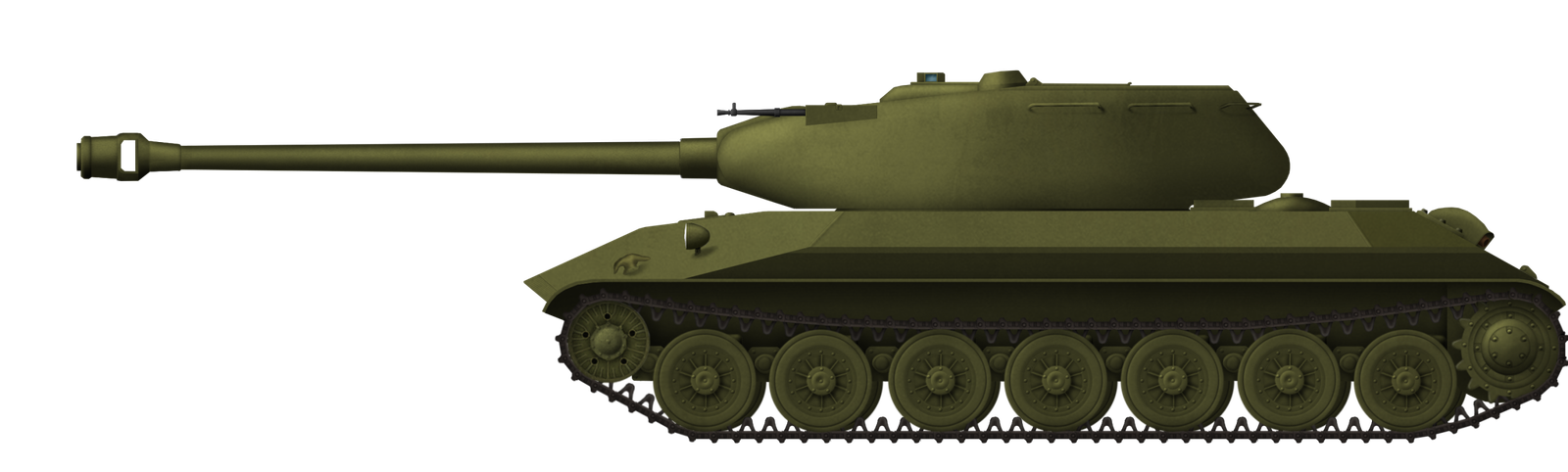
Soviet Union (1945)
Heavy Tank – Blueprints Only
With the discovery of the German Jagdtiger and Maus in spring of 1945, the Soviets realised that their most advanced heavy tank in development, the Object 257 (first iteration of the IS-7), was no longer going to cut it in terms of firepower and protection. Thus, requirements were arranged for a new heavy tank. In July 1945, Experimental Plant No.100 at ChKZ began work on several designs. While they had the same hull and turret, they had different engines and transmissions. These were indexed Object 258, 259, 260, and 261, keeping the umbrella name IS-7. Each model came in two variants, depending on the gun used, with a caliber of either 122 mm or 130 mm. In late 1945, the Object 260 was chosen as the primary design to continue development on, but by February 1946, the requirements were changed once again and the tank was redesigned, but kept the same index, Object 260.

🔥What’s inside?
✔ All 12 issues in one bundle
✔ Available in PDF and EPUB formats
✔ Enjoy instant access to articles prepared by our team of dedicated writers and illustrators, covering the history of armoured vehicles from the 19th century to the present day, in-depth armored warfare analysis, rare vehicles, prototypes, and much more.
👉 Visit our online store and grab your bundle for only $46, and save $12 off the regular price of $57.89!
Context
On 5 or 6 February 1945, the Soviet GABTU (Main Directorate of Armored Forces) and NKTP (People’s Commissariat of Tank Industry), through Order No.66, solicited the development of a new heavy tank. The technical requirements were similar to the ones that led to the development of the Object 701 from November 1943. Namely, the tank was to have an 122 mm or 152 mm main armament, be immune to 88 mm and 128 mm German guns, equipped with a 1,000 hp to 1,200 hp engine, and reach a top speed of 60 km/h while maintaining the 55 tonne weight. Lastly, the transmission was to be either mechanical-planetary or electromechanical.
The design of such a tank would be undertaken by the design bureaus OKB of Experimental Plant No.100, headed by Iosif Yakovlevich Kotin, and SKB-2 headed by Nikolai Leonidovich Dukhov, both bodies being part of the ChKZ complex in Chelyabinsk. These offices would work independently from one another and submit rivaling designs. Yet, during this period, SKB-2 was also working on both the IS-3 and Object 701, leading to their new heavy tank project being significantly delayed, in the form of the Object 705.
On the other hand, Plant No.100, after recently having their IS-6 (Object 252 and Object 253) project cancelled, quickly began work on the new heavy tank. Chief engineer of the project was Pavel Pavlovich Isakov and the tank would receive index Object 257, although the design bureau would call it IS-7, likely part of Kotin’s political marketing tricks. The tank’s technical blueprints were ready between May and June 1945, and after revision by the Commissar of Tank Industry, Vyacheslav Aleksandrovich Malyshev, the project was approved for further development.

Source: TiV 2016 No.10
Development
The end of the Second World War in Europe on 21 May 1945 revealed some of the most advanced weapons built by the Germans during the war. During this period, the Red Army had captured a Jagdtiger tank destroyer, a Maus super-heavy tank, but also a Sturmtiger assault tank. These vehicles were armed with powerful guns in the case of the first two, notably the 128 mm KwK/PaK 44. Additionally, their armor protection was exceptional, suggesting that the Soviet 122 mm D-25T gun on the IS-2, IS-3, and later Object 701 was no longer adequate.
The GABTU was made aware of the captured German vehicles on 4 July 1945, and despite the NKTP’s approval of the Object 257 on 6 July, Soviet authorities quickly came to the conclusion that the German vehicles were indicative of the future of heavy tanks. Consequently, the Object 257, in its current format, was not sufficient.

Source: Reddit user Maskedweasle
Initially, improving the Object 257 was considered. However, the turret was deemed too small to mount a larger gun, so a new design was required. The design bureau of Plant No.100 would begin work on the new tank in July 1945, using the Object 257 as a starting point. Likewise, the IS-7 name was inherited.
The team working on the new heavy tank was as follows:
- the project was headed by I. Y. Kotin
- chief engineers were P. P. Isakov and G. N. Moskvin
- Deputy Chief Designer was A. S. Ermolaev
- armament was designed by a group under A. S. Shneidman
- the hull group was led by S. V. Mitskevich
- the chassis group was led by G. A. Seregin
- the transmission group was led by G. A. Turchaninov
- the engine group was led by G. A. Osmolovsky
Due to the generally vague requirements from the GABTU and NKTP, Plant No.100 would explore two choice of armaments, the 122 mm BL-13-1 and 130 mm S-26, two engine types (one large diesel or two smaller twin mounted engines) and, as with the IS-6, either a mechanical or electromechanical transmission.
Between September and October 1945, several new designs for the IS-7 were drawn at OKB. These were assigned Object numbers 258, 259, 260, and 261. Each design was to have two variants, with either mechanical and electrical final drives, or, in terms of armament, the 122 mm BL-13-1 or 130 mm S-26.
The main difference between the four designs was the combination of engine and transmission. The Object 258 had the 1,200 hp KCh-30 engine and mechanical transmission, while the Object 259 also had the 1,200 hp KCh-30 engine but an electromechanical transmission instead. The Object 260 had 2x 600 hp V-16 engines and mechanical transmission, and lastly, the Object 261 had the 2x 600 hp engines and electromechanical transmission.

Source: chelyabinsk.bezformata.com
In October 1945, the designs were submitted to the Technical Council of the NKTP, GABTU and to representatives from the People’s Commissariats of Armaments and of Aviation Industry (who were responsible for the development of the KCh-30 engine). The designs were approved by the bodies present, but to facilitate production of prototypes, the project had to be accepted by the Soviet Government. Thus, a letter was sent to the Chairman of Operations Bureau of the Council of People’s Commissars of the USSR, Lavrentiy Beria:
“Comrade Kotin’s design bureau has developed a new heavy tank, significantly superior to all existing domestic and foreign models. Weighing 65 tonnes, it is armed with a 130 mm gun designed by TsAKB NKV, whose armor-piercing shell, weighing 34 kg, has a muzzle velocity of 900 m/s. This gun’s muzzle energy (1,380 tonne-meter [13.54 MJ]) is 1.9 times greater than that of the 122 mm D-25T tank gun and can penetrate 230 mm of armor at a range of 1,000 m.
To facilitate the loading of the gun, a special mechanism is provided, which ensures an increase in the rate of fire to 6-8 rounds per minute.
To increase fire effectiveness, it is proposed to install a rangefinder as well as night vision devices.
The tank’s frontal armor cannot be penetrated by 128 mm armor-piercing shells from any distance at an impact angle of 30 degrees, and also withstands hits from 150 mm caliber cumulative grenades such as the Faustpatron.
The powerplant is a unit of two V-16 diesel engines with a total output of 1,200 hp, which in the near future will be replaced by a diesel engine of the same power. This will allow the tank to have a maximum speed of at least 60 km/h.”
Lastly, state officials proposed that the Leningrad Kirov Plant (LKZ) would produce and test two prototypes in 1946, and TsAKB would build three 130 mm guns. It was also proposed that Kotin’s Plant No.100 be moved from Chelyabinsk to LKZ, with Kotin being appointed as LKZ’s Chief Designer, a move that would occur later on. After the meeting in October, work on the IS-7 designs continued at Plant No.100. Together with TsNII-48, the attachment of armor plates was studied. Discussions with the Central Design Bureau of People’s Commissariat of Armaments regarded the feasibility of an autoloading mechanism for guns of 122 mm and 130 mm in caliber, as well as the design of the fighting compartment, along with Plant No.9.
Following order No.312 of the People’s Commissariat of Tank Industry, seven self-propelled guns were also designed on the chassis of the IS-7 models in late 1945, but almost nothing is known about them.
Design
The new autumn IS-7 designs, inherited several design features from the Object 257, primarily its classical layout, steeply angled hull plates, and low, UFO-shaped cast turret. The roadwheels were of a large diameter steel design, with intricate ribbing for strengthening. The turret kept the same general shape, but enlarged to fit the larger 122 mm or 130 mm guns.
Besides the four IS-7 models (258, 259, 260, and 261), which were differentiated by the combination of powerplant (either KCh-30 or dual V-16 engines) and transmission (either mechanical or electromechanical), each model was further split into two variants, depending on the gun used. Variant 1 was equipped with the 130 mm S-26 gun and Variant 2 was equipped with the 122 mm BL-13-1 gun. This resulted in eight unique variations of essentially the same tank with different guns and powerplants. The only external difference between the models was the layout and length of the engine deck. Objects 258 and 259, which were equipped with the KCh-30 engine, had two smaller radiators with two fans in between, on each side of the engine deck. Meanwhile, Objects 260 and 261 had a large radiator followed by two fans, on each side of the engine deck, which was longer to accommodate the larger system.

Source: Stalin’s Supertank IS-7 and others (2015)
The turret was a standard “UFO-like” shape, common to Soviet heavy tanks of the period, with a slight hexagonal shape. It was made of cast steel, with varying levels of armor, maintaining effective line-of-sight armor effectiveness, while lowering weight. On either side of the gun, on the upper “cheeks” of the turret, was a 7.62 mm SG-43 machine gun, remotely fired using an electrical system. The main gun was mounted in the central axis of the turret, and behind it was the semi-autoloading system and ammunition storage. On the turret roof was a large rectangular hatch as well as smaller round hatches for easy entry and exit of the crewmen and loading of ammunition. In the center of the turret roof was the ventilation fan for the crew compartment. Unlike on previous Soviet heavy tanks, where the gun mantlet was in-front of the turret, on the IS-7 model 1945, the mantlet was encased by the turret cheeks.
The hull maintained most of its layout and shape as on the Object 257. The front was dominated by the “pike-nose” design. The side armor also kept its “diamond shape” design from the Object 257 but, to allow for the use of torsion bars, these were mounted outside of the hull, in thinly armored cases, a design feature also borrowed from the later variant of the Object 257. The rear of the hull was also mostly unchanged, the main difference being the repositioning of the exhausts from an “IS-style” on the engine deck, to the upper rear plate, like on the T-34. The two ports for servicing of the final drive were kept.
Crew
The crew of the IS-7 autumn 1945 models varied depending on the variant, more precisely on which main gun was used. Five men were required for Variant 1 armed with the 130 mm gun and four men for Variant 2 with the 122 mm gun.
In Variant 1, four crewmen sat in the turret, on seats suspended from the turret ring. The commander and one of the loaders were on the right side of the gun, while the gunner and second loader were on the left. Despite the use of the automated loading system, the shells still had to be lifted from the stowing position (many of which were in the hull) and into the rack, hence the two loaders for the heavier, 130 mm armed version. In Variant 2, with the 122 mm gun, there was only one loader. In both variants, the driver sat in the front of the hull, in a central position.

Source: Stalin’s Supertank IS-7 and others (2015)
Armament
Variant 1 – 130 mm S-26
Variant 1 of Objects 258, 259, 260, and 261 were all to be equipped with the 130 mm S-26 gun, based upon the 130 mm B-13 naval gun designed at TsAKB under V. G. Grabin. It had a 34 kg shell with a muzzle velocity of 900 m/s. It could fire two-piece armor piercing and high-explosive fragmentation shells. Though initially designed with a T-shaped muzzle brake, as tested on the ISU-130 (Object 250) in late 1944, the muzzle brake would be redesigned by 1946 with a slotted design.

Source: Alf Van Beem, via Wikimedia
Variant 2 – 12 mm BL-13-1
Alternatively, Variant 2 of the IS-7 models was to be equipped with the 122 mm BL-13-1. Designed at OKB-172 and built at Plant No.100, the 122 mm BL-13-1 was based upon the BL-13 but featured an automated rammer. The mechanism was mounted by the breech, between the recoil brake and recuperator. The gun was similar to the classic 122 mm D-25T. It had an increased muzzle velocity of 850 m/s, although plans were to increase it to 900 m/s. Testing was done in June 1945, when 250 rounds were fired. The rammer proved to operate reliably and eased the task of the loader, as well as accelerating the process. Theoretical calculations showed that the rate of fire would be of 8-10 rounds per minute, but trials only achieved 7-8 rpm.

Source: Yuri Pasholok, edited
There is not much information regarding the automated loading system. Based on the drawings, an automated tray can be seen. The tray would elevate a shell or casing placed by hand by the loader, after which the tray would lower. It is possible that the ramming in the breech of the shell/casing was done automatically as well.

Source: TiV 2013 No.2
Armor
The armor protection on the IS-7 models featured several innovative features, culminating from work on previous Soviet heavy tanks. The “pike-nose” was sloped even further, while the side armor had the distinctive sloping all the way to the floor, so called “diamond-shape” due to its silhouette from the front. Even the rear was heavily angled, increasing armor effectiveness all around the tank. Initial calculations showed that the probability of penetration of the IS-7 with a 88 mm or 105 mm gun with a muzzle velocity of 1,000 m/s was 5.3% and 7.5%, respectively. This was a significant improvement from the IS-3, which had a probability of 16.1% and 20.9% for the same guns.

Source: Domestic Armored Vehicles 1945-1965 (2021)
Propulsion
Dual 600 hp V-16
The Object 260 and Object 261 were to be equipped with two V-16 engines (sometimes also named V-16F in the literature). This four-stroke engine was developed in 1945 by Plant No. 77, also known as the Barnaul Plant of Transport Engineering (BZTM), and was based on the classic V-2 engine with 12 cylinders in a V-arrangement with an output of 600 hp at 2,000 rpm. Trials conducted between March and May 1945 revealed several issues with reliability. Supercharging it to 600 hp would cause breakdowns and even decreasing the power output to 520 hp revealed problems, by which point it was as effective as the V-2IS engine on the IS-2, which was more reliable and not suited for a tank of this mass. In contrast, the V-12 used on the IS-6 and Object 701 was more reliable and had a higher output, between 700 hp and 750 hp. In the IS-7 tanks, two of these would have been mounted next to each other, at an angle.

Source: Domestic Armored Vehicles 1945-1965 (2021)

Source: Yuri Pasholok
Single 1,200 hp KCh-30
The other engine option, which was to be mounted on Object 258 and Object 259 was the 1,200 hp KCh-30 (sometimes indexed KCh-30T to indicate it was for tank use). It was developed by Plant No.500 (Charomsky) of the Ministry of Aviation Industry, and was based upon the ACh-30 diesel engine used on the Petlyakov Pe-8 and Yermolayev Yer-2 bombers. The engine featured a centrifugal supercharger and two turbochargers. This was not the first time Plant No.500’s aviation engines were used on heavy tanks, as their M-40 engine was to be used by the KV-4 and KV-5 heavy tanks in 1941.

Source: Alf Van Beem, via Wikimedia

The mechanical transmission present on Object 258 and Object 260 was designed by F. A. Marishkin and N. T. Fedorchuk, and featured a six-speed synchronized gearbox with one reverse gear. For turning, a two-stage automatic transmission was used. The entire assembly and main clutch were incorporated into the engine, which in modern terms would be called a powerpack.
The idea of using an electromechanical transmission was inherited from the IS-6, which was also built in two prototypes, the Object 252 with a standard mechanical transmission and the Object 253, with an electromechanical transmission. Despite being cancelled, the Object 253 remained in use as a testbed for electromechanical transmissions until 1947.
The new IS-7 models (Object 259 and Object 261) were to have seemingly identical electromechanical transmissions, named EMT-259 and EMT-261 respectively. The exact number of generators is unknown, due to the ambiguity of the sources. Normally, the EMT-259 should only have one generator connected to the single crankshaft from the engine, while the EMT-261 would have two, one for each crankshaft (dual engine). As per the data sheet, a single generator had a power of 336 kW with 4,600 to 5,370 rpm. The motors used in both the EMT-259 and 261 were two 296 kW counter-rotating (rotor and stator rotate in opposite directions) electric motors, with rotor rpm of 2,200 to 4,380. The entire transmission weighed 2.4 tonnes. The additional weight and volume of the electromechanical systems brought doubts to their feasibility.

Source: Domestic Armored Vehicles 1945-1965 (2021)
Suspension
The running gear was, once again, inherited from the late variant of the Object 257, with seven large steel roadwheels per side and rear sprocket. Due to the steeply angled lower hull of the Object 257, external HVSS-style bogies were designed. The system was then renewed with externally mounted torsion bars in flexible bogies. On the new models, the idea carried over, but in a much simpler fashion. The torsion bars would be in a fixed box, outside of the main hull body. Due to their short length, these were likely made from a more rigid metal to achieve the same resistance compared to regular torsion bars, which regularly run across the entire width of the tank. To further combat this issue, bump stops (made out of a volute spring) were mounted at the end of each individual torsion arm, although this was common practice on Soviet heavy tank designs.
The wheels were also redesigned. In late 1944, large diameter roadwheels were tested on the IS-6 (Object 252) but were prone to cracking. Consequently, a different steel-rim design with ribbing was tested on the Object 244 in early 1945. The ribbing was once again redesigned for the Object 257 in June 1945, until the final design was settled for the IS-7 designs. This wheel design would be kept for all future IS-7 prototypes.

Source: Stalin’s Supertank IS-7 and others (2015)
Models
Object 258
The Object 258 was the version with the KCh-30 engine and mechanical transmission.

Source: Stalin’s Supertank IS-7 and others (2015)
Object 259
Arguably one of the most complicated alternatives of the four proposed, the Object 259 saw the use of the 1,200 hp KCh engine coupled to an electromechanical transmission, EMT-259.

Source: Stalin’s Supertank IS-7 and others (2015)

Source: Domestic Armored Vehicles 1945-1965 (2021)

Source: Domestic Armored Vehicles 1945-1965 (2021)
Object 260
The Object 260 was the variant with two V-16 engines and mechanical transmission. It was this layout that was chosen for further development of the IS-7 project.
Object 261
The Object 261 featured dual V-16 engines powering two electrical generators and in turn two electrical motors. The transmission was named EMT-261. After the Object 260 was chosen for further development in late 1945, the index Object 261 would be reused for self-propelled guns based on the IS-7 in 1948.

Source: Stalin’s Supertank IS-7 and others (2015)
Further Development of the IS-7
Following Order No.44 signed by Minister of Transport Machine-Building Industry V. A. Malyshev and the Resolution No. 350-142§ of the Council of People’s Commissars of the USSR signed on 12 February 1946 by Joseph Stalin, Experimental Plant No.100 was to move to LKZ, and was to produce two IS-7 prototypes by 1 September, 1946. Additionally, I. Y. Kotin was appointed head of the project. In this decree, the technical requirements of the IS-7 were altered, amongst others, a 65 tonne weight and 130 mm gun. Following this, work on the IS-7 accelerated. The design would receive significant modifications and redesigns in 1946, and two prototypes were built at LKZ. By this point, the Object 260 had ballooned to 65.8 tonnes, being armed with a 130 mm S-26 gun as well as eight machine guns, 240 mm of maximum frontal turret armor and a 1,200 hp TD-30 engine with an electromechanical transmission. After lengthy and problematic trials, the tanks were rejected in March 1947.

Source: Tank Archives
Despite these failures, work on improving the Object 260 continued under Kotin through 1947 and a new design was put forward. The tank had, once again, received significant redesigns across all components and systems. It was now armed with an autoloaded 130 mm S-70 gun, 2x 14.7 mm KPVs and 6x KPV-44 machine guns. These changes brought the total weight to 68 tonnes, the heaviest Soviet tank ever built. In total, four pilot prototypes were built by 1948, each with its own unique design elements and features. The project came to an end on 18 February 1949, as the Council of Ministers of the USSR, GABTU representatives, and command of the Armored and Mechanized forces of the Red Army signed a decree. This decree ordered that further development and production of the IS-7 and all other Soviet heavy tanks with a weight above 50 tonnes (including the equally colossal Object 705 or the infamous IS-4), be cancelled.

Source: Stalin’s Supertank IS-7 and others (2015)
In 1949, with the hard cap on weight, Soviet heavy tank design shifted towards lighter and more nimble designs, such as the IS-5, IS-8 and, eventually, the T-10.
Conclusion
The Object 260 model 1945 and its sister designs, the Object 258, 259, and 261 ended up being just another step in the development of the IS-7, and no prototypes were produced. Nonetheless, the introduction of more complex systems moved the design philosophy of heavy tanks away from the crude WWII-era designs, to a more modern and sophisticated approach.


Both illustrations by Pavel Alexe
| ||||||||
| Index | Object 258 | Object 259 | Object 260 | Object 261 | ||||
| Variant | 1 | 2 | 1 | 2 | 1 | 2 | 1 | 2 |
| Dimensions (L-W-H) | 10.965-2.700-2.600 m | 11.145-2.700-2.425 | 10.965-2.700-2.600 m | 11.145-2.700-2.425 | 10.965-2.700-2.600 m | 11.145-2.700-2.425 | 10.965-2.700-2.600 m | 11.145-2.700-2.425 |
| Weight (tonnes) | 63.4 | 59.7 | 65.0 | 61.3 | 65.0 | 61.3 | 62.2 | 61.5 |
| Crew | 5 | 4 | 5 | 4 | 5 | 4 | 5 | 4 |
| Engine | KCh-30 1,200 hp diesel | KCh-30 1,200 hp diesel | 2x V-16 600 hp diesell | 2x V-16 600 hp diesel | ||||
| Transmission | Mechanical planetary, 6+1 gears | Electromechanical, 2 generators | Mechanical planetary, 6+1 gears | Electromechanical, 2 generators | ||||
| Speed (km/h) | Max: 60 Average: 28 | Max: 60 Average: 30 | Max: 60 Average: 33 | Max: 60 Average: 35 | Max: 60 Average: 28 | Max: 60 Average: 30 | Max: 60 Average: 33 | Max: 60 Average: 35 |
| Main Armament | 130 mm S-26 (31 rounds) | 122 mm BL-13-1 (30 rounds) | 130 mm S-26 (31 rounds) | 122 mm BL-13-1 (30 rounds) | 130 mm S-26 (31 rounds) | 122 mm BL-13-1 (30 rounds) | 130 mm S-26 (30 rounds) | 122 mm BL-13-1 (301rounds) |
| Secondary Armament | 3x 7.62 mm SG-43 machine guns 2x 14.7 mm KPV heavy machine guns 25x F-1 grenades | |||||||
| Armor | Upper front: 150 mm @ 58° Lower front: 150 mm @ 50° Driver plate: 50 mm @ 82° Upper side: 150 mm @ 52° Upper rear: 80 mm @ 55° Turret front: 240 mm | |||||||
| No. Built | N/A, drawings only | |||||||
Sources
- Andrei, “IS-7 tank” btvt.info IS-7 tank
- Anon., “Charomsky” Aeroenginesaz.com (10 February 2020) Aeroengines AZ | CHAROMSKY Maxim Kolomiets, “Stalin’s Supertank IS-7 and others” (2015) pp. 93-102
- Mikhail B. Pavlov, Ivan B. Pavlov, “Domestic Armored Vehicles 1945-1965” (2021) pp. 48, 179, 187, 233, 683-687, 983-984
- Peter Samsonov, “Soviet Heavy Tank Destroyers, Tankarchives.com (23 March 2014) Tank Archives: Soviet Heavy Tank Destroyers
- Yuri Pasholok “Object 257: The First IS-7” Warspot.net
- Yuri Pasholok “Missing the Amplitude” Warspot.net
- Yuri Pasholok “Evolution with Revolution” Warspot.net
