

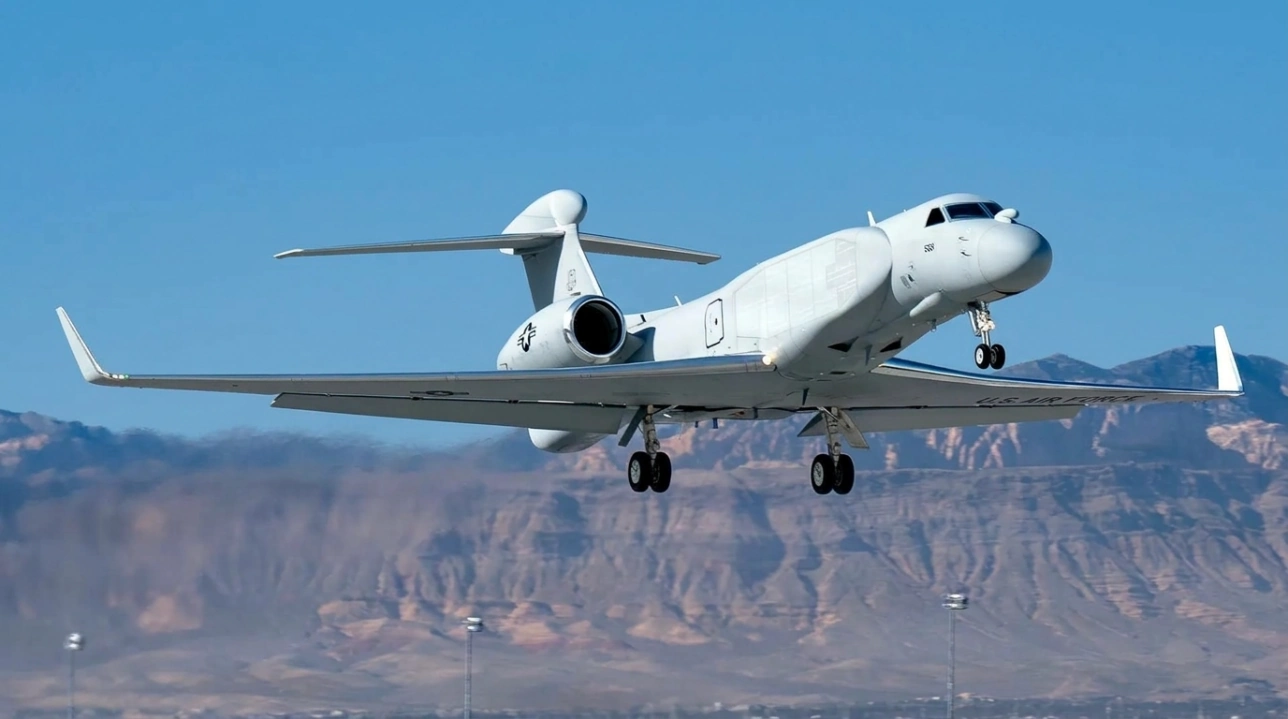
A Gulfstream business jet is about to become one of the U.S. Air Force’s strangest combat aircraft.
The EA-37B Compass Call looks familiar from the outside. Its roots are in the Gulfstream G550, a jet better known for carrying executives than electronic warfare crews. Inside, the mission is very different.
The aircraft is built to interfere with the electromagnetic signals that modern forces depend on to communicate, coordinate and operate.
That makes the EA-37B Compass Call more than a replacement for the aging EC-130H Compass Call. The real change is the platform itself.
The U.S. Air Force is moving a long-running electronic attack mission from a large four-engine turboprop to a smaller twin-engine jet that can fly higher and faster. The first EA-37B Compass Call was delivered to Davis-Monthan Air Force Base in August 2024, beginning a transition that has been years in the making.
And here’s the part many aircraft summaries miss.
The EA-37B Compass Call isn’t starting from scratch. Much of the proven Compass Call mission equipment is being moved onto the new jet, while newer systems and architecture are added around it.
So the interesting question isn’t simply what the EA-37B Compass Call can do.
It’s why the Air Force decided that a business jet was the better place to do it.
This inside look examines the aircraft’s specifications, electronic attack mission, onboard systems, relationship with the EC-130H and path toward operational service.
What Is the EA-37B Compass Call?
The EA-37B Compass Call is best understood as a flying electronic attack station, not a conventional combat jet.
Its job is to interfere with the systems that let an opposing force communicate, share information and coordinate operations. The aircraft can deny, degrade or disrupt communications, information processing, navigation and radar systems, while also supporting broader electronic attack missions.
That sounds abstract until you consider how modern military operations actually work.
A fighter may need data from another aircraft. A command post may need to pass instructions. A unit may depend on radio or navigation signals to understand what is happening around it. Disrupt those links at the right time and the problem is not simply “bad communications.” The entire chain can become harder to manage.
That is the niche Compass Call fills.
The EA-37B Compass Call is based on a heavily modified Gulfstream G550, giving the Air Force a much faster jet platform than the four-engine turboprop EC-130H it replaces. The Air Force selected the G550-based design as part of a program launched to move the existing Compass Call capability onto a newer airframe.
The first EA-37B Compass Call reached the 55th Electronic Combat Group at Davis-Monthan Air Force Base on August 23, 2024. The unit then began pilot planning and training with the aircraft, followed by the first official training sortie on May 2, 2025.
And the name itself can cause confusion.
The aircraft was originally called EC-37B, but the Air Force redesignated it EA-37B in October 2023 to better describe its electronic-attack mission. It is now taking over the Compass Call name as the EC-130H leaves service.
That change in designation tells you something useful: this aircraft isn’t just carrying old equipment on a new jet. It is the Air Force’s next step in airborne electromagnetic attack.
EA-37B Compass Call Specifications
The EA-37B Compass Call trades the EC-130H’s size for speed, altitude and efficiency. Those numbers matter because electronic attack is not just about what equipment an aircraft carries. The platform determines how quickly it can reach an area and how it can operate once there.
The aircraft is based on the Gulfstream G550 and uses two Rolls-Royce BR710C4-11 turbofan engines. It can reach about 629 mph and operate at up to 45,000 feet, according to Air & Space Forces’ published specifications. Its stated range is about 4,410 miles.
Here are the key figures:
| Specification | EA-37B Compass Call |
| Base airframe | Modified Gulfstream G550 |
| Engines | 2 × Rolls-Royce BR710C4-11 |
| Maximum speed | About 629 mph |
| Range | About 4,410 miles |
| Service ceiling | 45,000 ft |
| Maximum takeoff weight | 91,000 lb |
| Length | 96.4 ft |
| Wingspan | 93.5 ft |
| Height | 25.8 ft |
| Flight crew | 2 pilots |
| Mission crew | Up to 7 |
| First flight | August 25, 2021 |
The crew arrangement is one of the biggest clues that this isn’t a normal business jet. Two pilots handle the aircraft, while as many as seven mission specialists can operate the electronic warfare systems.
The 45,000-foot ceiling is particularly useful. Flying higher can expand the aircraft’s view of the battlespace and give its sensors and electronic systems more room to work. The jet’s speed also gives commanders more flexibility than the older turboprop platform.
But don’t mistake these figures for the whole story.
A common mistake is to judge the EA-37B Compass Call like a fighter. It isn’t built to dogfight or carry a conventional weapons load. Its value comes from the electronic systems packed into the aircraft and the people operating them.

In other words, the EA-37B Compass Call specifications explain why the Air Force changed the platform. The mission equipment explains why it matters.
How Does the EA-37B Compass Call Conduct Electronic Attack?
The easiest way to understand EA-37B Compass Call electronic warfare is to forget about bombs and missiles for a moment. Its main effect happens through signals.
Modern military forces depend on radio links, data networks, navigation signals and radar. Those systems move information between aircraft, command posts and units in the field. Compass Call is designed to interfere with parts of that electromagnetic activity, making those connections harder to use.
The U.S. Air Force describes the EA-37B Compass Call as a wide-area airborne electromagnetic attack system. Its mission includes denying, degrading or disrupting communications, information processing, navigation and radar systems.
Think of it as interference applied with purpose.
A military network may still exist physically, but its users can have a much harder time exchanging information if the electromagnetic links connecting them are disrupted. That distinction is why electronic attack can complement conventional aircraft rather than replace them.
The EA-37B Compass Call also brings the mission onto a platform capable of operating at 45,000 feet and traveling around 629 mph. Those characteristics give the aircraft greater mobility than the EC-130H, which was built around the much slower C-130H transport airframe.
But there is a common misconception here.

Electronic attack isn’t simply about creating as much interference as possible. Effective operations depend on identifying relevant signals and applying the right effect without disrupting friendly systems. That makes the mission heavily dependent on sensors, processing, mission planning and trained operators.
The aircraft’s seven-person mission crew matters for exactly that reason.
Read also: 5 Best Electronic Warfare Aircraft in the World
The EA-37B Compass Call is therefore better viewed as a specialized electronic attack platform than as a heavily armed aircraft. Its weapon is the electromagnetic energy it can manage, and its effectiveness depends on putting that capability in the right place at the right time.
What Is Inside the EA-37B Compass Call?
The most interesting part of the EA-37B Compass Call isn’t the Gulfstream airframe. It’s what the Air Force has packed into it.
From the outside, the aircraft still carries the clean lines of a G550. Look closer, though, and the differences become obvious. The modified jet has external antenna and array structures that support its electronic warfare mission, turning a business aircraft into a specialized electromagnetic attack platform.
Inside, the aircraft is built around mission equipment rather than passenger comfort.
The system includes electronic transmit and receive equipment, mission computers and operator workstations that allow the crew to manage the aircraft’s electronic attack role. Public U.S. government documents also describe fuselage-mounted array panels containing transmitter and receiver equipment, along with systems associated with radar countermeasures and mission control.
That arrangement matters because Compass Call has to do more than simply transmit a strong signal.
The aircraft needs to receive information about the electromagnetic environment, process it and allow trained operators to apply the appropriate electronic effect. The mission therefore combines hardware, software and human judgment.

The contractor mix also reflects the complexity of the program. BAE Systems has been closely involved with the Compass Call electronic warfare system, while L3Harris has played a major role in the EA-37B’s integration and aircraft modification work.
And this is where the “business jet” label becomes misleading.
The G550 provides the basic flight platform, but the aircraft’s military value comes from the systems installed around and inside that airframe. The result is a compact electronic warfare aircraft with a mission crew of up to seven.
There are limits to what can be publicly described. Exact operating techniques, signal libraries and detailed electronic attack parameters are not the sort of information the Air Force publishes.
Still, the basic architecture tells us enough.
The EA-37B Compass Call is essentially a purpose-built electronic warfare workstation in the sky, with a jet wrapped around it.
Why Did the USAF Replace the EC-130H With the EA-37B?
The switch from the EC-130H Compass Call to the EA-37B Compass Call comes down to a simple problem: the mission stayed relevant, but the aircraft became old.
The EC-130H was built around the C-130H Hercules, a platform that had already been serving for decades. Keeping those aircraft available became harder as airframe age, maintenance demands and service-life limits accumulated.
The EA-37B Compass Call approaches the same mission from a very different starting point.
Its Gulfstream G550 foundation gives it a much faster cruise profile and a higher operating ceiling. The aircraft can reach about 629 mph and operate at up to 45,000 feet, compared with the much slower C-130-based platform.
That speed changes the equation.

An electronic warfare aircraft may need to reposition between missions or respond to changing conditions across a large theater. A faster platform spends less time getting there. Its higher operating altitude also gives the aircraft more options when planning where and how to conduct its mission.
The EA-37B is also smaller. That’s not automatically better, but it can reduce the burden of moving a large four-engine turboprop aircraft when the mission does not require that much airframe.
| Feature | EC-130H | EA-37B |
| Base platform | C-130H Hercules | Gulfstream G550 |
| Engines | 4 turboprops | 2 turbofans |
| Maximum speed | About 300 mph | About 629 mph |
| Service ceiling | About 25,000 ft | About 45,000 ft |
| Mission crew | 9 | Up to 7 |
| Primary role | Electronic attack | Electronic attack |
The important point is that the Air Force isn’t replacing electronic warfare with something completely different. It is moving the Compass Call mission onto a more modern aircraft.
And there’s a practical reason for that approach. The Air Force can retain proven mission technology while gaining a newer airframe with more useful flight performance.
That’s a much smarter transition than treating decades of electronic warfare experience as something that can simply be discarded.
The aircraft changed. The mission didn’t.
How Much of the EC-130H Compass Call Technology Carries Over?
The EA-37B Compass Call is new as an aircraft, but its electronic warfare heritage is much older.
That distinction matters. The Air Force didn’t throw away decades of Compass Call development when it retired the EC-130H. Instead, the program moved much of the existing mission equipment onto the new Gulfstream-based platform.
Reports indicate that about 70% of the EC-130H mission equipment is being cross-decked to the EA-37B Compass Call. In simple terms, a large part of what made Compass Call useful is being transferred rather than rebuilt from the ground up.
That approach makes sense for a specialized system.
Electronic warfare equipment is not something you can replace like an aircraft engine. Years of testing, software work, mission experience and operator training are tied to the system. Keeping proven elements while changing the airframe reduces the amount of capability that has to be recreated.
But the EA-37B Compass Call isn’t simply an EC-130H system squeezed into a smaller cabin.

The new aircraft uses an updated architecture designed to support future improvements. The Air Force has described the program in terms of successive capability baselines, allowing new technology to be added as the system matures.
This is one of the less visible advantages of the EA-37B Compass Call.
The G550 airframe gets the attention because it is faster and can fly higher. Yet the more consequential change may be inside the mission architecture, where older Compass Call technology can be combined with newer processing and electronic warfare systems.
There is also a useful lesson here for military modernization: replacing the platform doesn’t necessarily mean replacing the capability.
The EC-130H accumulated decades of operational knowledge. The EA-37B Compass Call carries part of that inheritance forward while giving engineers a newer platform to build on.
So calling the EA-37B simply the “replacement” for the EC-130H misses half the story.
It is better described as the next generation of the Compass Call mission, built around a different aircraft and a more modern electronic warfare architecture.
When Will the EA-37B Become Fully Operational?
The EA-37B Compass Call has already moved beyond testing, but becoming a mature operational capability takes more than delivering the aircraft.
The first jet arrived at Davis-Monthan Air Force Base on August 23, 2024. The first official training sortie followed on May 2, 2025, giving crews hands-on experience with the aircraft and its electronic warfare systems.
The Air Force has also worked to integrate the EA-37B Compass Call with other platforms, including the RC-135 Rivet Joint. That matters because electronic warfare rarely operates alone. The aircraft has to fit into a larger network of intelligence, surveillance and command assets.
And the transition is about more than replacing an aging airframe.
The EA-37B Compass Call gives the Air Force a faster, higher-flying platform, with a 45,000-foot service ceiling and a top speed of about 629 mph. Its Gulfstream-based design also provides a newer foundation for future mission-system upgrades.

That last point may matter most.
Electronic warfare changes quickly. Communications systems change, sensors improve and new signal threats appear. A modern aircraft therefore needs room for new software and equipment rather than simply carrying today’s technology for decades.
The EC-130H proved that the Compass Call mission could remain useful for more than 40 years. But its aging C-130H airframes eventually became the limiting factor.
The EA-37B Compass Call is designed to avoid repeating that problem.
So don’t judge the program only by when the aircraft becomes fully operational. Watch how quickly crews gain experience, how the jet integrates with other U.S. and allied platforms and how easily its mission systems can be upgraded.
The aircraft is new. The mission is not.
What matters now is how well the EA-37B Compass Call carries that mission into an electromagnetic environment that keeps getting harder to control.
