

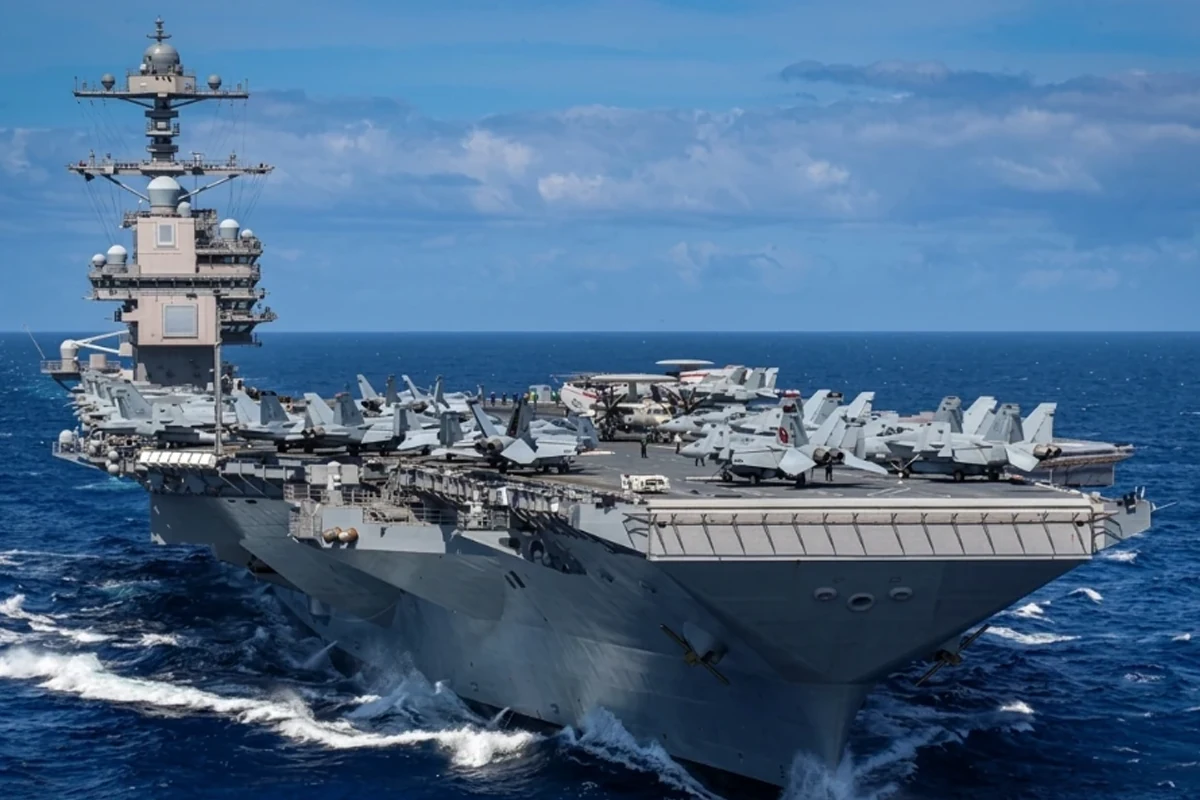
The next U.S. aircraft carrier named USS Doris Miller will be enormous, nuclear-powered and designed to serve for roughly half a century. Yet its most unusual feature isn’t its size, propulsion system or aircraft capacity. It’s the story behind the name.
The USS Doris Miller (CVN-81) is the fourth planned ship of the Gerald R. Ford class, a new generation of American supercarriers designed to generate more aircraft sorties, support future technologies and reduce some manpower and maintenance demands compared with the older Nimitz class.
The Navy has described the Ford-class carriers as central platforms for crisis response, power projection and major combat operations.
The ship is still a future carrier, but its construction is already moving through major stages. In 2023, the Navy awarded a $1.204 billion contract for CVN-81’s Electromagnetic Aircraft Launch System (EMALS) and Advanced Arresting Gear (AAG), with production and support extending through 2032.
That makes USS Doris Miller more than a name attached to another carrier hull. It is part of the Navy’s effort to build an aircraft carrier fleet capable of operating well into the second half of the 21st century.
But the name comes from a very different era.
Doris Miller was an enlisted sailor aboard USS West Virginia during the Pearl Harbor attack in 1941. His actions under fire eventually earned him the Navy Cross, and in 2020 the Navy selected his name for CVN-81, the first U.S. aircraft carrier named for an African American and an enlisted sailor.
That unusual connection between a World War II sailor and a next-generation nuclear carrier is what makes USS Doris Miller worth examining.
USS Doris Miller Specifications and Capabilities
The USS Doris Miller (CVN-81) will be a Gerald R. Ford-class nuclear-powered aircraft carrier, placing it among the largest and most technologically sophisticated warships ever built for the U.S. Navy. While the ship’s name comes from a World War II sailor, its design belongs firmly to the 21st-century carrier fleet.
| Specification | CVN-81 / Ford Class |
| Class | Gerald R. Ford |
| Hull number | CVN-81 |
| Type | Nuclear-powered aircraft carrier |
| Length | Approx. 1,092 ft (333 m) |
| Beam | Approx. 256 ft (78 m) |
| Displacement | Approx. 100,000 tons |
| Propulsion | 2 nuclear reactors |
| Speed | 30+ knots |
| Aircraft capacity | 75+ aircraft |
| Aircraft launch | Electromagnetic Aircraft Launch System |
| Aircraft recovery | Advanced Arresting Gear |
| Builder | Newport News Shipbuilding |
The scale is impressive, but the more interesting story is what the Ford-class architecture is trying to accomplish. The Navy designed these carriers to generate aircraft sorties more efficiently than the preceding Nimitz-class, while also incorporating greater automation and newer aviation systems.
One of the most visible changes is EMALS, which replaces traditional steam catapults with an electromagnetic launch system.
The carrier also uses Advanced Arresting Gear (AAG) to recover aircraft. Together, these systems are intended to improve launch and recovery flexibility while reducing some of the mechanical complexity associated with older equipment.
USS Doris Miller will also benefit from the Ford-class’s redesigned island and advanced radar architecture. These changes aren’t cosmetic. They are intended to free up deck space, improve aircraft handling and support the carrier’s ability to operate increasingly sophisticated aircraft.
The key point is that USS Doris Miller isn’t simply a larger aircraft carrier.
It represents a shift in how the Navy wants a carrier to generate combat power: more automation, more efficient aircraft operations and an architecture designed to accommodate technology that hasn’t even entered widespread service yet.
That makes USS Doris Miller (CVN-81)’s story much bigger than its namesake. The ship is being built not just for today’s carrier air wing, but for decades of changing naval warfare.
Read also: USS Gerald R. Ford (CVN-78): The Navy’s Most Advanced Warship
Why USS Doris Miller (CVN-81) Is Different From Older U.S. Carriers
The USS Doris Miller (CVN-81) is part of a carrier design that tries to solve a surprisingly simple problem: how do you generate more useful aircraft operations without simply making the carrier bigger?
The Gerald R. Ford class keeps roughly the same enormous footprint as the Nimitz class, but changes what happens on and below the flight deck. One of the biggest changes is the move from steam-powered aircraft catapults to the Electromagnetic Aircraft Launch System (EMALS).
Instead of relying on a large steam system to launch aircraft, EMALS uses electromagnetic energy to accelerate them down the catapult track. The Navy says the system provides more precise control across different aircraft weights and is intended to improve reliability and reduce maintenance demands.
The recovery side also changes. Advanced Arresting Gear (AAG) replaces the traditional Mk 7 arresting system used on Nimitz-class carriers. The combination gives Ford-class carriers a fundamentally different aircraft-launch-and-recovery architecture.
Then there is automation.

Ford-class ships were designed with greater use of automated equipment and modern information systems, allowing the Navy to reduce the number of sailors needed to operate the carrier compared with earlier designs. That matters because crew requirements are a major part of a carrier’s lifetime operating cost.
The redesigned island is another subtle but important change. Moving and shrinking elements of the superstructure creates additional flight-deck space and changes how aircraft and personnel move around the carrier.
For USS Doris Miller, these improvements are more important than any single headline specification.
The ship’s real advantage is the way its systems work together. EMALS, AAG, automation, sensors and redesigned deck arrangements are pieces of one larger attempt to make carrier aviation more efficient.
And that’s the point of the Ford class: not simply building another supercarrier, but changing how an American supercarrier generates airpower.
Why the Navy Chose Doris Miller as the Namesake
The decision to name CVN-81 USS Doris Miller was about more than honoring a famous Pearl Harbor sailor. It also reflected a broader change in how the U.S. Navy chooses to represent its history.
In January 2020, the Navy announced that the future fourth Gerald R. Ford-class aircraft carrier would carry Miller’s name. The decision was historic: CVN-81 became the first U.S. aircraft carrier named for an African American and the first named for an enlisted sailor.
Miller had served aboard USS West Virginia during the Japanese attack on Pearl Harbor in 1941. Although he was assigned as a mess attendant in a segregated Navy, he helped the wounded captain and later operated a .50-caliber machine gun during the attack. His actions earned him the Navy Cross.
That history gives the carrier’s name a very different character from the traditional names associated with American supercarriers.
For decades, carrier names have frequently honored presidents, senior military leaders and major national figures. Naming one after an enlisted sailor effectively says that the institution’s history isn’t defined only by the people who held the highest ranks.
There is also a striking technological contrast.

Miller fought aboard a battleship during the opening minutes of America’s Pacific War. The ship carrying his name will operate nuclear-powered propulsion, electromagnetic aircraft launch systems and a carrier air wing built around aircraft such as the F-35C and F/A-18E/F.
That gap of nearly a century is exactly what makes the naming so interesting.
USS Doris Miller connects the Navy’s past and future in one hull — a sailor who served under segregation remembered aboard a carrier designed to represent the next generation of American naval power.
And because that name was deliberately chosen rather than inherited from an earlier carrier, the decision itself became part of the story of CVN-81.
The Future Role of USS Doris Miller in the U.S. Carrier Fleet
The USS Doris Miller (CVN-81) is not being built as an isolated ship. It is part of a much larger effort to replace aging Nimitz-class carriers with the Gerald R. Ford-class, giving the U.S. Navy a carrier force designed to remain relevant for decades.
As the fourth planned Ford-class carrier, CVN-81 follows USS Gerald R. Ford (CVN-78), USS John F. Kennedy (CVN-79), and USS Enterprise (CVN-80). Its place in this sequence matters because the Navy expects each successive ship to benefit from lessons learned during construction and operation of earlier carriers.
The Ford class is also designed around a demanding operational reality: an aircraft carrier has to generate airpower repeatedly, not simply carry aircraft. Systems such as EMALS and Advanced Arresting Gear are therefore central to the concept, while the carrier’s nuclear propulsion provides the endurance needed for long deployments.
That becomes particularly important as the U.S. Navy prepares for more contested maritime environments.

A future carrier may have to operate alongside advanced fighters, unmanned aircraft, long-range weapons and increasingly sophisticated networks. The USS Doris Miller’s value will therefore depend not only on how many aircraft it can carry, but on how effectively it can integrate new technologies throughout its service life.
There is also a broader fleet-management issue.
Building a carrier takes years and requires an enormous industrial base. Once completed, the ship is expected to remain in service for decades. That makes future-proofing almost as important as initial performance.
For USS Doris Miller, this means its real story has barely started.
The carrier’s name connects it to Pearl Harbor, but its operational identity will be shaped by the wars, technologies and strategic competition of the coming decades.
In that sense, CVN-81 isn’t just a monument to the past. It is an investment in the Navy’s future carrier force.
What Makes USS Doris Miller (CVN-81) a Powerful Naval Aviation Platform?
The real combat power of USS Doris Miller (CVN-81) will not come from the carrier’s hull alone. Its value will come from what happens on the flight deck: launching, recovering and supporting a mix of manned and unmanned aircraft at a tempo that can turn the carrier into a mobile airbase.
As a Gerald R. Ford-class carrier, USS Doris Miller is designed to operate a broad carrier air wing built around platforms such as the F-35C Lightning II, F/A-18E/F Super Hornet, EA-18G Growler and E-2D Advanced Hawkeye, alongside MH-60 helicopters. Each fills a different role, from air combat and strike missions to electronic warfare, airborne early warning and anti-submarine operations.
The introduction of the MQ-25 Stingray adds another interesting dimension. The unmanned carrier aircraft is being developed primarily as an aerial refueling platform, allowing it to extend the range and endurance of manned aircraft while potentially freeing fighters from carrying as much fuel themselves. The Navy has described MQ-25 as a way to increase the reach and effectiveness of the carrier air wing.
Then comes the launch-and-recovery system.
EMALS is intended to provide more precise aircraft launches across different aircraft weights, while Advanced Arresting Gear handles aircraft recovery. These systems are central to the Ford-class effort to improve sortie generation and reduce some of the maintenance burden associated with older steam-based equipment.
This is where the design philosophy of USS Doris Miller becomes clearer.
A carrier is essentially an aircraft factory at sea. Its effectiveness depends on how quickly it can turn fuel, weapons, maintenance and aircraft into repeated sorties.
The USS Doris Miller is being designed around that idea; not simply to carry more aircraft, but to generate airpower more efficiently and adapt as the carrier air wing evolves.
The Political Fight Over CVN-81’s Name
The future USS Doris Miller (CVN-81) has become controversial for a reason that has little to do with aircraft, propulsion or combat systems: its name.
The Navy announced the carrier’s name in 2020, deliberately honoring an enlisted sailor whose actions during the Pearl Harbor attack made him a national hero. The decision was historically significant because CVN-81 became the first U.S. aircraft carrier named for an African American and an enlisted sailor.
That symbolism has become more complicated in 2026.
Reports have emerged that the administration is considering changing the carrier’s name, potentially to honor Donald Trump. However, this distinction is important: reports of discussions are not the same as a formally announced renaming, so the situation should not be presented as settled.
For the Navy, that makes CVN-81 an unusual case.

The ship is still under construction and has not yet entered operational service, but its name has already become part of a national argument over military tradition, historical recognition and presidential influence over naval naming.
There is a practical dimension, too. A carrier name isn’t just painted lettering on the stern. It becomes part of the ship’s identity, appearing in commissioning ceremonies, official records, crew traditions and eventually decades of operational history.
Changing it before the carrier enters service would therefore be relatively straightforward administratively compared with renaming an active warship. But the historical implications could be much larger.
That is why the controversy surrounding USS Doris Miller has attracted attention well beyond the Navy.
The underlying argument isn’t really about four letters on a hull.
It’s about which stories the United States wants its most powerful warships to carry into the future — and who gets remembered when those ships go to sea.
Why the USS Doris Miller Name Matters
The debate over USS Doris Miller (CVN-81) is ultimately about more than a carrier’s name. It raises a broader question about how the U.S. Navy chooses to preserve its history while building a fleet for the future.
Miller was an enlisted sailor who served aboard USS West Virginia during the Pearl Harbor attack and later received the Navy Cross for his actions. When the Navy selected his name for CVN-81 in 2020, it deliberately connected that history to one of America’s most powerful naval platforms.
The contrast is striking.
Miller served in a segregated Navy with limited career opportunities. CVN-81, by comparison, will be a nuclear-powered Ford-class carrier built around advanced aircraft-launch systems, modern sensors and decades of future technological upgrades.
That makes the name more than a tribute.

It creates a direct link between the Navy’s past and the kind of force it wants to become.
Carrier names also have an unusually long life. Aircraft, radars and weapons can be replaced as technology changes, but the name remains attached to the hull through deployments, ceremonies and generations of sailors.
That’s why any discussion about changing CVN-81’s name carries significance beyond administrative paperwork.
At the same time, the carrier itself should remain the center of the story. The real military significance of USS Doris Miller will ultimately come from its ability to generate airpower, integrate new aircraft and operate as part of a carrier strike group in an increasingly contested maritime environment.
The name gives the ship its historical identity.
The USS Doris Miller’s technology will determine its battlefield value.
That combination is what makes USS Doris Miller particularly fascinating. It isn’t simply a memorial to a Pearl Harbor hero, nor is it merely another Ford-class supercarrier.
The USS Doris Miller is a modern combat platform carrying a piece of American naval history into a future that Miller could never have imagined.
